

There's a mystical Naples tucked away in the folds of this city at the heart of the Mediterranean, a city full of breathtaking natural, cultural and artistic beauty. Across three thousand years of history, the ancient Neapolis has never forgotten its magical roots and still guards a dark, esoteric side that today can be felt among cloisters and catacombs, noble palaces, churches built over pagan temples, unexplained mysteries and unsettling legends.
In the Naples hidden from the eyes of both residents and tourists, one can savor legendary myths, rites and traditions, alchemical experiments and discoveries left buried for centuries, magical gardens and secrets still waiting to be revealed. From the neighborhoods of the historic center to the sea at Mergellina and the acropolis of Cumae, Naples is home to some of the most esoteric places in Italy.

Mystical Naples : a Guide to the City's Dark and Occult Places
Cimitero delle Fontanelle - Società cooperativa La Paranza Onlus
The itinerary takes in squares, narrow lanes and passageways that jealously guard their riddles. It all begins on the hill of Pizzofalcone, on Monte Echia, and at the Platamonian caves carved by the Greeks overlooking Castel dell'Ovo, born on the islet of Megaride where the legend of the siren was born. Parthenope is ever-present: she is the magical, eternal soul of the city, the bond with the sea and the capacity to rise again and again from her own ashes.
To experience the Naples of mysteries means walking in the shadows, finding the sacred and the mythical in everyday life, following rough paths marked by the mystery cults of antiquity, getting to know magicians and alchemists, freemasons and theosophists, ghosts and munacielli, until the city's wondrous genius loci finally reveals itself. One of the most storied, best-known and most depicted metropolises in the world is, at the same time, one of the most mysterious: here is a magical guide to uncovering the city's secrets, through alchemy, astrology and hermeticism.
20. The Fontanelle Cemetery
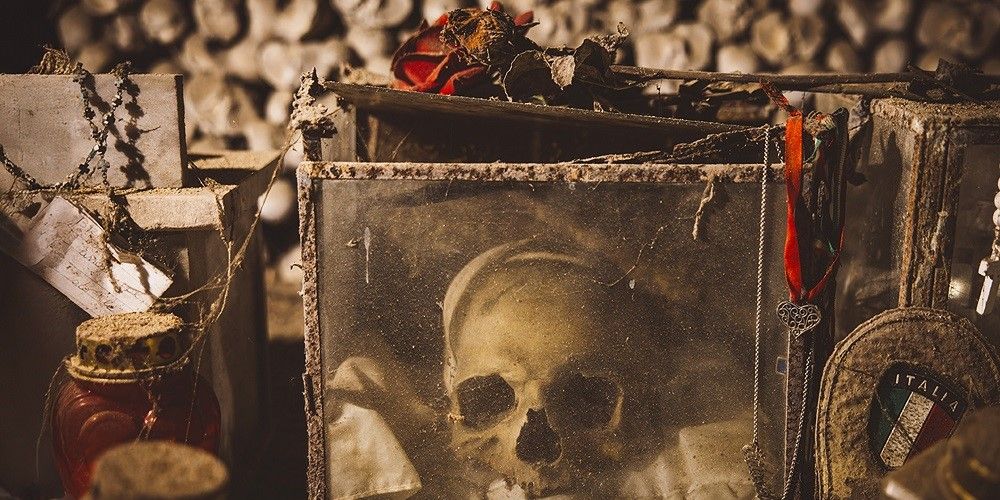
A journey into esoteric Naples can only begin at the Fontanelle Cemetery, freshly reopened and a new addition to the Naples Pass. After a long restoration, the tuff hypogeum in the Sanità district has come back to life thanks to a project to enhance both the site and its intangible heritage. In this magical place, popular fascination and mystery intertwine with religiosity and superstition, phenomena tied to the cult of the souls in Purgatory and to the city's special relationship with the afterlife.
The ossuary dates back to the sixteenth century, when what had simply been a tuff quarry became a burial site to make up for the lack of space in the churches. During the plague epidemic of 1656, it began to receive thousands of victims who had died in the streets of Naples, the epicenter of the tragedy. Many more bodies were brought there during the cholera epidemic of 1836, in the years following the Edict of Saint-Cloud, which required cemeteries to be built outside city walls for hygiene reasons, with identical graves for all.
In 1872, after years of neglect, canon Gaetano Barbati conceived and built the ossuary as it appears today. With the help of a group of devout women from the neighborhood, the bones were arranged into three symbolic naves, each dedicated to a "category": priests, plague victims, and the pezzentelli, the poor. It was then that the cult of the "pezzentelle souls" began: an act of Christian piety and charity for those who had lived and died in anonymity and extreme poverty, through epidemics and famines, uprisings and earthquakes, without even a name on their grave.
Three souls from the Fontanelle are especially famous. The first is Concetta, "the head that sweats," protector of fertility and confidante of women who wish to become mothers. The second is that of the Captain, the black-eyed skull that symbolizes justice and fairness, said to be capable of incinerating with a handshake a camorrista who dared to desecrate the cemetery with his blasphemous behavior. The third is that of Countess Margherita Petrucci, the only identifiable skeleton in the cemetery, buried in a glass coffin alongside her husband, Count Filippo Carafa. A legend explains why Margherita's skull has its mouth open: it is said she died choking on a dumpling.
Devotion to these anonymous remains gave rise in Naples to the tradition of taking home a small relic belonging to one of the many bodies buried there. The ritual of the "capuzzelle" came to an abrupt halt in 1969, when the Neapolitan ecclesiastical court issued a decree closing the ossuary and banning the cult, deeming it a form of fetishism and superstition out of step with the doctrine of the Second Vatican Council. But despite the ban, nothing has managed to stop this tradition of reconciliation, woven from faith, history and legend.
Discover the Fontanelle Cemetery with the Naples Pass19. Santa Maria delle Anime del Purgatorio ad Arco
The cult of the "pezzentelle souls" is also present in the monumental baroque complex on Via dei Tribunali, in the heart of Naples's historic center. Consecrated in 1638, the church is known as "de''e cape 'e morte," the heads of the dead: anonymous souls adopted by the living in an act of compassion and hope. On the church's exterior stand bronze skulls with crossed shinbones atop the ancient piperno bollards; inside, the winged skull by Dionisio Lazzari is a striking sight, the crowning image of the building's funerary iconography. But it is in the hypogeum that the true cult of the dead is celebrated: a lower church devoted to the burial of the "pezzentelle souls."
These anonymous remains were not just imagined faces but genuine intermediaries with the afterlife. The faithful would adopt a skull that had not yet been chosen, clean it, polish it and decorate it with handkerchiefs, inscriptions, votive lamps, flowers and rosaries: in caring for that "capuzzella," they asked in return for graces, miracles and intercessions. An intimate, profound bond grew around these skulls, smoothed by time. If the soul did not appear in a dream, or did not grant the favor, the faithful would adopt another soul, and the previous "capuzzella" was turned to face the wall. If the miracle did occur, the "capuzzella" became part of the family, adorned with an embroidered and lace-trimmed cushion and placed in a display case bearing the date the grace was received.
18. The Church of Gesù Nuovo
On Piazza del Gesù Nuovo, right in the heart of Naples's historic center, stands a church with an extraordinary concentration of alchemical and esoteric symbols, steeped in Masonic mysteries and "curses." Built in 1470 by Novello da San Lucano, commissioned by the then Prince of Salerno, Roberto Sanseverino d'Aragona, the Church of Gesù Nuovo took its current form in 1584, when it was purchased by the Society of Jesus following the expulsion of the Sanseverino family from Naples by order of King Philip II.
Novello da San Lucano and the Neapolitan stonecutters had built the old Sanseverino palace with a distinctive ashlar façade, its stones jutting out in pyramid shapes. When the Jesuits renovated the building to turn it into a church, they preserved the façade with the stonework crafted by the master stonemasons. The quarrymen, carvers and stonecutters of the time were known as pipernieri (from the piperno stone of Soccavo) and formed a guild that passed the art of stoneworking down orally from father to son. Their works, like this façade, were filled with alchemical symbols.
The church's ashlar stonework bears symbols born of the pipernieri's knowledge and esoteric practices, a direct descendant of the ancient Egyptian rites once practiced in the belly of Naples. The sequence of diamond-pointed stones and the engravings on the pyramids form a kind of alphabet, with ideograms repeating according to a precise pattern. According to interpretations offered by scholars and experts, the pipernieri's symbols draw on alchemical-astrological knowledge and were meant to charge the stones with positive energy, channeling it into the building's interior while keeping negative energies at bay.
17. Sansevero Chapel
This jewel of baroque art is famous not only for Giuseppe Sanmartino's Veiled Christ and Antonio Corradini's Modesty. Hidden within its marble and paintings, arranged according to a precise scheme, are the secrets of the Masonic initiation ritual and the stages of the alchemical process. The mind behind this design was Raimondo di Sangro, seventh Prince of Sansevero: a learned nobleman and patron, inventor and anatomist, a many-sided genius who turned his family mausoleum — one of the most important in the Kingdom of Naples — into an initiatory temple of timeless beauty and memory.
Beyond the celebrations of the family lineage in its funerary monuments, the vault frescoed by Francesco Maria Russo, and the labyrinthine floor with swastika-like crosses and concentric squares — symbols of the arduous path the initiate must travel to reach knowledge — the Sansevero Chapel is also home to its evocative anatomical machines. In the underground chamber, two display cases preserve the skeletons of a man and a woman with an arterial and venous system that is almost perfectly intact. Di Sangro acquired the machines in 1756, struck by a public exhibition given by Giuseppe Salerno, the Palermo-based pathologist who had created them. The prince invited the physician to Naples and commissioned this unsettling gallery, where science and spectacle still coexist today.
The room where the enigmatic anatomical machines were kept was known as the Phoenix Apartment, after the bird that symbolizes the final stage of the alchemical process; originally, at the feet of the female skeleton there was even a fetus complete with placenta and umbilical cord. According to popular legend, the astonishing state of preservation of the circulatory system was owed to the work of Salerno and Di Sangro: it was said the two had injected the blood vessels of the bodies with a "magical" ingredient to petrify the vascular system.
In reality, the anatomical machines are so well preserved because their interiors are a reconstruction made with dyes and beeswax. Who those two people actually were, however, remains a mystery: popular belief holds they were two servants whom the prince had killed in order to embalm their bodies, so as to display human veins, arteries and viscera, astonish visitors, and above all study immortality through what amounted to a physics of resurrection.
16. The Bonfires of Sant'Antuono

In Naples, esotericism and folklore blend together in the cult of Saint Anthony the Abbot, especially on the night of January 17th in the district of Sant'Antonio, known as 'o Buvero, between Porta Capuana and Piazza Carlo Terzo. The protector of animals and patron of farmers is honored with a purification and renewal ritual of pre-Christian origin: the lighting of the cippi, bonfires that burn to ward off evil and negativity, and to call the sun back, lighting up the darkness of winter.
On this day, from the first light of dawn, people build woodpiles that by evening become small and large bonfires, fed with pruned branches, pinecones, chestnut shells and burrs, brushwood and everyday objects no longer in use. When the procession dedicated to Saint Anthony sets off, the faithful bring their animals to be blessed, to ward off misfortune and wish for a good harvest. It is a fundamental rite of passage, one that cements the community and welcomes the new year under the best possible omens.
15. Parthenope's tomb in the Basilica of San Giovanni Maggiore
Parthenope, the ancient name of the city of Naples, was a siren worshipped as a protective goddess. Inside San Giovanni Maggiore, a monumental church in the historic center founded at the will of Emperor Constantine over an ancient temple dedicated to Antinous, there is an ancient marble slab bearing the words "Partenopem tege fauste," meaning "protect Parthenope happily." This inscription has fueled the legend that the siren lies buried right beneath the city.
Parthenope was the siren with the enchanting voice whom Ulysses managed to resist in Apollonius of Rhodes's Argonautica. Wounded in her pride by his rejection, she threw herself into the sea and let the waves carry her to the shores of the gulf: if Naples exists, and if its language is so sweet, melancholy and melodious, this is owed precisely to Parthenope's beguiling song. Whether or not her tomb is real matters little: Parthenope is an immortal spirit who "does not die, has no tomb," as Matilde Serao once wrote.
14. Santa Fede Liberata: the Palace of the Vecchiarelle
On Via San Giovanni Maggiore Pignatelli, in the heart of the historic center near Via San Nicola al Nilo, lies a place little touched by tourism yet well worth visiting for its singular story of pain and rebirth. It is the old sixteenth-century convent of Santa Maria della Fede, which over time became a women's penitential retreat by the will of Queen Consort Maria Amalia of Saxony, then a hospital for prostitutes (hence the nickname "palace of the vecchiarelle", ie the old women), then a conservatory, and even the print shop of philosopher Benedetto Croce.
After decades of neglect and decay, the former oratory was occupied by a group of associations, committees and local citizens who reopened it to create "a concrete experience of community." Within walls that once sheltered women in distress, the space now hosts cultural events, workshops, community health outposts and shared medicine initiatives, and days of gathering and socializing. Cinema, too, has added to its mystical aura: Santa Fede Liberata is the location where director Ferzan Özpetek set the scene of the fortune-teller Assunta — the Sibyl who predicts the future — in his film Naples in Veils.
13. Dracula's Tomb at Santa Maria la Nova
The monumental complex of Santa Maria la Nova, near Piazza Bovio, is a treasure trove of art, history and mystery. The splendid church was built between 1596 and 1599, the cloister of San Giacomo della Marca also dates to the sixteenth century, and the convent has been active since the late nineteenth century. But Naples, a city that is an absolute repository of myths and legendary traditions, could hardly do without a fascinating, dark curiosity even in a baroque jewel like this one.
According to a famous legend, a Gothic tombstone inside Santa Maria la Nova belongs to the tomb of Count Vlad III of Wallachia. Indeed: the famous vampire prince is said to be buried right here in Naples. The myth of the Neapolitan Romanian Dracula tells that, upon the Impaler's death, his remains were secretly transported to the city and placed in a tomb located in one of the church's chapels. Fueling the legend's evocative power are the symbols and inscriptions adorning the burial site: a dragon, canopies typical of medieval Slavic culture, and an epitaph written in a mysterious language.
Is it a true story or a sensational historical fabrication? The matter is divisive. A group of researchers from the University of Tallinn argues that the voivode prince did not die in battle but was instead imprisoned in Hungary by the Turks and later freed thanks to the intervention of his illegitimate daughter, Maria Balsa, who had in the meantime been adopted by a Neapolitan family. The Prince of Wallachia would then have spent the final years of his life in the city, where upon his death he was laid to rest in the tomb of his father-in-law, Matteo Ferrillo, Count of Muro, chamberlain to Ferrante I and tutor to Alfonso II of Aragon, King of Naples from January 25, 1494 to January 23, 1495.
12. Underground Naples and the Pain of War
The secrets, legends and mysteries of Naples lie hidden beneath its streets. Carved out of tuff, the city above was born and developed alongside the city below, made up of miles-long caves, dark caverns, funerary hypogea, deep wells, Christian and Jewish catacombs, and endless tunnels running through Neapolis in every direction. Beneath the alleys and streets of the city lies a parallel Naples made up of 15 million cubic meters of empty space, extending to varying depths.
Naples has a history spanning more than five thousand years, breathes to the rhythm of its volcanoes, and its underground is populated by spirits and ghosts from ages past and present. From prehistory to today, the journey through underground Naples passes through the Fontanelle ossuary, the Bourbon Tunnel, Lake Averno, the "hundred camerelle" (little rooms) among the lanes of Bacoli, the caves of Posillipo and Virgil's tomb, all the way to the air-raid shelters built during the Second World War. In the war museum, which can be visited as part of the Naples Underground tour, built around the memories of the 40,000 people who lived in the city's underground during the bombings, the echo of grief and of Italy's mournful wartime history still resounds.
Visit Naples from the undergrounds with Naples Pass11. Piazzetta Nilo, Isis and the Esoteric Triangle
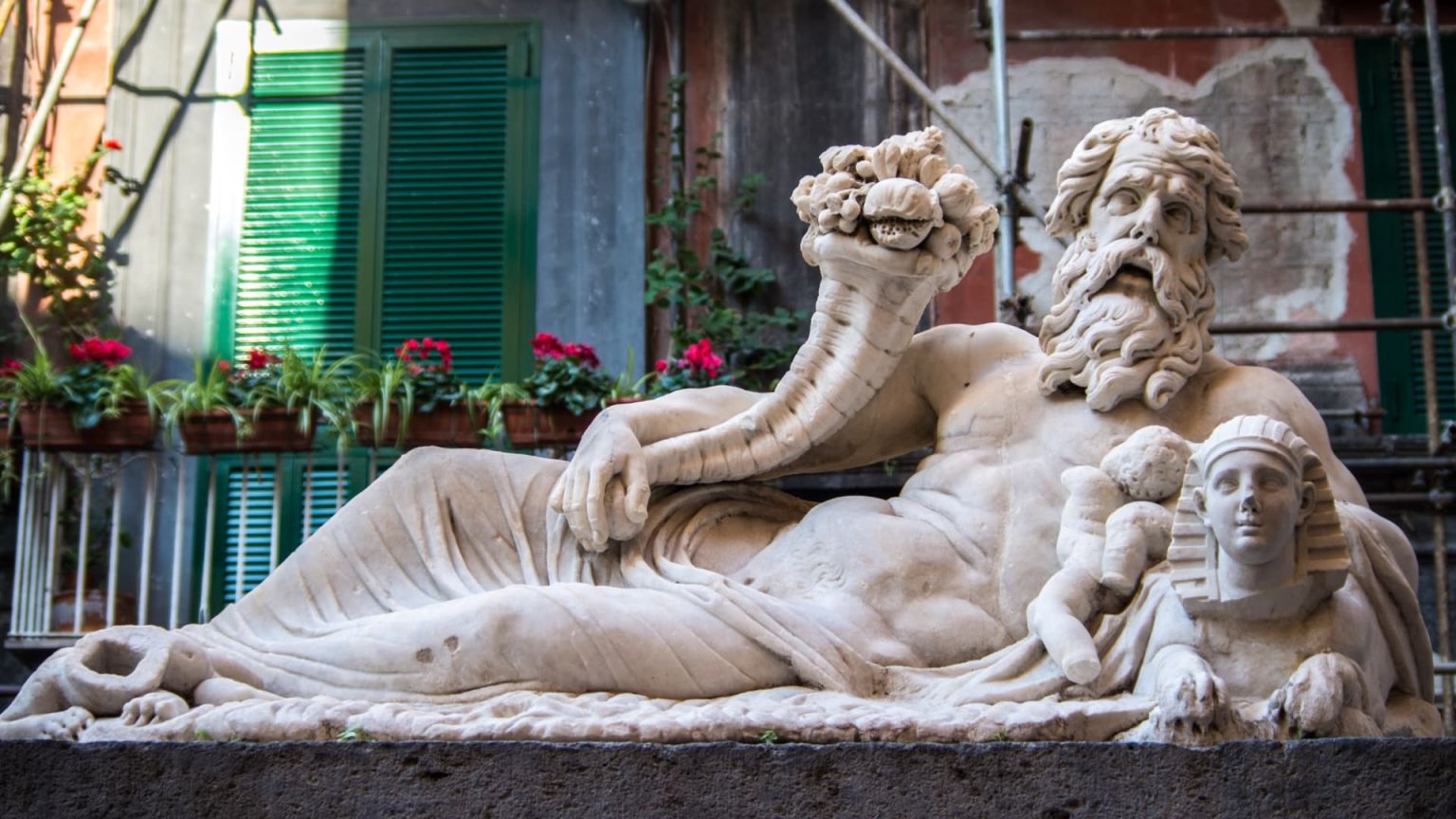
Turin isn't the only esoteric city at the center of occult triangles: Naples too has an energetic bridge linking the Campania capital with Egypt. Near the statue of the God Nile, the remains of an ancient temple dedicated to Isis were found — guardian of mysteries, goddess of fertility, and living archetype of the Great Mother. In esotericism, Isis is the initiator of ages, the dark, fertile womb from which the light of consciousness is born, presiding over the genesis of awareness.
A few steps from Piazzetta Nilo stand the Sansevero Chapel, the treasure chest of arcane wonders built by Prince Raimondo di Sangro, and the Basilica of San Domenico Maggiore, consecrated in 1255 on the site of the ancient church of San Michele Arcangelo a Morfisa. Together, these places form a triangle of forces, a primary alchemical symbol representing the balance between the elements. This zone of Neapolitan power extends according to a precise geometric arrangement, forming a geodetic triangle within which knowledge, active research and the city's geothermal energy combine to produce a sensitivity capable of direct contact with the afterlife.
10. Colapesce and the Sons of Neptune on Via Mezzocannone
In the beating heart of the historic center, between Piazzetta Nilo and Corso Umberto I, stands a statue that tells one of Naples's most fascinating and mysterious legends. The figure depicted in the relief is the mythological giant Orion, the hunter transformed into a constellation by Diana, though popular tradition identifies him with Colapesce, the swimmer cursed by his mother for his diving exploits, who eventually turned into a fish, was swallowed at sea by a great predator, and cut his way out of its belly with a knife.
The tale, recounted by Benedetto Croce and Raffaele La Capria, by Italo Calvino and Leonardo Sciascia, draws on the cult of the Sons of Neptune, a sect of divers endowed with extraordinary magical powers. These divers, able to hold their breath to recover treasures hidden on the seabed, were said to gain their prodigious abilities by mating with mysterious sea creatures, aided by the siren Parthenope. In reality, the skilled divers of antiquity were devoted to the god of the sea and would ingest a seaweed whose toxins are able to slow the rhythm of breathing.
9. The Bourbon Gallery and the Legend of the Munaciello
Along Naples's fascinating underground route, one comes across a cavity that intersects the ancient Renaissance-era Bolla aqueduct and stretches beneath the hill of Pizzofalcone all the way to the Royal Palace, in the San Ferdinando district. This long underground tunnel, now open to visitors as part of the Bourbon Tunnel tour, was commissioned by Ferdinand II of Bourbon as an escape route in the event of unrest, is full of secret passages and ancient water cisterns that have fed the evocative legend of the munaciello, the mischievous sprite of city folklore, dressed in a monk's habit and hood.
This Neapolitan trickster, bearer of both gifts and misfortune, has historical roots tied directly to the Bourbon Gallery. The people employed to work in the tunnel were the pozzari, experts responsible for maintaining and cleaning the wells and cisterns. To move through the darkness underground and protect themselves from the damp, they wore a hooded habit that made them resemble small friars. What's more, to communicate with one another across great distances, they left symbols, crosses and messages that, over time, fueled tales of a hidden treasure wrapped in mystery.
Visit Bourbon Gallery with Naples Pass8. The Ghosts of the Monastery of Santa Chiara
The Franciscan complex, made up of monastery, basilica and convent, was commissioned by Robert of Anjou and his wife Sancha of Majorca, devotees of Saint Francis of Assisi and Saint Clare, and built between 1310 and 1328. The complex owes its fame to the marvelous majolica cloister of the Poor Clares, a rustic garden decorated with majolica tiles by the master craftsmen Donato and Giuseppe Massa. Behind the blue, green and yellow of the ceramics — reflections of the sky, the grapevines and the lemons that grow abundantly in the cloister — lies a ghost story full of mystery and magic.
The ghost story revolves around the tragic death of Queen Joanna I of Anjou, the first female ruler of Naples, from 1343 to 1381, who was imprisoned in the castle of Muro Lucano and had her assassinated by strangulation on the orders of her nephew Charles of Durazzo. Ever since, the queen's spirit is said to wander the cloister of Santa Chiara, the place where she was buried anonymously to escape her political enemies and the followers of Urban VI, the pope who had excommunicated her. Perhaps the inexplicably deep affection Neapolitans feel for the monastery stems precisely from the sense that part of their own history has passed through this place and its mysteries.
7. Palazzo Penne on Via Donnalbina
A Renaissance palazzetto built in 1406 in the small square of Teodoro Monticelli, right in the historic center, in what was once the city's first gateway, Palazzo Penne is tied to the figure of Antonio Penne, secretary to King Ladislaus of Durazzo, eldest son of Charles of Anjou and ruler of Naples from 1386 to 1414. The beauty of its façade and entrance portal leaves plenty of room for imagination once you know the legend behind the building commonly referred to as the "palace of Beelzebub."
Penne had fallen hopelessly in love with a beautiful woman, who set a rather complicated condition for agreeing to marry him: she would only accept if he managed to build a princely residence in a single night. Obsessed with this task, Penne summoned the devil and, as in the legend of Faust, struck a deal with Beelzebub himself, obtaining the lavish palace he desired in exchange for his soul.
The pact, however, contained a clause: Penne would only forfeit his soul for good if the devil managed to count how many grains of wheat had been scattered across the building's courtyard. Hidden within that condition was a trick: along with the wheat, Penne had scattered pitch, which stuck five grains to Beelzebub's claws and threw off his count. Once the mistake was made, the now-rightful owner of the palace made the sign of the cross, opening up a chasm that swallowed the devil and sent him back to hell. The trick, however, proved useless — in fact it ended up punishing him: the woman he loved went on to marry another man. Never try to deceive the devil: you always end up paying the highest price.
6. Carmine Maggiore and the Miraculous Crucifix
Basilica Carmine Maggiore
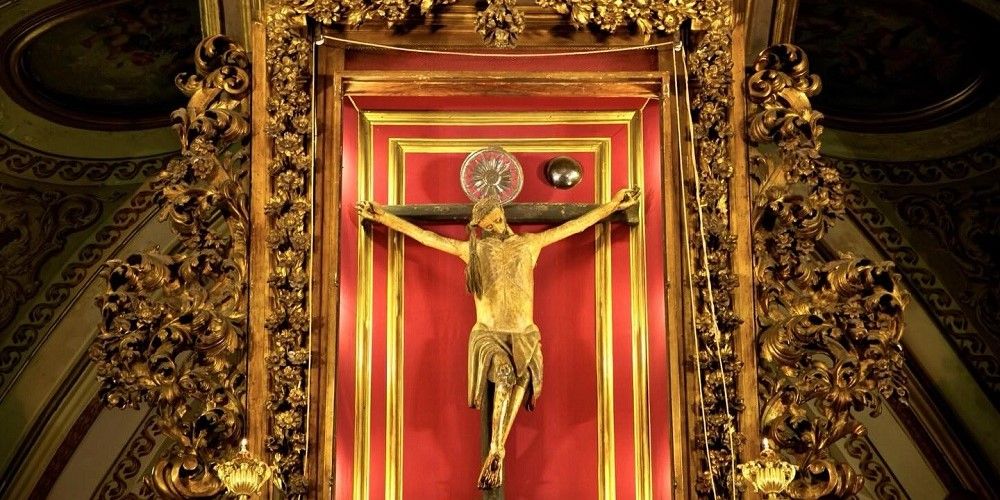
On Piazza Mercato, in the old part of Piazza del Carmine, stands the sanctuary basilica of Carmine Maggiore, the Marian heart of the city of Naples. The faithful venerate the Madonna Bruna (Our Lady of Mount Carmel) with the affectionate nickname "Mamma del Carmine." Adding an inexplicable aura to this devotion is a particular wooden crucifix inside the church, dating to 1439, which legend holds cannot be moved.
In October of that year, Alfonso of Aragon was besieging the city amid the bloody war of succession for the throne of the Kingdom, and a stone cannonball fired by the enemy Angevin forces struck the church, knocking the crown of thorns off the crucifix. The Christ figure on the statue miraculously bowed its head, and the stone lodged itself in the wall above the door, where it remains to this day.
Having become King of Naples in 1442, Alfonso I quickly became devoted to the "most holy crucifix" and commissioned a master sculptor to create a magnificent tabernacle for the Eucharist, to be placed at the center of the altar. Beside the church stands the bell tower of Fra' Nuvolo, the centuries-old centerpiece of a popular ritual tied to the feast of the Madonna del Carmine: the burning of the bell tower, when it bursts into a column of fire crafted by Neapolitan pyrotechnicians for the festival on July 16th.
5. The Church of Santa Maria Maggiore alla Pietrasanta
Among the engravings left by the pipernieri of Soccavo, a jar surrounded by rays often appears: it is the Holy Grail, the chalice from the Last Supper in which Joseph of Arimathea collected drops of Christ's blood after his side was pierced by the spear of the Roman centurion Gaius Cassius. Legend has it that the eucharistic chalice was kept safe in various places until the Knights Templar handed it over to Frederick II of Swabia, who kept it for years at Castel del Monte.
When it was thought the Grail was no longer safe in the Murge hills, it was moved to Naples thanks to the intervention of Roberto Sanseverino. The Prince of Salerno hid it in the Church of Santa Maria Maggiore alla Pietrasanta, using underground passageways marked out by twenty-two Templar crosses that led from Piazza del Gesù to the Sansevero Chapel, passing through Via dei Tribunali. But the Pietrasanta is one of Naples's oldest and most mysterious basilicas for another reason too.
Its construction dates back to 525: the basilica stands on the remains of the Temple of Diana, because its founder, Bishop Pomponius, wanted to assert the dominance of Christianity over earlier cults and their practices, considered "diabolical." The church served to purify the space of the ancient, pre-biblical deities, in particular those said to "haunt" the area between Piazza Miraglia and the historic center in the form of a pig that terrorized passers-by in the dead of night, grunting and running wildly.
The Temple of Diana was the heart of the ancient cult of the Goddess, the place where water flowed abundantly through underground passages and cisterns, and where its priestesses — later renamed "janare" — performed their rites and ceremonies. One night, the Madonna appeared to Pomponius in a dream, ordering her shepherd to build a church where a sky-blue cloth would be found. The discovery took place right at the Pietrasanta, where beneath the cloth a rock was found engraved with a cross. That episode led the bishop to consecrate the basilica, renamed Santa Maria Maggiore, as a form of exorcism to drive out the "evil" presences of the pre-Christian pagan divine.
4. The Church of San Giovanni a Mare
Founded by the Benedictines in the mid-twelfth century and later remodeled, with its entrance today on Via San Giovanni a Mare, this masterpiece of Neapolitan Romanesque architecture stands as powerful testimony to pre-Christian cults linked to water and the summer solstice, and to the mysteries of the medieval knightly orders. Every year, between the night of June 23rd and the dawn of June 24th, the feast of San Giovanni a Mare is celebrated: purification bonfires and maritime processions in honor of Saint John the Baptist are the legacy of ancient mystical celebrations meant to strengthen the sun, which from that day onward grew weaker and weaker.
Outside the Church of San Giovanni a Mare stands an imposing marble head of a woman, whose original, found nearby, has been placed on the second landing of Palazzo San Giacomo. It was likely an icon of either the siren Parthenope or Aphrodite, goddess of fertility and acceptance, but by now everyone simply calls her Donna Marianna, "the head of Naples." That statue was in fact converted into an object of devotion for the two saints Maria and Anna, and since the days of the Parthenopean Republic of 1799 it has come to represent the ideals of liberty, equality and fraternity — just like the French Marianne.
3.The Catacombs of San Gennaro
Naples celebrates the cult of its patron saint not only above ground, with the rituals of the liquefaction of his blood three times a year, but also underground, in the Valley of the Dead, in the Sanità district. The catacombs on Via Capodimonte date back to the second century, and mass is still celebrated today in the underground basilica of Sant'Agrippino, the city's first patron saint. Over the centuries, a lower catacomb carved into the tuff and an upper one — the burial place of bishops, home to the earliest Christian paintings in southern Italy — developed around the central catacomb.
Beneath the bishops' basilica lies the tomb of San Gennaro, affectionately called "faccia 'ngialluta" (yellow face) for the color of the statue's face carried in procession. His remains were brought into the catacombs by Bishop John I in the fifth century; from then on, the hypogeum became a place of pilgrimage. In Naples, San Gennaro, patron saint since 472, is venerated and invoked to halt epidemics and to stop eruptions of Vesuvius.
Visit the Catacombs of San Gennaro with Naples Pass2. The Monastery of Sant'Arcangelo a Baiano
In Forcella, in the oldest heart of the Pendino district, stands a run-down church that was at the center of a scandalous affair dating back to 1577. Sant'Arcangelo a Baiano was a convent built on the ashes of a temple dedicated to the cult of Serapis, constructed over an underground watercourse used for fertility rituals. In the sixteenth century, many young women from noble families, particularly second-born daughters, were shut away in this monastery and forced into a cloistered life devoted to Saint Benedict. Their parents, in fact, did not want to squander the family fortune on costly marriages.
Unable to bear giving up their ties to the outside world, the young nuns fell into sin and, overcome by dark forces, grew rebellious, giving themselves over to what a decree from the archdiocesan curia described as "acts of lust, blood and sacrilege." The historical account of orgies, luciferian worship and demonic presences is fairly sketchy and wrapped in a biased aura. What is true is that the church of Sant'Arcangelo a Baiano stood on a significant energy field, a special place enveloped in a mystical atmosphere that gives off particular vibrations.
In the end, the affair of the possessed, lustful nuns was closed in absolute silence. Reported by two fellow sisters, who later took their own lives under circumstances never fully clarified, the rebellious novices were taken away from the monastery, and the convent was shut down to prevent a scandal from breaking out. Today the church stands abandoned, but it is said that on winter nights, anguished cries can be heard coming from within — the spirits of those rebellious Benedictine nuns.
1. The Sibyl's Cave at Cumae
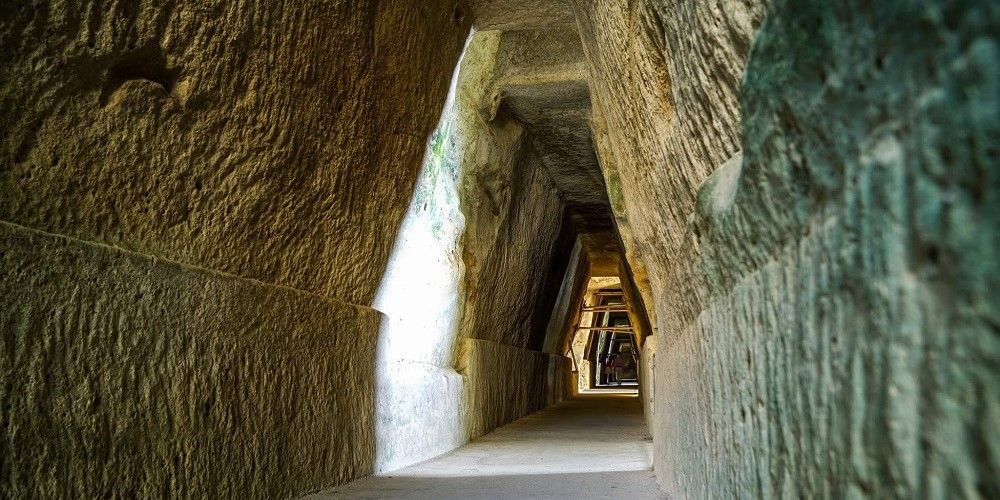
Parco Archeologico Campi Flegrei
Moving away from the city center, one reaches the acropolis of the Cumae Archaeological Park, within the Phlegraean Fields, just steps from Lake Averno. Here, at the foot of the hill, stands the famous Cave of the Sibyl, the seer who foretold the future and delivered her prophecies in a trance-like state. The cave, an ancient military gallery carved into the tuff, consists of a long, enigmatic stone tunnel: the only light filtering in comes from twelve side openings, creating a striking play of light and shadow.
In the early Christian era, the inner chamber where the prophetess carried out her oracular activity was used as a place of worship, while the cisterns that collected rainwater served as burial sites. In Virgil's Aeneid, the cave was the gateway to the Underworld, and the Sibyl was tasked with guiding Aeneas into the realm of Hades in search of his father, Anchises. In Ovid's Metamorphoses, the priestess asked her beloved Apollo to let her live as many years as the grains of sand she held clenched in her fist, but forgot to also ask for eternal youth.
Condemned to endless aging, the Sibyl was forced to watch her body waste away and wither. Transformed into a cicada and shut inside a small cage, the prophetess, now with an insect's body, dissolved until only a voice remained: the same voice that, even today, speaks to those who reach the acropolis and walk through the tunnel in search of a revelation, suspended between myth and reality.
About the author
Written on 20/07/2026
Alessandro Zoppo
He has been listening to music and watching movies since he was 6. Proudly Samnite but Roman by adoption, he writes about culture, travel, economics, finance, politics and sports and curates film festivals.

Alessandro Zoppo
Not just the city of the siren: with its millennia-old history, there's a mystical Naples waiting to be discovered, full of occult and esotericism.