
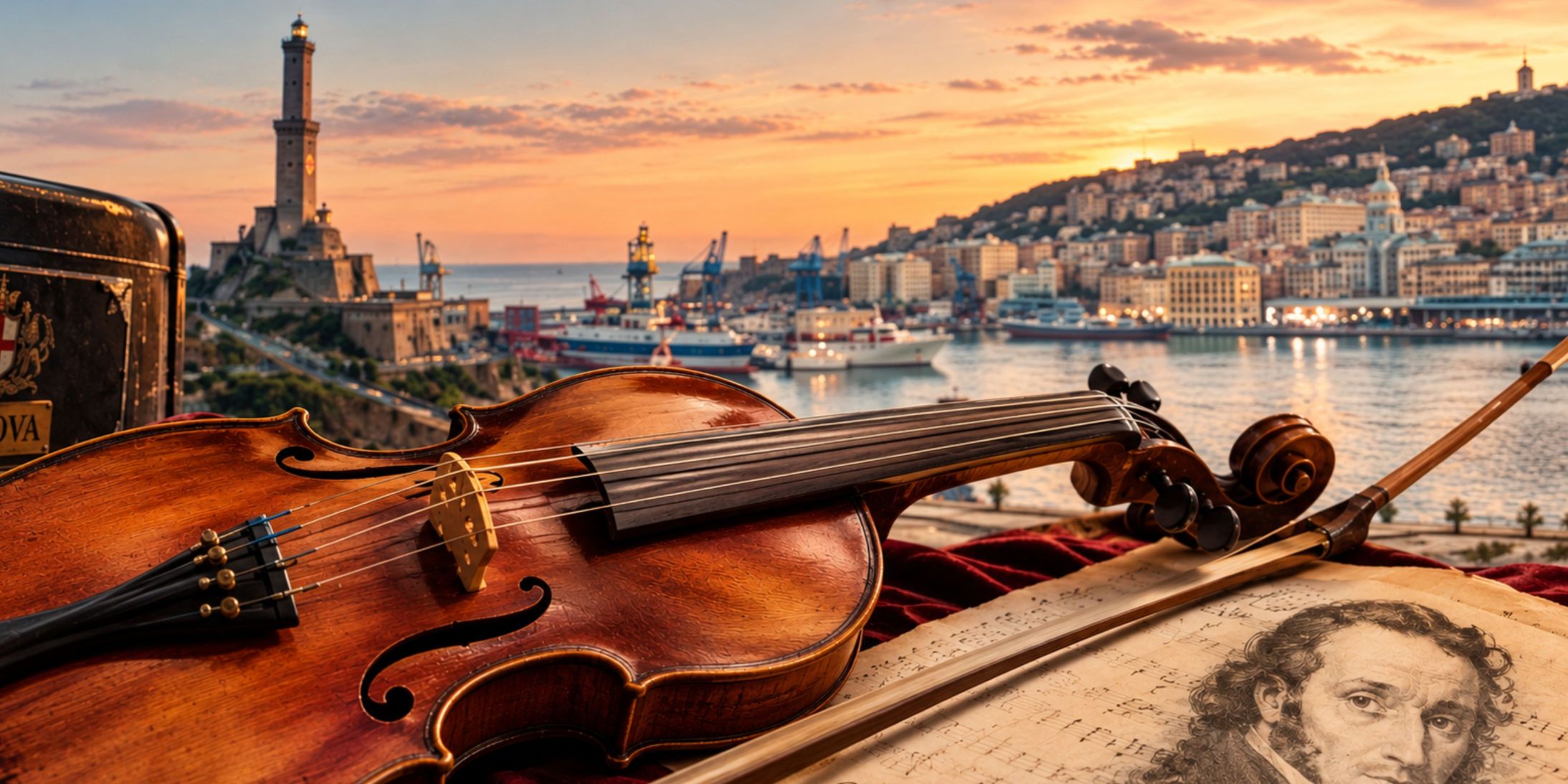

Nearly three centuries after it was made, this legendary violin is still alive with sound. It belonged to Niccolò Paganini, the rockstar violinist who wanted it to remain in his hometown forever. Made in 1743, Il Cannone has survived remarkably intact.
Housed at Palazzo Tursi, the violin is still played on special occasions. This is the story of Paganini’s favourite instrument, lovingly preserved by the city of Genoa.

Paganini’s “Cannone”: The Violin That Became a Legend
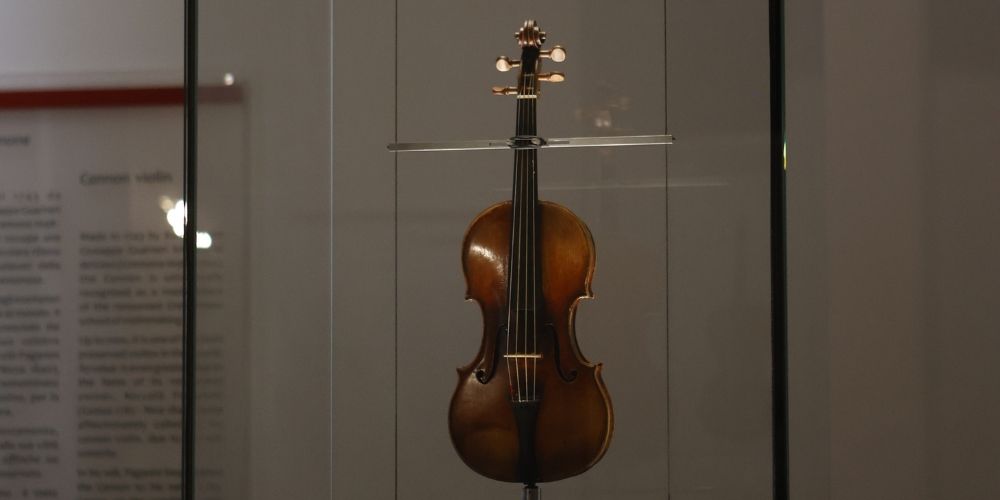
The violin that would go down in history as Il Cannone (the Cannon) got its nickname from Paganini himself, who chose it for the extraordinary power and force of its sound.
Bartolomeo Giuseppe Guarneri, known as “del Gesù” because of the small cross the luthier placed beside his signature, made it in Cremona in 1743.
Paganini acquired it in the early 19th century and soon made it one of the most important instruments of his phenomenal career. The Cannon travelled with him on concerts and journeys and became an inseparable part of his musical life.
The great virtuoso owned several violins, but none held quite the same place in his heart. He considered Il Cannone his favourite and even decided what should become of the instrument after his death.
He left it to the city of Genoa, “so that it may be preserved forever”. That's why, since 1851, the violin has been kept at Palazzo Tursi.
Find more on GenoaListen to the podcast version of the article with the voice of Monna Lisa & Leonardo
The Story of Paganini’s Most Famous Violin
When Il Cannone landed in Paganini’s hands – likely in Livorno, circa 1802 – it wasn’t just a meeting of musician and instrument, but a turning point for the violin itself.
Paganini explored every nuance of it, stretching the boundaries of what was thought possible. His partnership with the Cannon propelled violin technique into uncharted territory, redefining virtuosity for generations to come.
In 1833, however, he was forced to part with it. The violin needed delicate work on its sound system and was entrusted to Jean-Baptiste Vuillaume, one of the most important Parisian luthiers of the era.
Vuillaume did more than repair it. With Il Cannone on his workbench, he made an exact copy, which he then presented to Paganini himself.
The story continues in Genoa. A few years later, in 1840, Paganini gave the copy to his student Camillo Sivori, a Genoese violinist who kept it for years.
After Sivori’s death, his heirs decided that the instrument should be donated to the city of Genoa, just as Paganini had done with the Cannon. Since then, the Sivori and the Guarneri del Gesù have been kept together.
Related story - A guide to Genoa for 2026
Where to See Paganini’s Cannone in Genoa
To see Il Cannone, curious visitors must head to the Sale Paganiniane at Palazzo Tursi.
The visit offers a close-up look at the legendary violin and a view into Paganini’s life. The three dedicated rooms also display the copy made by Jean-Baptiste Vuillaume, along with some manuscripts, sheet music, two guitars, a music stand, a chessboard and pieces, and several portraits.
If one detail astonishes visitors most, it is that the Cannon is in remarkably good condition, with accessories reconstructed from the original parts to recreate, as closely as possible, how the instrument looked when it was given to the city in 1851. Even the varnish is still the authentic 18th-century finish. On the soundboard, you can see the marks left by years of use: like many violinists of his time, he played resting his chin directly on the instrument.
It is hard to imagine a more direct way of getting close to Paganini than standing before the very instrument he once held in his hands.
Paganini’s Connection to Genoa
Paganini’s bond with Genoa runs deeper than the walls of the Paganini Rooms. Traces of his passage are everywhere: in the Church of San Filippo, where young Niccolò gave his first public performance, inside the Grimaldina Tower, where he spent a brief stint behind bars in 1815, around Passo Gattamora, the area of the old city where he grew up.
In 2014, the Amici di Paganini association also mapped out a tribute: 12 brass-plaque landmarks that lead visitors through Paganini’s Genoese story.
His legend doesn’t stop at Genoa’s borders. Paganini was a true European celebrity. He astonished grand theatres across the continent and rubbed shoulders with the most celebrated composers of his era. An international dimension that inspired the European Paganini Route, the cultural network that celebrates the musical and artistic heritage connected with Paganini and his legacy. In 2026, it received the prestigious Cultural Route certification from the Council of Europe.
Related story - Why Genoa is Europe's most surprising city
Where to Hear the Cannon Being Played
@theviolinchannel Violinist Aozhe Zhang was awarded First Prize at the 2025 Premio Paganini Violin Competition Aozhe will receive a cash prize of €30,000 as well as a series of concert engagements and the opportunity to record a studio recital album with the Platoon label Here, Aozhe performs Tchaikovsky's Violin Concerto in D Major All rounds of this year’s competition are available for playback on The Violin Channel!
original sound - The Violin Channel
It would be a mistake to consider the Cannon a merely historic object kept behind glass. Paganini’s favourite violin is still played today, although performances are rare and carefully controlled to protect the instrument.
To monitor how it responds over time, the violin is played periodically, a musical workout to keep it in shape.
One of the most important opportunities to hear its sound comes with the Premio Paganini, the international violin competition founded in Genoa in 1954 and now one of the world’s most prestigious contests for young violinists.
The winner is allowed to play Il Cannone. That happened at the most recent edition, in 2025: 17-year-old Aozhe Zhang, the first-prize winner of the 58th competition, played the Guarneri del Gesù during the gala concert at the Teatro Carlo Felice.
The next opportunity will come in 2027, when Genoa hosts the 59th edition, scheduled for Oct. 11–24.
In the meantime, we've put together a list of the best events in Genoa for 2026.
The Day the Cannon Went Under X-Rays
Il Cannone had a remarkable medical-style checkup a few years ago. In 2024, the violin was taken to Grenoble, France, to the European Synchrotron Radiation Facility (ESRF), where it underwent sophisticated X-ray imaging to evaluate its condition in unprecedented detail.
Understanding its structure in such detail helped experts determine how best to preserve it and how to protect it during the rare occasions when it is played.
Using X-ray microtomography, scientists were able to create a 3D reconstruction of the interior, revealing even traces of previous restoration work.
The diagnosis was reassuring for an instrument built in the 18th century. The Cannon has a few microfractures, but they are considered stable and do not require intervention.
Ottobre Paganini, a feast of music in Genoa
In fall, Paganini’s connection to Genoa spills out of museum galleries and comes alive across the city. From Oct. 2 to Nov. 8, 2026, Paganini October brings together concerts, lectures, master classes, guided tours, and events designed for different audiences, stretching from the historic centre to the city’s western neighbourhoods.
The program also has children’s workshops, flash mobs, travelling performances, and events centred on local food. The lineup features concerts by Kevin Zhu, Giuseppe Gibboni and Giovanni Angeleri, all winners of the Paganini Competition, as well as a complete performance of the 38 Sonatas for solo guitar.
The festival represents a new way to encounter Paganini in Genoa through the music, places and people who continue to study his legacy and reinterpret it for new audiences. Most events are free, except for performances presented by the Teatro Carlo Felice and GOG.
The Cannon Is Still Here, in the Heart of Genoa
Il Cannone is housed at Palazzo Doria-Tursi. This is where Genoa preserves the instrument that Paganini, in his will written in 1837, left to his hometown so that it might be “perpetuamente conservato” (preserved forever).
The bequest entered the city’s collections in 1851, and the violin has remained part of Genoa ever since.
A visit goes beyond the Cannone itself. The same space houses the copy made by Jean-Baptiste Vuillaume, along with other personal memorabilia and a copy of the sheet music for Carmagnola, his first composition.
Since 2021, the precious collection has been enhanced by a new display featuring digital and multimedia content, so that visitors can now have an immersive experience.
Paganini's Violin - The Questions Everyone Asks
How Much Is Paganini’s Violin Worth?
The 1743 Guarneri del Gesù owned by Niccolò Paganini belongs to the City of Genoa and has no real market price. Its historical and cultural value is considered priceless. When the violin was transported to Grenoble for scientific testing in 2024, it was insured for €30 million. Other Guarneri del Gesù violins have fetched record prices on the private market: the famous Vieuxtemps, made in 1741, was sold in 2012 for more than $16 million.
Can You See Paganini’s Cannone in Genoa?
Yes. Il Cannone is on display in the third Sala Paganiniana at Palazzo Tursi, one of the historic palaces that forms part of the Strada Nuova Museums. The room also houses the Sivori violin, the copy made by Vuillaume, as well as other objects that belonged to Paganini.
Why Is Paganini’s Violin Called “Il Cannone”?
Paganini called it “my cannon violin” because of the fullness and power of its sound. The name has nothing to do with its shape; it refers instead to the extraordinary acoustic qualities Paganini heard in the instrument.
About the author
Written on 01/09/2026
Lorena Calise
I'm a content writer for magazines and websites. I also explore Italy through my writing for Visit Italy and Visit Naples.

Lorena Calise
The world’s most famous (and valuable) violin is in Genoa: the story of Paganini’s Cannon, a legendary instrument still played today.