
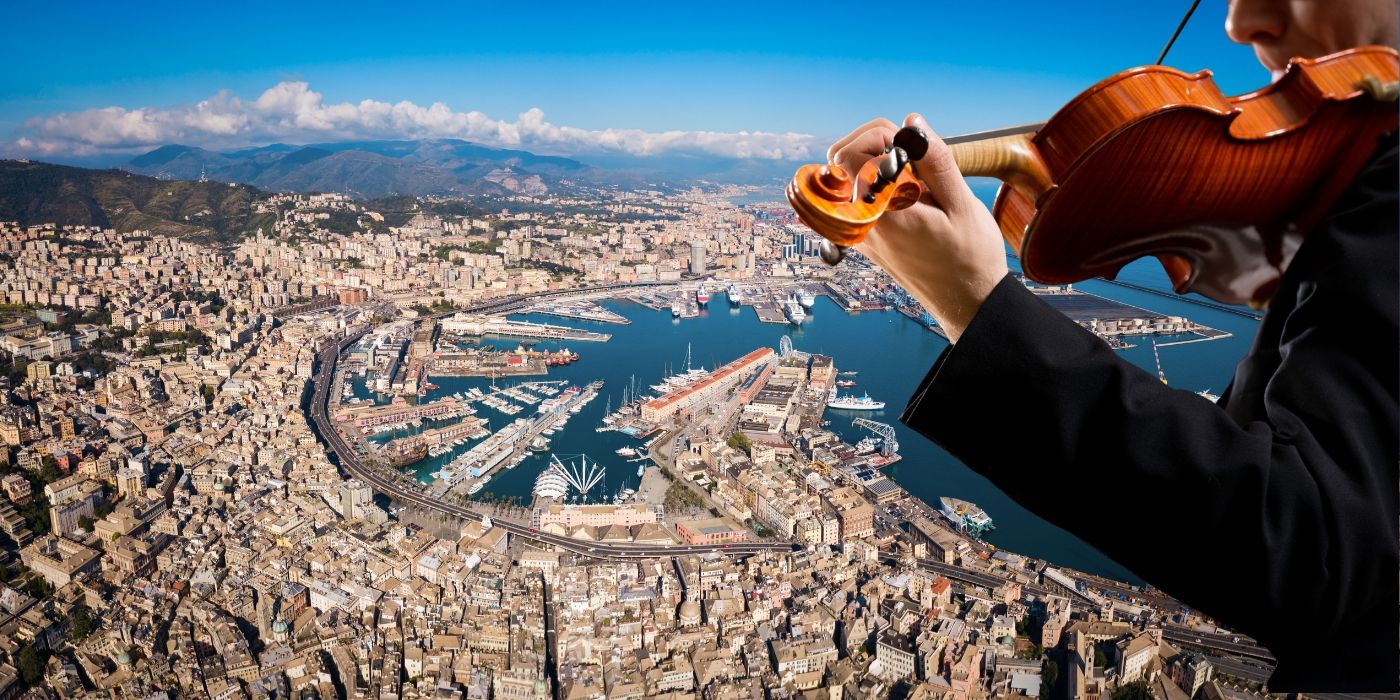

This October, Genoa strikes the perfect chord with Niccolò Paganini, the “Devil’s Violinist” who transformed musical virtuosity into legend. From October 2 to November 8, the Ligurian capital hosts a city-wide festival (open to everyone) entirely devoted to the iconic Genovese musician.
Ottobre Paganini explores the places, sounds, and extraordinary talent of an artist who conquered Europe after emerging from the narrow alleyways of Genoa’s caruggi. We went to find out more.
Paganini October: Genoa’s Month-Long Tribute to the Maestro Who Redefined the Violin
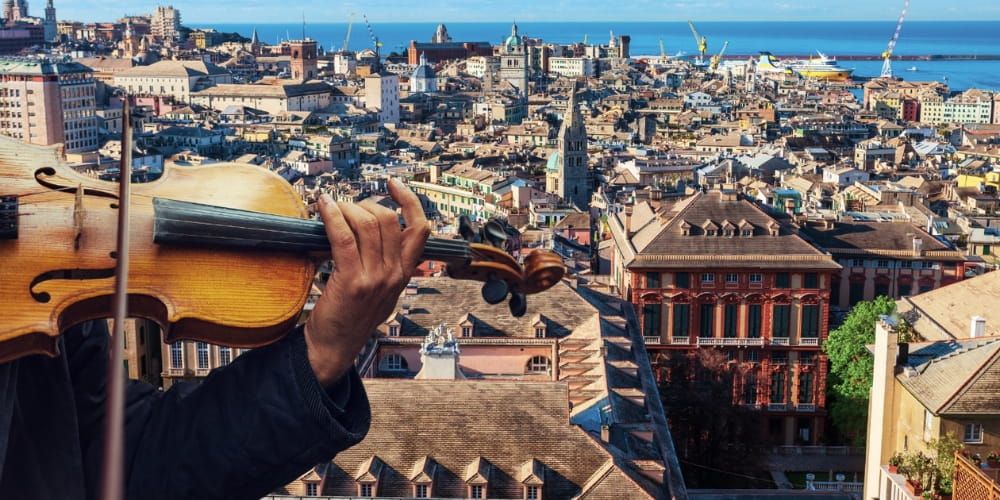
Nearly two centuries after Niccolò Paganini’s death, Genoa’s connection to its legendary violinist remains as strong as ever. This year, the city is set to honour his extraordinary legacy with Ottobre Paganini, a celebration designed to capture the imagination on a grand scale.
For a full month, Genoa transforms itself into a city-wide stage devoted to the Maestro, whose breathtaking skill once led contemporaries to whisper of a deal with the devil.
The 2026 edition will feature concerts, lectures, guided tours, meetings, masterclasses, and cultural events.
The festival unfolds across theatres, museums, historic palaces, and city neighbourhoods as an invitation to trace Paganini's beginnings – from his birthplace around the Via del Colle area to the Church of San Filippo, where the young prodigy first left audiences spellbound – before following the path that made him Genoa's most enduring icon.
But why does Paganini hold such importance for Genoa?
More info on Paganini OctoberNiccolò Paganini and Genoa: A Story That Never Ends
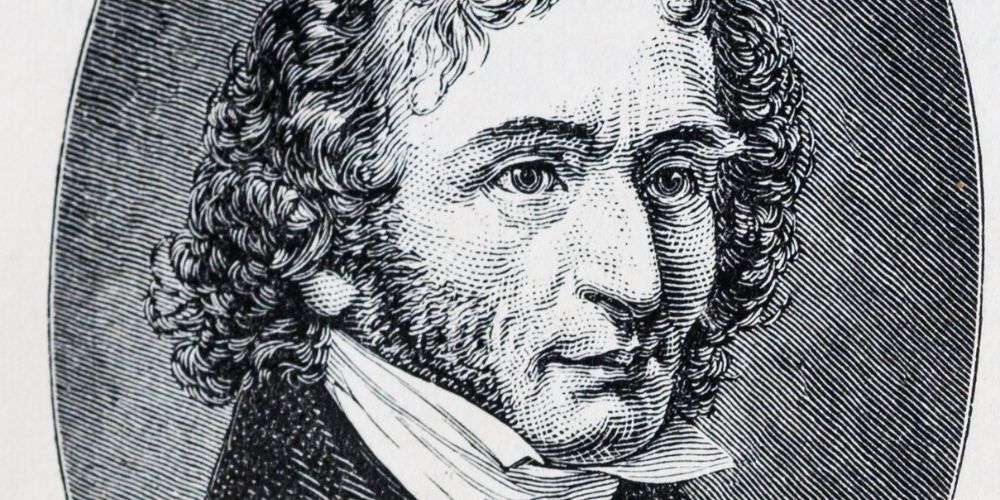
Talented, eccentric, rebellious, larger-than-life – Niccolò Paganini transformed his own existence into myth. Born in Genoa in 1782, he left his hometown to conquer the grandest stages of Europe, dazzling audiences with a virtuosity the world had never witnessed.
His concerts were a sensation. Crowds couldn't get enough of him and his extremes: his flamboyant playing, his disregard for convention, his magnetic stage presence. Even in an era before mass media, Paganini was hailed as a true rock star, his every performance the talk of Europe.
The myths only grew. Rumours that he had struck a pact with the devil circulated across Europe, fueled as much by his uncanny talent as by his nonconformist lifestyle. Paganini did little to dispel them. He cultivated an enigmatic public persona and rarely conformed to the expectations of his era.
The iconic phrase “Paganini non ripete” – after his refusal to repeat a piece for King Carlo Felice – is an example of his fiercely independent character. He was never one to be boxed in by the rituals of performance.
His rise was extraordinary for the son of a modest Genoese family with little formal education. Yet beyond the legends and colourful anecdotes was a genuine innovator. Paganini expanded the technical possibilities of the violin in ways that transformed the instrument forever.
Now Genoa preserves the legacy of a musician who never really left the city.
Paganini’s Genoa: Landmarks Every Music Lover Should Visit
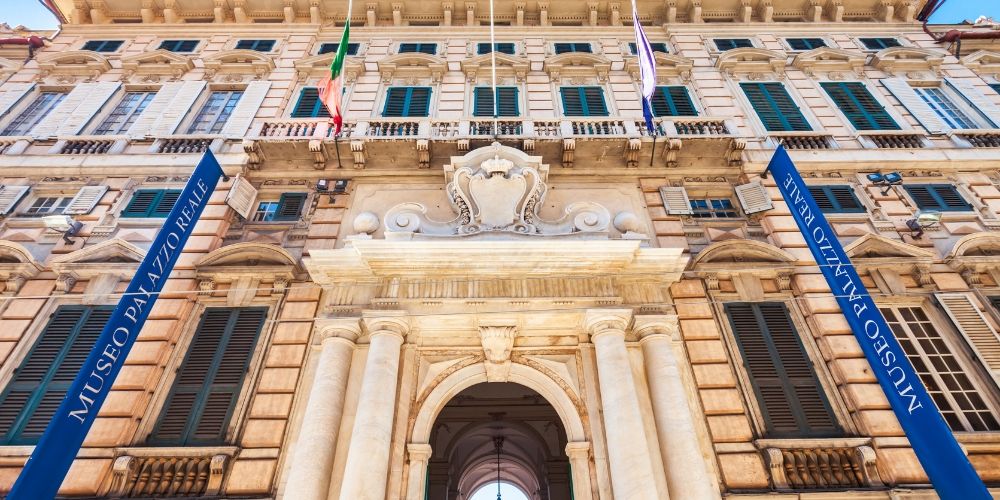
Many of the sites connected to Paganini have become stops on a dedicated trail: La Genova di Paganini. Along the route, each landmark is marked with a brass plaque commemorating a key moment in the musician’s life that occurred right there.
The ideal place to begin is the Teatro del Falcone, inside the Royal Palace. On November 9, 1827, Paganini performed here before King Carlo Felice and the royal family – a concert that would become the stuff of legend. Just a short walk away stands the Church of San Filippo Neri, where an eleven-year-old Niccolò made his public solo debut in 1794.
The route then leads to Palazzo Tursi, its Sala Paganiniana and the city's most treasured musical artefact: Il Cannone, the 1743 Guarneri del Gesù violin that Paganini famously nicknamed "my cannon" for its astonishing power and resonance.
The itinerary continues to Teatro Carlo Felice, where, in 1834, Paganini gave two of his final concerts in Genoa.
Where Paganini’s Legacy Lives On
Beyond the concert halls, churches, palaces, and museums preserve stories that offer a more intimate insight into his life. A significant stop is the Church of San Donato, home to the earliest official document about Paganini: his baptismal certificate.
Another site linked to his childhood is Casa Paganini. Created from the restoration of the historic Santa Maria delle Grazie la Nuova complex, the complex symbolically gives the Maestro a home after his original birthplace was demolished in the 1970s.
Paganini’s story is also connected with one of Genoa’s iconic landmarks, La Torre Grimaldina, where he was briefly imprisoned in 1815 after being accused of “abduction and seduction” of a young woman, a scandal resolved with a substantial payment to her family.
The tour concludes at the Nervi Museums, which display two rare portraits painted during Paganini’s lifetime, and at the old Teatro Sant’Agostino (today’s Teatro della Tosse) where Paganini first performed the “Carmagnola with Variations” in 1795.
Here are the key Paganini sites to visit when in Genoa:
– Teatro del Falcone (Royal Palace)
– Church and Oratory of San Filippo Neri
– Sala Paganiniana, Palazzo Tursi (Musei di Strada Nuova)
– Church of Nostra Signora delle Vigne
– Teatro Carlo Felice
– Palazzo di Giustizia (formerly Pammatone Hospital)
– Palazzo Ducale and the Grimaldina Tower
– Church of San Donato
– Site of the former Teatro Sant'Agostino (today Teatro della Tosse)
– Villetta Di Negro
– Musei di Nervi
– Galleria d'Arte Moderna
– Casa Paganini
Related story – A week in Genoa: the perfect itinerary
Paganini Events in October 2026: A Citywide Celebration
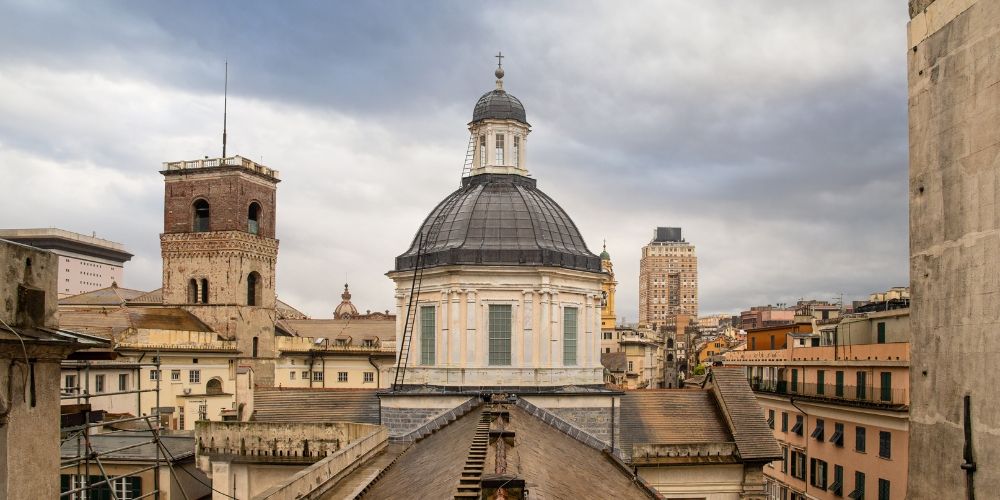
Paganini October is not just another classical music festival. It opens up Genoa in unexpected ways, with something for everyone, whether you love the violin or are just curious.
The celebration goes beyond the usual Paganini sites and extends into outlying neighbourhoods, with workshops for children, flash mobs, pop-up events, and initiatives that animate piazzas, train stations, and theatres.
Many events are free. Among the most anticipated: concerts featuring Paganini Prize winners Kevin Zhu, Giuseppe Gibboni, and Giovanni Angeleri; the complete performance of all 38 Sonatas for solo guitar; and guided tours along the European Paganini Route, which was recently recognised as a Cultural Route by the Council of Europe.
A major innovation for Ottobre Paganini 2026 is the permanent working group that, for the first time, brings together Genoa’s leading musical and cultural institutions. The aim: to turn Paganini October into a lasting project that lifts Paganini’s legacy onto the international stage.
Related story – All the 2026 events in Genoa
The “Cannon” Violin: The Treasure Preserved in Genoa
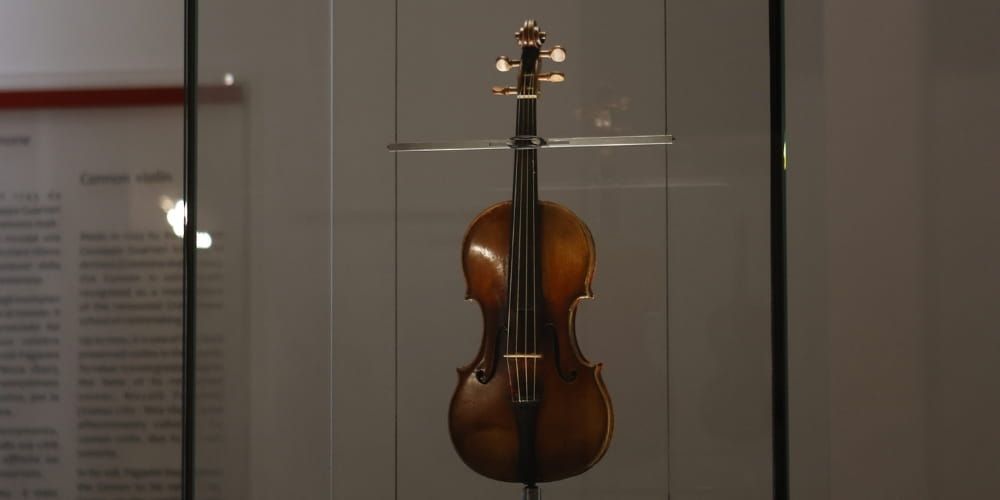
Among all the places connected to Niccolò Paganini, one holds the very heart of his legend: Il Cannone, the famed violin crafted in 1743 by the Cremonese luthier Giuseppe Guarneri del Gesù.
Paganini affectionately called it “my cannon violin” for its extraordinary power and depth of sound – qualities that made his performances unmistakable across Europe.
Upon his death, Paganini decreed that the instrument should remain forever in the city of Genoa. Today, the Cannone is housed in the Sala Paganiniana at Palazzo Tursi, within the Musei di Strada Nuova, alongside his bow, handwritten letters, sheet music, and other priceless mementos.
Regarded as one of the world’s most precious instruments, Paganini’s Cannone is played only on rare occasions, most notably by the winners of the prestigious biennial Paganini Competition.
The Paganini Prize in Genoa
Niccolò Paganini’s legacy lives on through Premio Paganini (Paganini Prize), one of the world’s most prestigious international violin contests.
Founded in Genoa in 1954, the biennial competition was created to nurture and showcase the finest young violinists from around the globe. Over the decades, it has discovered and celebrated some of the most remarkable performers of their generation, becoming a benchmark for emerging talent.
To win the Paganini is a test of technique and artistry. The presence of past winners among the highlights of Paganini October 2026 underscores the connection between the Maestro’s memory and the new generation of musicians in a dialogue with tradition, innovation, and the future of music.
The next Paganini Prize will take place in Genoa from October 11 to 24, 2027.
Visiting Genoa During Paganini Month
A musician born in Genoa who went on to conquer the world, and a city that continues to tell his story through music: nearly two centuries after his death, Paganini remains a bridge between the past and the future.
October 2026 is a special time to experience the bond between Genoa and its legendary violinist and to take a journey through music, history, and cultural identity. Concerts, performances, and accessible events invite everyone to experience Paganini’s hometown from a new perspective.
Further enriching Genoa's autumn, the month also marks the return of the Rolli Days, the event that opens the doors to the magnificent Palazzi dei Rolli, a UNESCO World Heritage Site that, in 2026, marks the 20th anniversary of its inscription on the list.
Exploring Paganini’s Genoa: Questions and Answers
When does Paganini October take place in Genoa?
Paganini October runs from October 2 to November 8, 2026, with a city-wide programme dedicated to Niccolò Paganini and his connection with Genoa.
Where is Paganini’s “Cannone” violin kept?
The Guarneri del Gesù violin once owned by Paganini is preserved at Palazzo Tursi, home to the Musei di Strada Nuova in Genoa. Opening hours: Tuesday, Wednesday, Thursday, and Friday from 9 a.m. to 7 p.m.; Saturday and Sunday from 10 a.m. to 7 p.m.
What are the main events of Paganini October 2026?
The programme has concerts, talks, lectures, masterclasses, guided tours, and events spread across the city’s most significant locations. Highlights include performances by Premio Paganini winners and the complete performance of Paganini’s 38 Sonatas for Solo Guitar.
About the author
Written on 10/08/2026
Lorena Calise
I'm a content writer for magazines and websites. I also explore Italy through my writing for Visit Italy and Visit Naples.

Lorena Calise
A rockstar ahead of his time, a violin genius, and a rule-breaking artist: Paganini takes over Genoa for an entire month.