

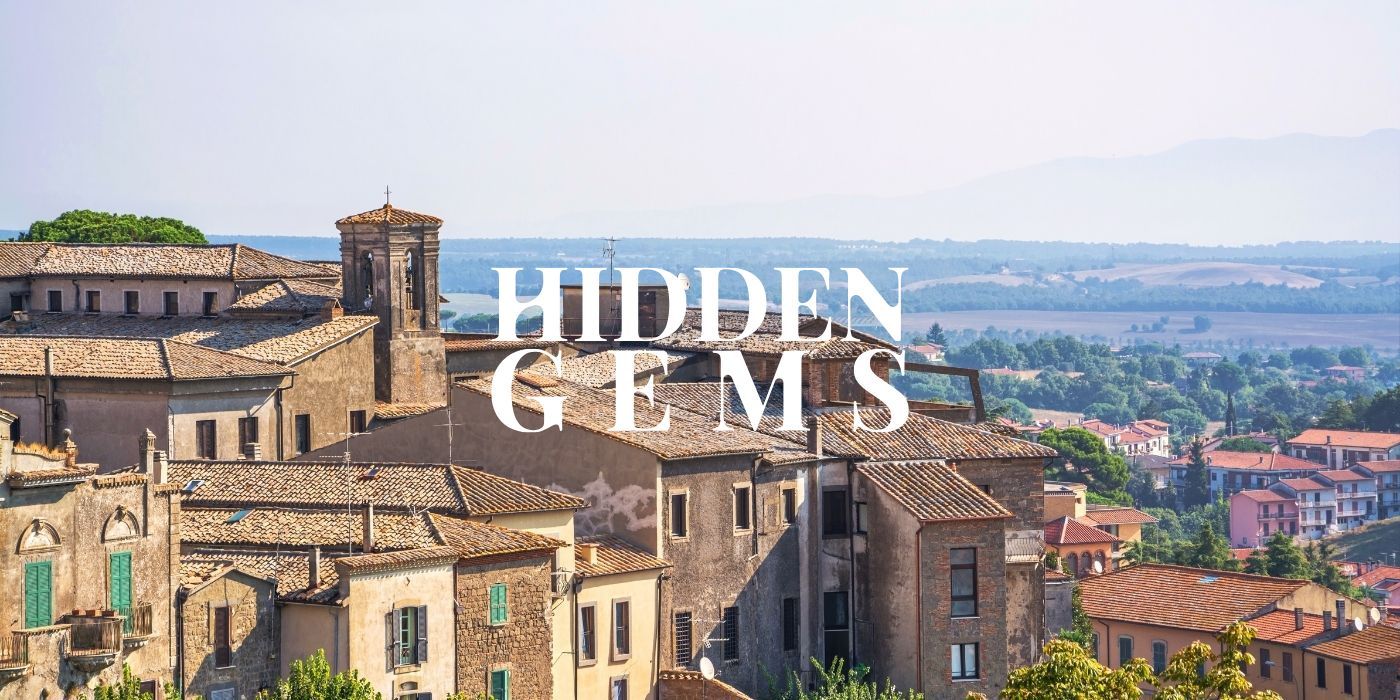

Est! Est!! Est!!! No, it is not a typo. And no, someone did not simply get carried away with exclamation marks.
Behind one of the most unusual names in Italian wine lies a story that takes us back more than nine centuries, to roads once travelled by emperors, pilgrims, prelates and merchants on their way to Rome. Most importantly, it leads us to Montefiascone, a hill town in northern Lazio overlooking Lake Bolsena, where you can still retrace the legend, walk along the ancient Via Francigena and, of course, taste the wine that bears its name.
That is precisely what makes this story so compelling: what begins as a curious medieval legend gradually turns into a real journey. To follow it, all you have to do is reach Montefiascone and let those three words guide you: Est! Est!! Est!!!

Est! Est!! Est!!!: From the Defuk Legend to a Town Shaped by Wine
According to local tradition, it all began in 1111. Henry V of Germany was traveling to Rome, where the Pope was preparing to crown him Holy Roman Emperor. Among those accompanying him was the German bishop Johannes Defuk, a great lover of wine.
The resourceful Defuk decided to send his servant Martino ahead with a rather pleasant assignment: taste the wines served in local taverns along the route. The two are said to have devised a code. Whenever Martino found a good wine, he would write “Est”—Latin for “there is”—outside the inn. If the wine was particularly good, he would repeat the signal.
When Martino reached Montefiascone, apparently one Est was not enough. Nor were two. On the door of the inn appeared the message Est! Est!! Est!!! Three repetitions of the same word, reinforced by six exclamation marks. Defuk is said to have agreed wholeheartedly with his servant, finding the wine so excellent that, after returning from the imperial coronation, he decided to settle in Montefiascone.
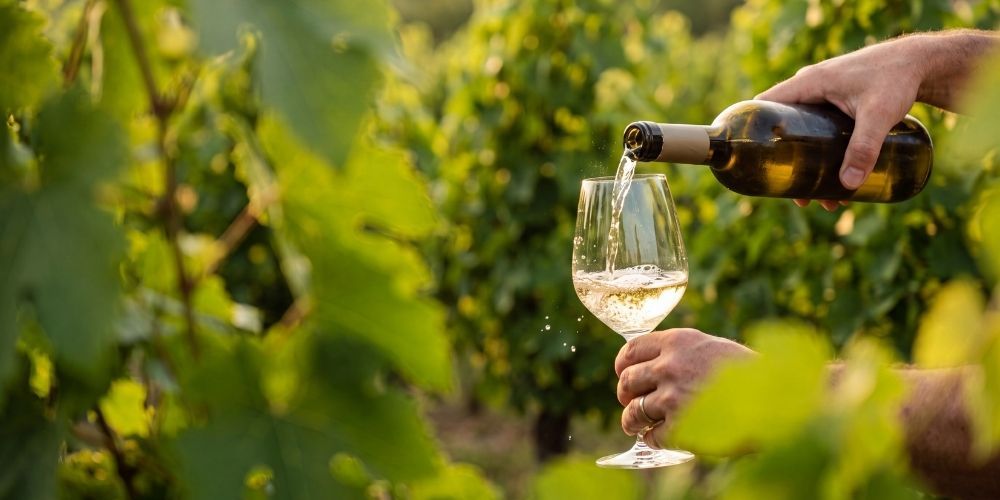
All you have to do is look around to understand how deeply wine still belongs to the landscape and identity of Montefiascone today. The town lies in the province of Viterbo, on the Volsini Mountains, overlooking the beautiful and peaceful Lake Bolsena. This is an agricultural landscape with a long history of vine growing, and it is here that Est! Est!! Est!!! di Montefiascone is still produced: a white wine granted DOC status in 1966 and made mainly from Trebbiano, Roscetto and Malvasia grapes.
Following the story of Est! Est!! Est!!! means discovering Montefiascone through its relationship with the vine. Come with us as we explore the monuments and traditions of this hidden gem in Lazio, where you can step into the story itself, enjoy a leisurely escape from the city and sample the local wine and food along the way.
The Basilica of San Flaviano: Where Legend Becomes History
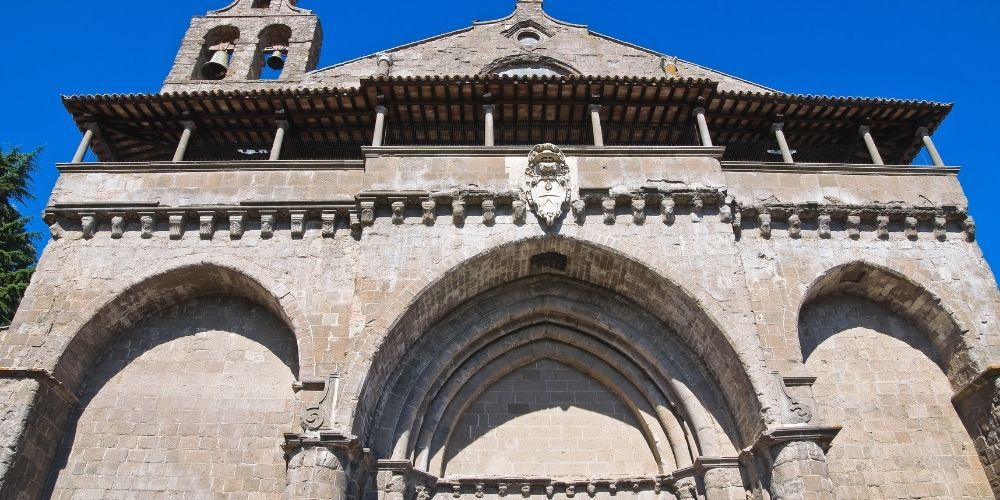
If we want to find the point where the story leaves the realm of legend and becomes something we can actually see and touch, we need to head down towards the Basilica of San Flaviano.
This is where you will find the tomb traditionally associated with the famous Defuk, who is said to have died in Montefiascone after settling here. According to tradition, his faithful servant Martino had an inscription placed on the tomb declaring: “Here lies my lord, who died from too much EST EST EST wine.” You can still find the tomb near the entrance to the church.
The legend also claims that, in gratitude for Montefiascone’s hospitality and as a tribute to its excellent wine, the bishop left the town 24,000 scudi on one condition: every year, on the anniversary of his death, a small barrel of muscat wine was to be poured over his tomb.
The Basilica of San Flaviano is one of Montefiascone’s most fascinating monuments and would be worth visiting even without the Defuk story. The building consists of two churches built one above the other, created in different periods and facing in opposite directions. The lower church dates back to the 11th century, while the upper church was built in the 13th. Inside, capitals, arches and frescoes reveal several centuries of medieval art.
San Flaviano also tells another story of travellers. The basilica stands along one of the great medieval routes to Rome: the Via Francigena.
The Montefiascone Wine Fair: When the Story Comes Back to Life
In Montefiascone, Defuk has never remained confined to a tombstone. The town continues to tell his story through its traditions.
Every year, during the first half of August, the Fiera del Vino di Montefiascone (Montefiascone Wine Fair), among the most fascinating historical reenactments in central Italy, celebrates the area’s winemaking tradition with tastings, performances and historical reenactments.
Do not expect to see a barrel of wine poured over Defuk’s tomb today, but the bishop and his servant are still remembered through theatrical performances, historical celebrations and traditional banquets. The event has now reached its 66th edition, a sign of just how deeply the relationship between Montefiascone and wine has become part of the town’s identity.
Visit during the festival and Montefiascone takes on an atmosphere of its own. For a few days, it is easy to imagine medieval travellers passing through the streets and to feel as though the town has slipped temporarily into another age. The many opportunities to taste local wines certainly add to the experience.
Beyond the Legend: What to See in Montefiascone
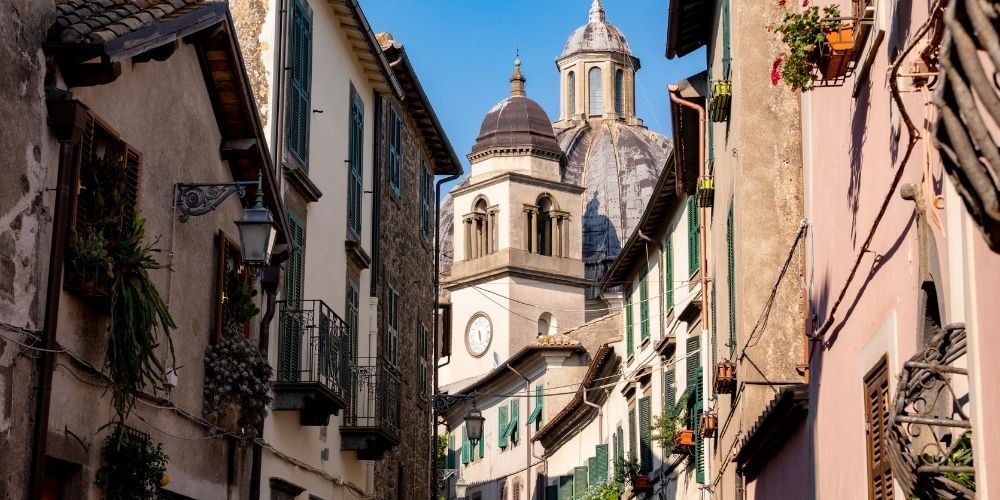
After finding traces of Defuk inside the Basilica of San Flaviano, do not be too quick to leave. The best way to discover Montefiascone is to keep climbing, leaving the lower part of town behind and following the streets that lead towards the historic centre.
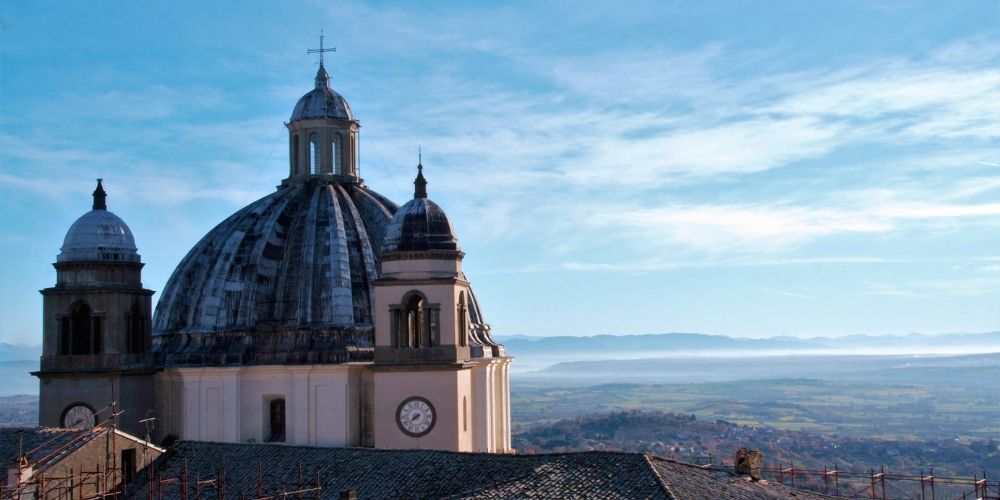
The great dome of the Cathedral of Santa Margherita, which you will probably have noticed before even arriving, becomes your first landmark. It is one of Montefiascone’s most distinctive silhouettes and a reminder of the religious importance the town acquired over the centuries. As you enter the centre, narrow streets, squares and old buildings gradually take you beyond the wine story and reveal a place with a much richer history.
Keep climbing a little farther. At the highest point of the hill stands the Rocca dei Papi, the fortress that became one of the centers of papal power in Tuscia during the Middle Ages. Cross its courtyard and make your way to the Torre del Pellegrino, the Pilgrim’s Tower.
This is where the route reaches its natural conclusion. From the top, Lake Bolsena opens out below you, surrounded by countryside, vineyards and the rolling hills around Montefiascone. On the clearest days, the view stretches as far as Monte Amiata and the Apennines.
It is also the moment when the story that began with Est! Est!! Est!!! takes on a different dimension. The wine is no longer merely the protagonist of an unusual medieval legend: spread out before you is the landscape that still produces it, shaped by vineyards, olive groves and the presence of the lake. Montefiascone stands on the highest hill of the Volsini Mountains, in an area historically linked to vine growing.
Then you can slowly make your way back down towards the centre, stop at a small shop or sit down for a glass of Est! Est!! Est!!! You arrived following the story of a wine, but step by step you discover that behind those three exclamations lies an entire town.
Along the Via Francigena: Reaching Montefiascone at a Slower Pace
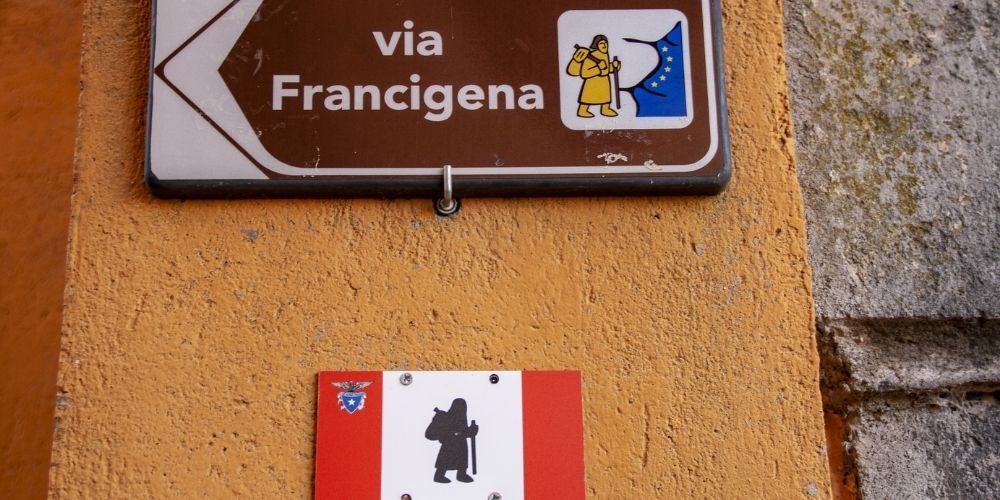
It is difficult to imagine a more fitting way to continue this story.
The legend of Defuk begins on a road towards Rome and, almost a thousand years later, that same direction still brings travellers and pilgrims through Montefiascone.
The town lies on the Via Francigena, the ancient pilgrimage route that crossed Europe from Canterbury to Rome. If you arrive on foot from the north, Montefiascone is the third stage of the Lazio section. From Bolsena, the route covers around 17.8 kilometres, a little over five hours of walking through olive groves, woodland and continuous views over Lake Bolsena.
It changes completely the way you experience your arrival. First, the outline of Montefiascone appears in the distance. Then you begin to pick out the great dome of Santa Margherita, before finally reaching the Rocca dei Papi and the Torre del Pellegrino, almost as though the panorama waiting at the top were your reward for the climb. But Montefiascone is not only a destination. From here, the Via Francigena continues towards Viterbo along a stage of roughly 18.4 kilometres.
The first section is among the most evocative. Once you leave the town behind, you walk along the ancient paving of the Via Cassia, with the stones of the Roman road still beneath your feet. From there, the route continues through the Tuscia countryside, between hills and views that occasionally open back towards Montefiascone.
You do not need to be a long-distance pilgrim to understand its appeal. Walking even a small section of this road is enough to realize that the Via Francigena connects much more than a series of destinations. It brings together landscape, history, architecture, food and memory. Planning an itinerary along the Via Francigena is also a wonderful adventure.
And perhaps this is one of the best ways to discover Montefiascone: arrive slowly, watch the lake appear between the trees, enter the town along a road travelled for centuries and then stop, just as the legend suggests, in front of a glass of Est! Est!! Est!!!
Montefiascone: A Detour Worth the Journey
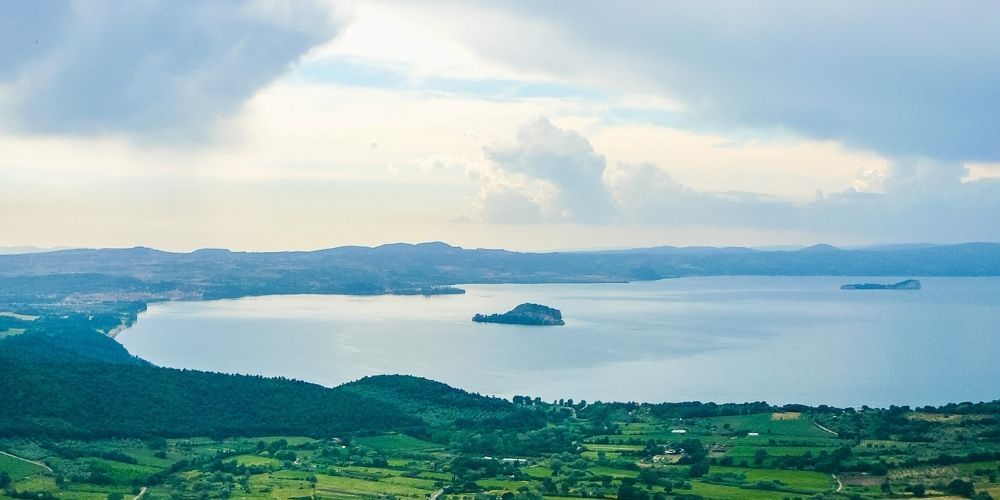
If you are visiting Rome and have a few extra days, or simply want to discover an Italy beyond the major cities, Montefiascone can become one of those detours that changes the pace of your journey.
Leave the capital behind and head north, and the landscape gradually begins to open up. Towns become less frequent, hills, fields and vineyards appear, until Lake Bolsena emerges almost unexpectedly in the heart of Tuscia.
You may arrive following the legend of Est! Est!! Est!!!, but you will probably stay for much more.
Step into the medieval shadows of San Flaviano, climb towards the Rocca dei Papi and look out over the lake from the Torre del Pellegrino. Wander through the streets of the historic centre without a precise destination, stop outside a small shop or sit down at a table and discover how wine and food continue to tell the story of the same landscape you have just crossed.
Montefiascone is especially rewarding for travelers who prefer to move slowly. You can walk a section of the Via Francigena, follow paths between vineyards and olive groves, head down towards the shores of the lake or simply give yourself enough time to watch the landscape change with the light.
And perhaps it is worth resisting the temptation to make Montefiascone just a short day trip. Stay for a night and you will see the town become quieter once the day visitors leave. You can linger over dinner, wake up with Lake Bolsena in front of you and walk another stretch of the Via Francigena the following morning. It can become a romantic weekend, a solitary retreat or simply a few days devoted to silence, nature and a slower rhythm.
Sometimes, all it takes is a short detour from the major routes to discover another side of Italy. Montefiascone is one of those detours.
About the author
Written on 25/09/2026
Chiarastella Campanelli
Dreamer, editor, beauty lover

Chiarastella Campanelli
In Montefiascone, the story of Est! Est!! Est!!! still leads through wine, medieval churches, ancient pilgrimage routes and views over lake Bolsena