
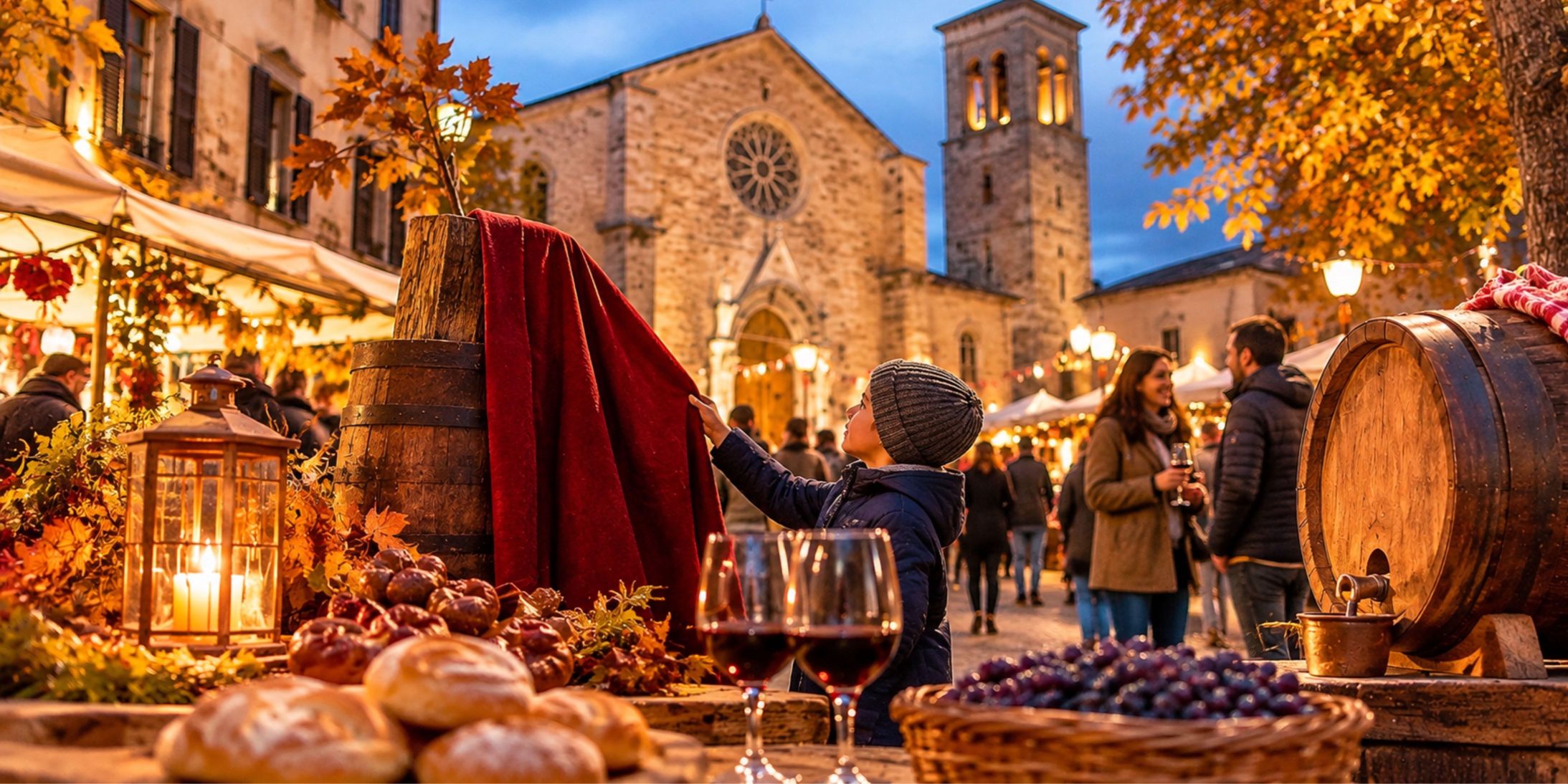

As autumn settles in, something special happens in the high-heeled boot of Europe. Somewhere between a religious festivity and a toast to the new wine, La Festa di San Martino in Italy celebrates the rural rites and local folklore that have grown up around 11 November for centuries.
Goose races, bonfires lighting up villages, children making a racket with pots and pans, curious rituals involving horns: what are these customs, and where can you still experience them? We’ve put together some of the most fascinating, funny and bizarre San Martino traditions in Italy.

Who was San Martino, and why do Italians celebrate on 11 November
Before becoming Bishop of Tours, France, Martin served as a Roman soldier. He was born around 316 in Pannonia, in present-day Hungary, and his story is best known for one of the most famous episodes in Christian lore.
According to legend, while in Amiens, he came across a beggar shivering in the cold and cut his cloak in two to give half to the man. That night, Jesus appeared to him in a dream, pleased by his act of kindness. The encounter was a turning point in Martin’s life and eventually led him to embrace Christianity, leave the army and devote himself to religious life.
Over the centuries, 11 November (the day Martin was buried in 397) also became an important date in the agricultural calendar. In many parts of Italy, it marked the end of the farming season, the expiry of sharecropping agreements and the time to take stock of the year’s harvest. It was also when wine was racked and the new vintage tasted.
Related story - 20 autumn destinations in Italy
San Martino and the first taste of the new wine
“A San Martino ogni mosto diventa vino” – “By Saint Martin’s Day, all must has turned into wine”- is the Italian saying that captures the association between 11 November and the dynamics of the countryside. After the grape harvest, now it's time to open the casks and raise a glass or two of the new wine.
Italian poet Giosuè Carducci summed it up in his poem San Martino with evocative descriptions of wine fermenting in the vats and its pungent aroma filling the air. You can still smell it today.
One clarification is worth making here: vino nuovo (new wine) and vino novello are not the same thing. Vino nuovo is simply the wine from the current year's harvest, freshly made and ready to drink. Vino novello is a specific type made using a technique in which whole bunches of grapes are left in oxygen-free containers before being crushed and proceeding through the remaining stages of winemaking.
La Festa di San Martino in Italy and its extravagant rituals
St. Martin has long outgrown his religious role to become part of Italy’s popular imagination, where faith and folklore sometimes go hand in hand.
First of all, he has acquired quite a lot of patronages: he is the patron saint of travellers, knights, soldiers, and beggars, as well as innkeepers, coopers and drinkers. But that’s not all: according to popular folklore, he also protects cuckolds!
One of the most common explanations for this bizarre association traces it back to the livestock fairs held in early November, where cattle, sheep and goats – all horned animals – were brought together in large numbers.
The connection has given rise to some irreverent celebrations, complete with tongue-in-cheek processions through the streets. The so-called feste dei cornuti (cuckold festivals) take place in several Italian towns and villages: San Valentino in Abruzzo Citeriore, Ruviano in the province of Caserta, Rocca Canterano in Lazio, and more.
These are just a few of the unusual customs held around 11 November; plenty of other San Martino traditions and ancient rituals exist across Italy, some truly surprising.
Beyond wine: the November traditions in Italy for San Martino
Some celebrate San Martino by defying the darkness with enormous bonfires; others turn the streets into an impromptu concert of pots and pans. And in some places, if you want to ward off suspicions of infidelity, all you have to do is walk beneath a pair of horns hanging from an arch.
The 11 November festivities vary in character, form and degree of superstition from one part of Italy to another. Some are about religious devotion, but others preserve traces of age-old farming practices and folk pranks. Here are five customs worth discovering – because behind the religious feast lies a surprisingly eccentric world.
Le Glorie di Scanno, Abruzzo – On the evening of 10 November, the eve of San Martino, three enormous bonfires are lit simultaneously on the hills surrounding this small town in the Abruzzo region. Known as Le Glorie, they represent Scanno's three districts: Cardella, La Plaia and San Martino. Each one tries to outdo the others, with bragging rights going to the team that builds the tallest pyre or keeps its fire burning the longest. In the past, the ritual revolved around a single huge bonfire near the San Martino grotto, where, according to lore, the saint once stayed.
Bater el San Martin, Venice – On 11 November, the streets of Venice ring with the sound of wooden spoons banging against pots, lids and pans. The noisy procession is led by children wearing little paper crowns, who make their way through the city’s calli and campielli, chanting rhymes in the Venetian dialect and asking shopkeepers and passers-by for a few coins or a sweet. The event is linked to the longstanding devotion to San Martino in the Castello district, home to an ancient church dedicated to the saint.
La Fiera dei Becchi, Santarcangelo di Romagna – The large horns hanging beneath the Ganganelli arch have something to do with the fair’s agricultural past. Decorated with colourful ribbons, much like those once used to adorn oxen taken to livestock fairs, they are now at the centre of a playful superstition. Anyone walking beneath the arch is supposed to watch how they move: if they swing, it could spell trouble for their love life! There’s plenty more to enjoy, too, from street food stalls, local specialities and crafts to storytellers, a piadina-making competition and a large market. 7–11 November 2026.
Lantern Processions, Alto Adige – Children take centre stage in the Laternenumzüge, or lantern processions, held in villages across Alto Adige, a region where several places even bear the name of San Martino (like San Martino in Badia, San Martino in Passiria, or San Martino in Casies). Little ones parade through the streets carrying colourful handmade lanterns, singing Ich geh’ mit meiner Laterne (“I walk with my lantern”), a traditional German children’s song.
I Fuochi di San Martino, Predazzo – On the evening of 11 November, the five districts of this village in the province of Trento light huge bonfires on the surrounding hillsides. As the flames blaze, cowbells and horns ring out across the valley. Then everyone moves towards the centre along the so-called Via dei Campanacci (Street of the Cowbells), in a noisy procession that ends with a village-wide party featuring roasted chestnuts, vin brulé (mulled wine) and music.
In Venice for San Martino? Get your City PassWhere to celebrate San Martino in Italy: fairs and food festivals
There’s no single way to celebrate San Martino in Italy. While goose races take place in certain towns, others mark the occasion with chestnuts and local specialities, and wineries across the country open their doors for a first taste of vino nuovo. Here are a few events to add to your calendar.
In Cortina sulla Strada del Vino, in Alto Adige, la Sagra di San Martino takes place on 11 November 2026, with a market, local specialities, and a rather amusing race between a geese.
Over in Mirano, near Venice, Fiera de l’Oca returns on 7 and 8 November, along with the entertaining Zogo de l’Oca: a giant board game played in the town square, with local districts competing using oversized dice and game squares.
Further south, in Campania, Capitignano hosts the 13th edition of San Martino Castagne e Vino from 13 to 15 November: three days of food stalls, live music, local crafts and a competition dedicated to vino novello.
In Salento, Galatone gets into the festive spirit on 10 November with a glass of wine, roasted chestnuts, freshly made pettole and local folk music.
If you’d rather explore the vineyards, the Movimento Turismo del Vino organises Cantine Aperte a San Martino, a nationwide programme of tastings, winery tours and meetings with wine producers, running from 1 to 15 November 2026.
Related story - The best events in November for 2026
What do Italians traditionally eat on San Martino?
San Martino has its fair share of food and drink, too. Chestnuts are the star of the show, alongside wine, and appear on tables, at tastings, and at food festivals across Italy.
In the north-east, goose dishes are a San Martino classic. According to legend, when Martin tried to avoid being made a bishop, he hid in a flock of geese – only to be given away by their honking. It may be no more than a folk tale, but it helped cement the bird’s association with the feast day.
In Venice, pastry shops fill their windows with biscotto di San Martino: a brightly decorated biscuit shaped like a knight on horseback, made especially for children.
Sicily and Sardinia have their own sweet treats, too. Sicilian biscottini are dunked in Moscato wine and also come in richer versions filled with ricotta or topped with icing. Sardinian papassini, meanwhile, are made with dried fruit and raisins, then decorated with icing and colourful sprinkles.
The tour continues in Abruzzo, where pizza coi quattrini is a sweet cornmeal cake made with walnuts, dried figs and honey. A small coin is hidden inside, and whoever finds it is said to have good luck coming their way. Fragneto l’Abate, near Benevento (Campania), has its pizza dedicated to San Martino, too – but this time it’s savoury: a spiral-shaped pastry filled with anchovies, olive oil and black pepper.
Fun facts about Festa di San Martino in Italy - FAQs
What is San Martino in Italy?
La Festa di San Martino in Italy is both a religious feast, rooted in the values of generosity and sharing associated with this saint, and a popular celebration linked to the customs and practices of the countryside. In many parts of Italy, November marked the end of the farming year and a time of change in rural communities.
Why is San Martino celebrated on 11 November?
St. Martin died on 8 November 397 and was buried in Tours three days later, on 11 November. The date of his burial, commemorated in the liturgical tradition, became the day of the celebration.
What is the connection between San Martino and new wine?
It all comes town to the farming calendar. After the grape harvest and the initial weeks of fermentation, the first days of November were the standard time to taste the wine from that year's crop. That's where the Italian expression "A San Martino ogni mosto diventa vino" (By St Martin's Day every must has become wine) comes from.
About the author
Written on 06/11/2026
Lorena Calise
I'm a content writer for magazines and websites. I also explore Italy through my writing for Visit Italy and Visit Naples.

Lorena Calise
Italy celebrates La festa di San Martino with everything from wine-fuelled gatherings to some rather unusual customs. We’ve picked out a few.