
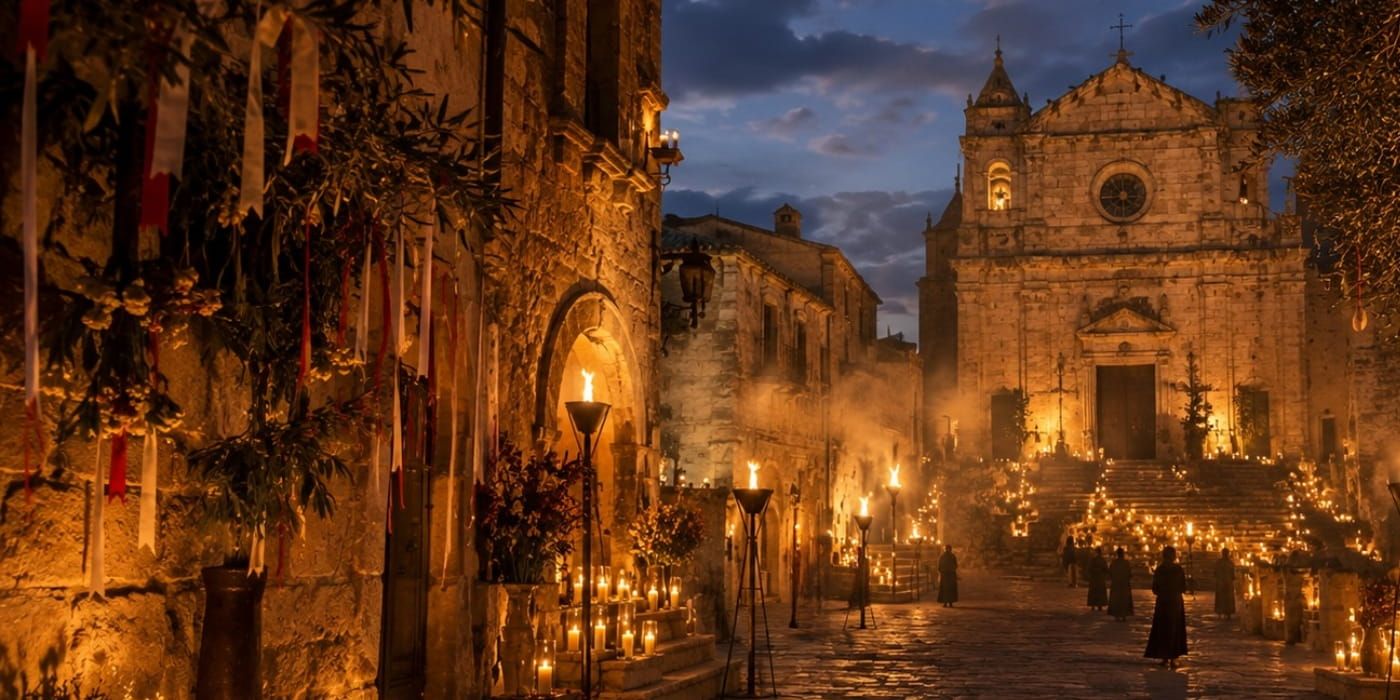

A journey into the places of southern Italy where the past has never quite become past and gestures handed down for centuries come to life before local communities, year after year.
Some Italian traditions have roots in pre-Christian rites; others have become interlaced with religious devotion. All of them, however, tell the story of a Italy far removed from the postcard version sold to tourists.
From the raucous Festa della 'Ndenna in Castelsaraceno to the dramatic rites of the Vattienti, these time-honored Italian rituals safeguard a matrix of symbols, beliefs, and stories that continue to astonish. Here are 10 ancient folk traditions from southern Italy that endure to this day.

10 Southern Italy Traditions That Seem to Come From Another Time
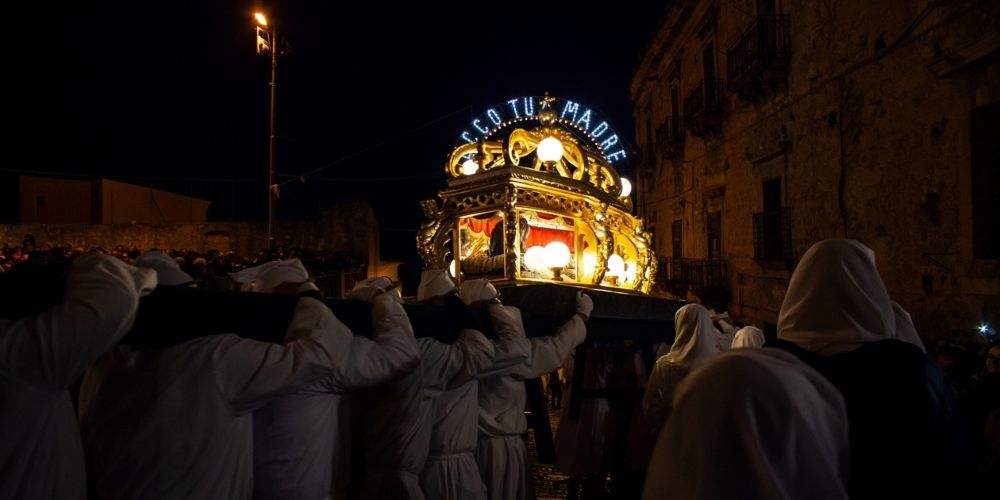
A tree carried on people’s shoulders, enormous bonfires, hundreds of snakes, men covered in blood. These are just some of the elements that feature in Italy’s most unusual surviving rituals.
Born from a mixture of ancient beliefs, religious faith and folk traditions, they have endured for centuries without losing their hold on local communities, which continue to carry them out with devotion – and, yes, a healthy appetite for celebration.
Some of these events pay homage to saints and Madonnas; others channel a primal bond between people, land, and nature.
To uncover their secrets, we made our way into the secluded corners of Italy rarely glimpsed by tourists, where tradition isn’t relegated to history books, but lives and breathes in the everyday.
The Italian rituals and traditions we selected for our journey:
– Festa della Ndenna – Castelsaraceno, Basilicata
– Le Glorie di San Martino – Scanno, Abruzzo
– Festa dei Serpari – Cocullo, Abruzzo
– Festa della Madonna delle Galline – Pagani, Campania
– I Vattienti – Nocera Terinese, Calabria
– Corsa degli Scalzi – Cabras, Sardegna
– Festa della Bruna – Matera, Basilicata
– Festa dei Giudei – San fratello, Sicilia
– Festa di Sant’Antonio Abate – Macerata Campania, Campania
– La ’Ndocciata – Agnone, Molise
10. Festa della ’Ndenna: Midsommar Vibes Among the Trees in Basilicata
Summer, trees, fertility symbols and an entire community gathering around an ancient ritual: the scene might sound like Midsommar, the Swedish midsummer celebration, but we’re actually in Castelsaraceno. If your thoughts turn to Ari Aster’s 2019 folk horror film, don’t worry: thankfully, the atmosphere here is anything but sinister.
Every June, in this lovely town in Basilicata, one of Italy’s Borghi più belli d’Italia and one of our Luminous Destinations 2026, a tree ritual unfolds that seems to have come from another era — or another movie.
La Festa della ’Ndenna celebrates the symbolic marriage of two trees: ’Ndenna, a towering beech selected from the Favino Forest, and Cunocchia, a pine brought down from Mount Armizzone.
The celebration stretches across three Sundays: first, villagers fell and haul the trees, then, on the grand finale, the trunks are joined and hoisted upright in a spectacle that draws crowds from across the region.
While the festival’s origins are lost to history, its symbolism (community, nature, and the promise of fertility) has been absorbed into the veneration of St. Anthony of Padua, Castelsaraceno’s patron.
While we were in the area, we also took on a dizzying attraction: here’s our story about the world’s longest Tibetan bridge.
When: June 6, 13, and 20, 2027
9. Le Glorie Fires of San Martino: Ancient Traditions Light Up Abruzzo’s Night
Every November 10, on the eve of St. Martin’s Day, a spectacular ritual lights up Scanno, the Abruzzo village famed for its heart-shaped lake and for an iconic photograph displayed at the MoMA - Museum of Modern Art in New York.
Here’s what happens: three enormous woodpiles, known as the Glorie di San Martino, are set ablaze simultaneously on the hillsides above the village.
Built by the rival districts of Cardella, La Plaia, and San Martino, the pyres can soar up to 20 meters high and are the centrepiece of a friendly rivalry among locals, who compete to build the tallest bonfire or the one that burns the longest.
The event began with the farming and herding traditions of southern Italy and still reflects old rituals that used to mark the end of the season. Over the years, it became part of Christian tradition through San Martino.
Beyond the fires, the festival fills Scanno’s streets with people enjoying local foods and classic dishes prepared for the special occasion.
When: November 10, 2026
8. La Festa dei Serpari and a Statue Covered in Snakes in the Village of Cocullo
One can only imagine Indiana Jones passing through Cocullo, Abruzzo, on the first of May, resignedly muttering, “Why did it have to be snakes?” (a line from Raiders of the Lost Ark). But let’s set the scene.
During the procession honouring San Domenico Abate, the statue of the saint is draped in a writhing mass of live snakes for one of the most striking and ancient traditions in Italy.
The serpents are supplied by the serpari, townspeople who spend weeks beforehand capturing nonvenomous snakes from the local fields and forests.
Though it’s a celebration (St. Dominic himself is also venerated as a protector against snakebites and poison), echoes of more ancient traditions linger – some say it harks back to the worship of the old Italic snake goddess Angizia.
Indiana Jones might not approve, but the festival draws visitors from all over Italy every year.
When: May 1
7. Festa della Madonna delle Galline: Folk Traditions, Faith, and Feathers in Southern Italy
@visititalyofficial Step into one of Southern Italy’s most powerful traditions The Madonna delle Galline Festival in Pagani is not just a celebration, it’s pure identity. For four days, the streets come alive with devotion, ancient rituals, and unstoppable energy: from the hypnotic rhythms of tammurriata dances to the iconic “toselli” altars decorating every corner of the city. Rooted in a centuries-old legend where chickens unearthed a sacred icon of the Virgin, this festival blends faith, folklore, music, and authentic local food into one unforgettable experience. This is not a tourist show. This is real Italy. Thanks to @Agro24 Pagani, Campania Save this for your next cultural trip #visititaly #pagani #madonnadellegalline #religious #tradition suono originale - Visit Italy
A Madonna statue, throngs of devoted faithful, and – yes – chickens. Each spring in Pagani, a small town near Salerno, La Festa della Madonna delle Galline fills streets and piazzas with one of southern Italy’s most captivating folk rituals.
According to local tradition, in the 16th century, some chickens uncovered an image of the Madonna del Carmine, giving rise to the devotion that continues to this day.
During the festivities, chickens are still brought as offerings to the sanctuary and even take part in the procession. Meanwhile, courtyards and streets fill with communal tables, home cooking, tamorra music and dancing.
Alongside the religious ceremonies and moments of devotion, the festival embraces conviviality and rural customs with an atmosphere that makes it much more than a religious festivity.
It is one of the most deeply felt festivals in the Salerno area, and a notable example of how Italian folk traditions can turn an ancient story into something Italianly cool.
When: April 2–5, 2027
6. I Vattienti, Nocera Terinese, and Southern Italy’s Most Enigmatic Holy Week Ritual
During the Good Friday procession, I Vattienti – literally, those who beat or strike themselves – make their way through the streets of Nocera Terinese, Calabria, for an intense penitential ritual.
Clad in black shorts with bare legs, the vattienti strike themselves with the cardo, a cork paddle embedded with thirteen shards of glass, a nod to Christ and his twelve apostles. Before the ritual begins in earnest, they use the rosa, a smooth cork tool, to prime the skin for what’s to come.
Though the earliest records go back to the 1600s, the practice beats powerfully at the heart of the community today.
However dramatic it may appear, this ancient Italian ritual is not a spectacle for outsiders, but a profound act of faith lived as an intensely personal and spiritual experience. Visitors are urged to watch with respect for those who take part.
When: Friday evening and Saturday morning of Holy Week
5. Corsa degli Scalzi: 900 Barefoot Men Race Through the Dust of Sardinia
Nine hundred men clad in white, sprinting barefoot through the dust, the statue of San Salvatore hoisted high on their shoulders for more than seven kilometres. It’s not a scene from a historical epic, but La Corsa degli Scalzi in Cabras, one of Sardinia’s most powerful and enduring folk rituals.
As summer gives way to fall, the is curridoris set out at dawn from the church of Santa Maria Assunta, racing across the sunbaked trails of the Sinis Peninsula to the village of San Salvatore.
The next day, they retrace their path, carefully returning the statue to Cabras.
The tradition has been documented since at least the 17th century. It commemorates the escape of the people of Cabras during a Saracen raid in 1619, when the statue was carried to safety.
But for those who run, Corsa degli Scalzi is first and foremost an act of faith and a test of devotion, undertaken to honour a vow or seek a blessing.
When: The first weekend of September
Related story – Sardinia's most spectacular rituals
4. Festa della Bruna: In Matera, the Madonna’s Float Is Torn Apart by the Crowd
An enormous papier-mâché float, painstakingly crafted over months, is stormed and dismantled by the crowd. That is what happens every July 2 in Matera during La Festa della Bruna, the annual celebration honouring the city’s patron saint.
Matera’s master papier-mâché artists build a triumphal float to carry the Madonna della Bruna through the city. As the procession ends, hundreds rush forward, tearing the float apart, piece by piece, until nothing remains but scattered fragments. The strazzo del carro (the tearing of the float), is the festival’s iconic moment, and the remnants become prized tokens of luck and faith.
Festivities kick off before sunrise with the Processione dei Pastori, followed by the Cavalcata della Bruna – a horseback parade of riders in elaborate costumes. At night, the Madonna is placed atop the float for the grand procession, culminating in the strazzo and a fireworks finale.
When: July 2
3. Festa dei Giudei: The Sicilian Holy Week Carnival
If you imagine all Holy Week processions as hushed and solemn, you’ve never witnessed San Fratello’s bold tradition in Sicily’s Messina province.
Between Holy Wednesday and Good Friday, the giudei take over the village: masked characters in scarlet jackets, ornate trousers, long-nosed masks, and lavishly decorated headpieces.
To the wild ringing of trumpets and cowbells, they dash through the crowds, shattering the processions’ silence and turning the town into a surreal crossroads of sacred ritual and folk spectacle.
Hailed as one of Sicily’s oldest and most distinctive folk traditions, the ritual is a pillar of identity for San Fratello, handed down through generations.
To truly experience the atmosphere of the moment, visitors should plan to stay at least two days, catching both the solemn processions and the riotous appearances of the Giudei, who animate the town until Good Friday.
When: From Holy Wednesday to Good Friday
2. Festa di Sant’Antonio Abate: The Musical Floats That Ring Through the Streets
During the festival in honour of Sant’Antonio Abate in Macerata Campania, a small town near Caserta, the true highlight is called Battuglie di Pastellessa: raucous bands of musicians rolling through town atop tractor-pulled floats, pounding out spellbinding rhythms on barrels, vats, sickles, and other farm tools repurposed as percussion instruments.
Those driving beats fill the air for hours, sweeping the whole community into the celebration. The origins of Pastellessaare linked to rural celebrations honouring St. Anthony the Abbot, the patron saint of domestic animals and agricultural life.
To get the full experience, plan to spend a whole day: beyond the musical floats, you’ll find religious rites, lively parades, and festive gatherings that draw the entire town together.
When: Around January 17
Visit Caserta Royal Palace1. La ’Ndocciata: The River of Fire That Lights Up Christmas in Molise
Imagine a procession lit not by candles, but by enormous wooden torches : this is the spectacular sight that takes place every December in Agnone, Molise, during La 'Ndocciata, one of Italy's most spectacular fire rituals.
The stars of the show are the torchbearers, hefting massive ’ndocce – bundles of white fir and broom – ablaze on their shoulders. As they twist through the old town, they create a mesmerising river of fire that lights up the night and dazzles thousands of onlookers.
The practice is closely connected to Christmas celebrations and attracts thousands of visitors.
To live the magic, come in the afternoon: along with the fiery procession, Agnone’s old town offers live music, festive events, and stalls packed with traditional foods and local specialities.
When: December 8 and December 24
Southern Italy Traditions and Rituals - FAQs
What Are the Oldest Traditions in Southern Italy?
There is no definitive ranking of the oldest traditions in southern Italy, because many have origins that are difficult to document and have evolved. Some rituals that are still practised today, such as the Festa della ’Ndenna in Castelsaraceno and the Festa di San Domenico in Cocullo, preserve elements that may predate Christianity and have become intertwined with Christian devotion. The result is a range of celebrations that remain meaningful to local communities and, in some cases, remarkably evocative.
Which Traditional Rituals Are Still Practised Today?
Many folk rituals are still celebrated every year. Those featured in this article include the Festa della ’Ndenna in Castelsaraceno, the Glorie di San Martino in Scanno, the Festa dei Serpari in Cocullo, the Festa della Madonna delle Galline in Pagani and the Vattienti ritual in Nocera Terinese. Although very different from one another, they continue to bring together residents and visitors while maintaining a strong connection to the places where they originated.
Why Are These Traditions Important?
Because they are not just old customs from the past, but something that local communities still practice. Through different forms of devotion, they tell of the relationship between people, places, faith and memory. So, when you go to one of these festivals, remember that you are not just watching a show. As a visitor, you are taking part in something that means a lot to the people who keep the tradition going.
About the author
Written on 04/08/2026
Lorena Calise
I'm a content writer for magazines and websites. I also explore Italy through my writing for Visit Italy and Visit Naples.

Lorena Calise
Snakes, towering bonfires, and barefoot runners: our journey to discover the oldest and most fascinating rituals of Southern Italy.