
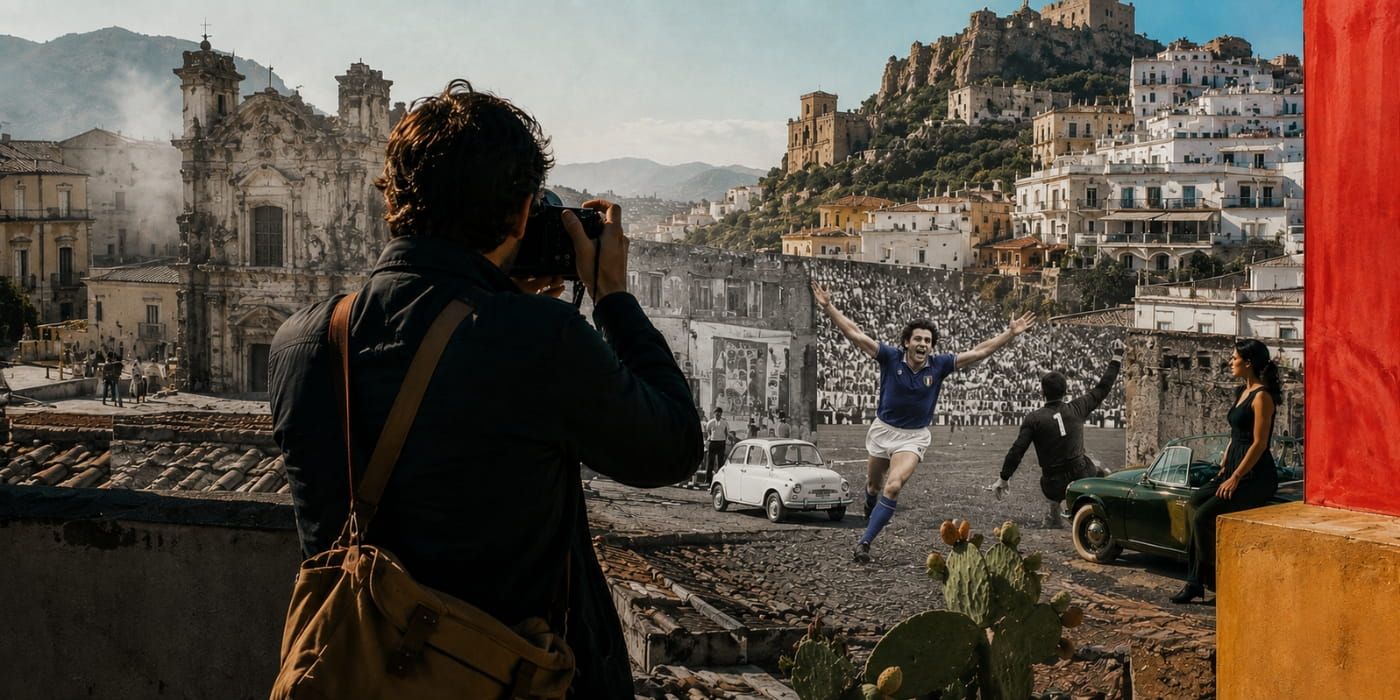

The Italy everyone recognises – Mediterranean yet restless, elegant yet strongly popular, cinematic yet real – has been captured in a series of iconic images. Snapped on busy streets, amid the chaos of battlefields, or on the edge of a football match, these photographs freeze wildly different moments and lift them into collective memory.
1980s Sicily, Milan’s turbulent Years of Lead, postwar Abruzzo, a paparazzi-crowded Mediterranean island: the following images chronicle a nation in flux, seen through the lenses of photography’s most revered icons.

Iconic Italy Images: 7 Photographs That Made History
We have selected 7 photographs whose stories go far beyond their immediate subjects. They are shards of memory, images potent enough to conjure entire eras. Even decades later, they speak volumes about the kind of country Italy used to be.
Now housed in the world’s most prestigious museums and gracing the pages of renowned magazines, these shots have become a visual treasury, opening a window onto all of Italy: the breathtaking and the mundane, the postcard vistas and the moments we rarely talk about.
Before we dive into the stories behind Italy’s iconic images, here’s a roadmap of our journey and its protagonists:
. Robert Capa — Sicilian Peasant Telling an American Officer Which Way the Germans Had Gone, 1943: Sicily seen through the eyes of war.
. Marcello Geppetti — Liz Taylor and Richard Burton’s Kiss, Ischia, 1962: the portrait of paparazzi Italy.
. Henri Cartier-Bresson — Scanno, 1951: a town captured in the rhythms of everyday life.
. Paolo Pedrizzetti — Milan, May 14, 1977: a photograph that became a defining image of Italy’s Years of Lead.
. Cesare Galimberti — Italy’s Most Famous Card Game, 1982: the iconic image of Italy’s victory at the 1982 World Cup.
. Ferdinando Scianna — the Dolce & Gabbana campaign in 1987: Sicily transformed into a language of fashion.
. Franco Fontana — Landscape, Puglia, 1987: Italy reduced to pure geometry and colour.
Related story - The landscapes that inspired famous paintings
7. Robert Capa and the War That Came Down a Country Road
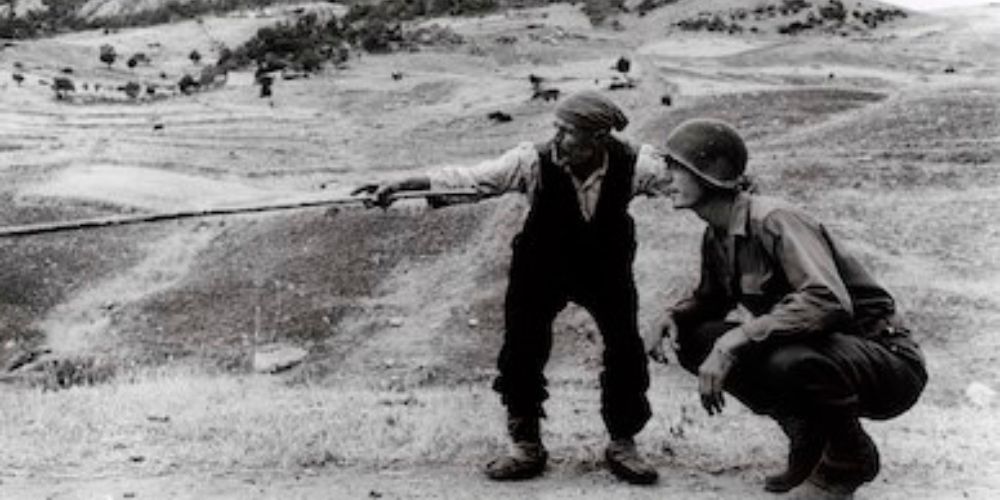
A man points the way. In front of him, a crouching American soldier listens. It’s Sicily, August 1943, at the height of the Allied advance. Robert Capa took this photograph near Troina during the Sicilian campaign.
Its original title reads almost like a newspaper caption: Sicilian Peasant Telling an American Officer Which Way the Germans Had Gone. Capa puts the focus not on the battle itself, but on the people who, caught up in war, had no choice but to move through it.
Troina, a medieval town in the heart of the Nebrodi Mountains, is now home to the Robert Capa Museum of Photography, housed in the Palazzo Pretura. Its collection, Fragments of War in Sicily, brings together 62 prints, many of them previously unpublished and made from the original negatives, documenting the Sicilian campaign and its civilian population.
While in Sicily, Capa would also cross paths with a future literary giant: Andrea Camilleri. The creator of Inspector Montalbano novels, then just a boy, recalled encountering the photographer among the ruins of the Valley of the Temples. Capa was hunting for the perfect angle on the Temple of Concordia when Allied and Axis planes clashed overhead. Once the danger had passed, the two introduced themselves by scribbling their names on a scrap of paper.
Visit Vally of the Temples in Sicily6. Liz Taylor and the Kiss The World Was Waiting For
On June 18, 1962, Marcello Geppetti did what no other photographer could: he caught Elizabeth Taylor and Richard Burton locked in a kiss aboard a speedboat, just off Ischia.
The pair, in Italy for the filming of Cleopatra, were already the talk of Hollywood – their romance, still shrouded in secrecy, had ignited one of cinema’s great scandals. Geppetti, the legendary paparazzo of Rome’s Dolce Vita, snagged the image every lens in Italy was chasing.
Burton, desperate to keep it under wraps, reportedly offered Geppetti 12 million lire to bury the negative. Geppetti refused. The photograph became an icon of paparazzi history, so celebrated that the University of Pennsylvania later named it among the most famous images of Pop Art, placing Geppetti alongside Andy Warhol and Cecil Beaton.
In 1997, David Schonauer, then editor of American Photo, called Geppetti “the most underrated photographer in history.” In 2010, the New York Post crowned this very image the most legendary paparazzi photo of all time.
5. Henri Cartier-Bresson in Abruzzo and An Italy Still Out of Focus
In December 1951, Henri Cartier-Bresson travelled to Scanno, a remote mountain village in Abruzzo, to capture Christmas as it unfolded far from the Italy of the coming economic boom.
Through his camera, he immortalised villagers moving through narrow lanes, women dressed in black, children at play, and scenes of everyday life, never staging or bending reality into folklore.
His reportage offered an unfiltered glimpse of a community, seen with the direct and discreet eye that made Cartier-Bresson a legend of international photojournalism.
These photographs would help shape the image of southern Italy as a land unspoiled and suspended in time.
Today, his shots from Scanno are held in the collections of major institutions, including New York’s MoMA.
4. The Defining Image of Italy’s Years of Lead
Milan, May 14, 1977. What began as a protest on Via De Amicis erupted into a gunfight with police.
Paolo Pedrizzetti was on the scene, camera in hand, when a masked youth materialised in his lens, pistol raised, aimed squarely at the advancing officers. That young man was Giuseppe Memeo, a militant of Autonomia Operaia.
Moments later, deputy police officer Antonio Custra is shot. He dies the following day. Pedrizzetti’s photograph, published in newspapers in the days that followed, became one of the defining images of political violence in Italy during the 1970s.
Memeo would be convicted for his role in the clashes, but not for Custra’s death. Years later, the courts determined the fatal shot had been fired by Mario Ferrandi.
3. The 1982 World Cup Card Game
The World Cup had ended, but the game wasn’t over – not for Italy. On the presidential DC-9 flying home from Madrid, a deck of cards and the gleaming World Cup trophy crowded the table.
Four unlikely companions gathered around it: President Sandro Pertini, coach Enzo Bearzot, captain Dino Zoff, and Franco Causio.
It was July 12, 1982, the morning after Italy's triumph over the West Germany team. Cesare Galimberti was there, camera poised, to capture what would become one of Italian sport’s most iconic images: a game of scopone scientifico, with Pertini and Zoff facing Bearzot and Causio.
The match even had a twist ending: Causio later confessed that he’d tricked Pertini by slipping in a seven, which the president missed, letting Bearzot claim the settebello, the prized seven of coins. Years down the line, Zoff would confirm the tale.
The photograph would go on to become one of the pop symbols of Italy: a World Cup victory distilled into four men, a deck of cards and a moment of unmistakable Italian spontaneity.
Related story - 10 stadium in Italy to know
2. 1980s Sicily: When Fashion Met Photojournalism
When Domenico Dolce and Stefano Gabbana approached him in 1987, Ferdinando Scianna had never worked in fashion photography. He was a Magnum photojournalist, accustomed to documenting people, stories and events. The two designers asked him to photograph their clothes in Sicily.
Scianna, a Bagheria native, agreed. He brought Marpessa, the Dutch model destined to become a Dolce&Gabbana muse, through alleyways and sun-bleached landscapes, weaving the designers’ clothes into the everyday rhythms and textures of Sicilian life.
The resulting photographs for the Fall/Winter and Spring/Summer 1987 catalogues blurred the line between fashion and reportage. First came Bagheria, Porticello and Palermo; then Modica, Ragusa Ibla, Caltagirone and Aci Trezza became protagonists of a new visual identity.
The campaign marked a turning point in fashion photography. Scianna would later recall how convincing the images were, so much so that many believed Marpessa, Dutch by birth and Surinamese by heritage, was herself Sicilian.
Realed story - 20 iconic Italian brands
1. Franco Fontana and Puglia Turned Into Geometry
In 1970, Franco Fontana set off for Puglia with a group of friends. Near Baia delle Zagare, a stretch of coastline the New York Times once called “one of the most beautiful in the world”, they began taking photographs. For Fontana, it took just a single frame to capture what would become one of his most celebrated images.
As he later wrote in his book Fotografia Creativa (2016), “It was taken on the Gargano, but it doesn’t portray the Puglian coast. It’s an archetype, an absolute landscape, detached from geographic reality”.
At a time when fine art photography was still dominated by black and white, Fontana made color his signature, searching the landscape for form, contrast, and chromatic relationships above all else.
The image found its way into his 1978 collection, Skyline, and was later chosen by France’s Ministry of Culture for a communications campaign distributed to embassies and consulates worldwide. Today, it resides in the collections of museums across the globe.
Related story - The best Puglia beaches for 2026
The Iconic Italy Images - FAQs
What are Italy's most iconic images?
Among the most iconic images of Italy are Robert Capa’s wartime shots in Sicily, Henri Cartier-Bresson’s evocative street scenes, the photograph of Italy’s president, the legendary card game aboard the presidential plane after the 1982 World Cup victory, Ferdinando Scianna’s campaign for Dolce&Gabbana, and Franco Fontana’s scenes of Puglia.
Why Are These Places Famous?
Some of these places became part of the Italian imagination through the photographs taken there. Ischia, for example, became inseparable from the glamorous world of the Dolce Vita after Marcello Geppetti photographed Elizabeth Taylor and Richard Burton there. Sicily acquired an equally strong visual identity through the work of Ferdinando Scianna. Other places, such as Milan, are remembered through photographs that captured a particular moment in Italy’s history. All these images helped turn specific places into familiar and lasting symbols of parts of Italy's history.
Where Were Italy’s Most Famous Photos Taken?
The photographs featured in this article were taken in different parts of the country: Sicily; Abruzzo; Campania; Milan; Puglia; and aboard the presidential plane carrying the Italian national soccer team home after the 1982 World Cup.
About the author
Written on 06/08/2026
Lorena Calise
I'm a content writer for magazines and websites. I also explore Italy through my writing for Visit Italy and Visit Naples.

Lorena Calise
War, cinema, fashion, football, landscapes: 7 photographs to tell the story of Italy through moments frozen in time.