
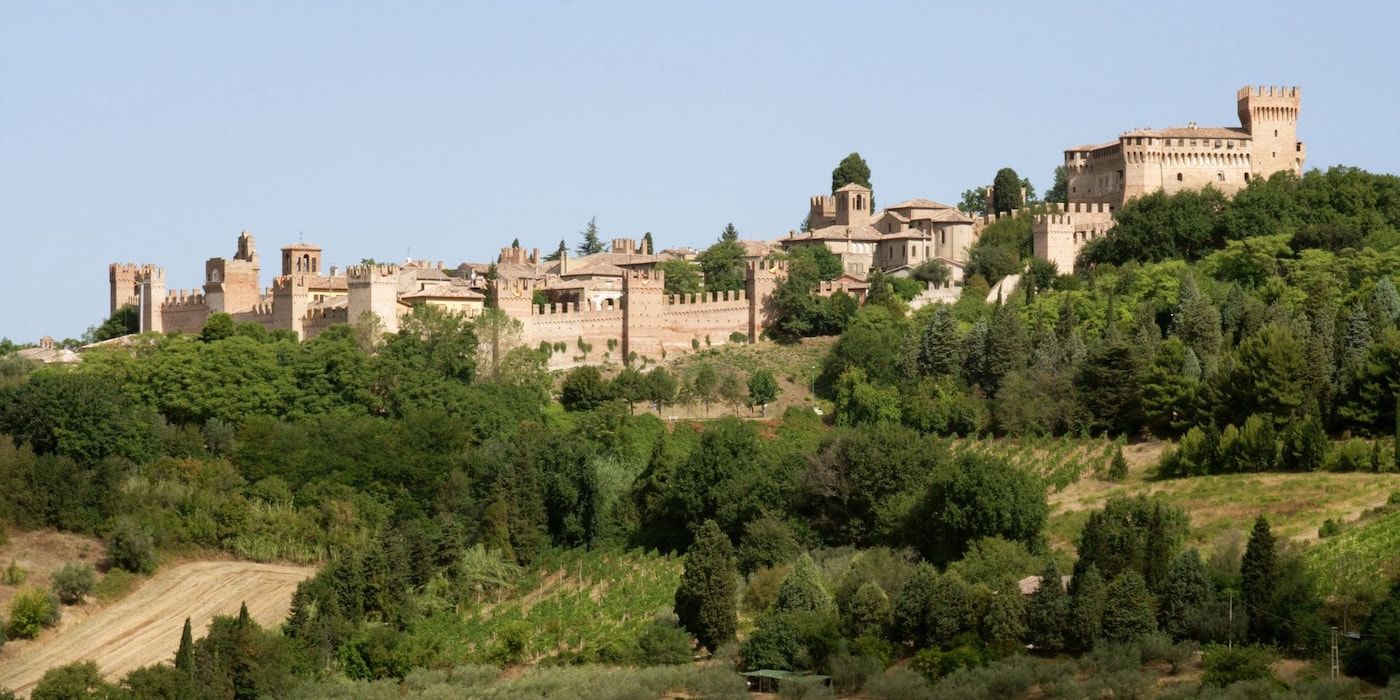

Among the rolling hills of the Pesaro and Urbino province, castles and fortresses reveal a landscape that still bears the marks of the major events that shaped its history.
Built to defend borders, control key routes, and showcase the power of the ruling dynasties that followed one another over the centuries, these strongholds are now the highlights of a unique journey through architecture, heritage, and beauty.
This itinerary invites travelers to see these ancient structures not simply as extraordinary historical landmarks, but as places that reveal the character of a land shaped by encounters, conquests, and transformations. A route through fortified walls, hilltop villages, and landscapes that preserve Le Marche’s unique heritage, with a past that remains deeply relevant today.
From Gradara to Urbino: a 7-stop itinerary through castles and fortresses of Le Marche
🥇 Visit Italy’s brand partnership
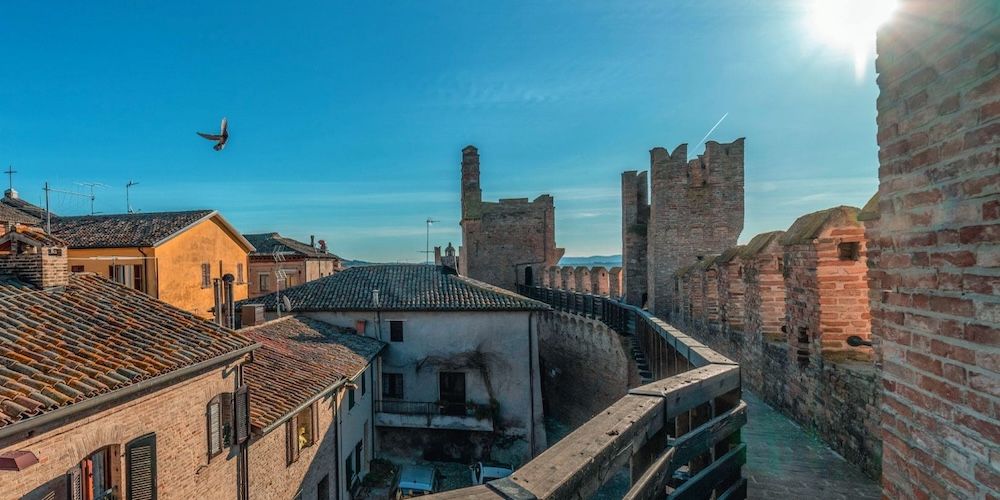
Image by itinerariodellabellezza.it
Le Marche is home to some of Italy’s most spectacular fortresses. This itinerary connects seven of them, following a route through castles and fortified towns across the province of Pesaro e Urbino.
The first stop is Gradara, a remarkable fortified village listed among Italy’s Most Beautiful Villages. Its impressive medieval walls, the Rocca overlooking the town, and the legendary story of Paolo and Francesca make it the perfect starting point to enter the fascinating world of Le Marche’s fortifications.
Monte Cerignone, Sassocorvaro Auditore, Piobbico, Cagli, and Mondavio add different layers to our itinerary, taking us through hilltop villages, imposing walls, and breathtaking views stretching across the surrounding countryside.
The final stop is Urbino, where the power of defensive architecture gives way to the elegance of the Renaissance. The Ducal Palace, the historic streets, and the legacy of Federico da Montefeltro provide the perfect conclusion to the route.
Traveling by car is the best way to fully embrace this adventure: it gives us the freedom to follow scenic roads, reach tucked-away villages, and pause along the way to admire breathtaking views and unexpected discoveries.
Because, on this itinerary through castles and fortresses, even the journey between one stop and the next becomes an unforgettable part of the discovery itself.
Discover more about itineraries in Le MarcheStop 1. Gradara, the gateway to the castles and fortresses of Le Marche
🥇 Visit Italy’s brand partnership
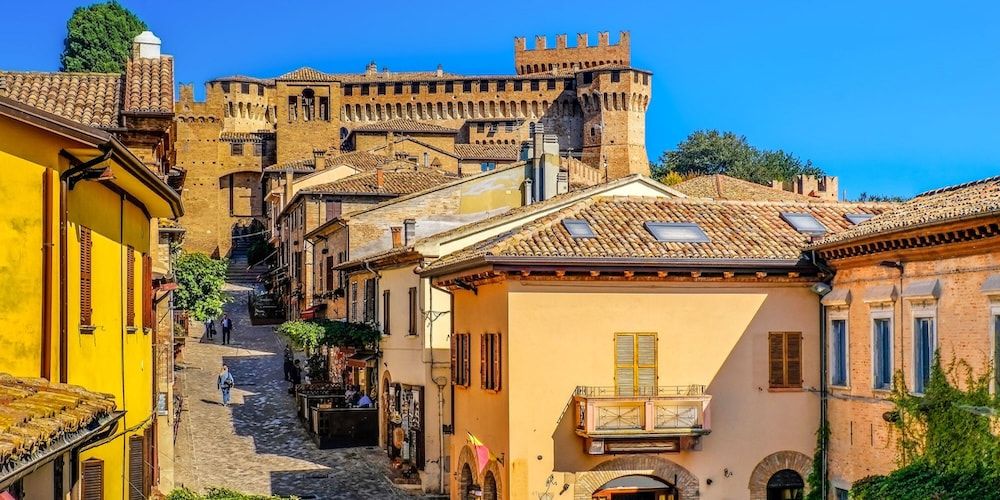
Our itinerary through the fortresses and castles of Le Marche begins in Gradara. Just a few kilometers from the Adriatic Sea and on the border with Romagna, this extraordinary fortified village, considered one of the most beautiful and fascinating in Italy, seems to preserve another era. Crossing the ancient Clock Gate and walking up toward the Rocca, visitors are immersed in an authentic medieval atmosphere.
The Rocca dominates the village with its imposing tower. Originally built as a defensive structure, over the centuries it was transformed into an elegant noble residence: beyond its walls, visitors can explore refined rooms decorated with frescoes, historic furnishings, and works of art that reveal the life of the court.
According to tradition, the tragic story of Paolo and Francesca unfolded within the rooms of the Rocca, a tale immortalized by Dante in Canto V of the Inferno. Today, the visit also includes the chance to discover Francesca’s Room, where history and legend continue to intertwine.
Beyond the castle, it is worth taking time to explore the streets of Gradara, where ceramic workshops, small taverns, and views framed by the medieval walls preserve the atmosphere of a village from another time. For those who enjoy a walk surrounded by nature, the Lovers’ Path completes the visit with views stretching across the hills and toward the Adriatic Sea.
How to get to Gradara?
Gradara is located in the northern part of Le Marche, just a few kilometers from Cattolica and the Adriatic coast.
By car, it's easily reached from the A14 motorway, taking the Cattolica–San Giovanni–Gabicce Mare exit (about 30 minutes from Rimini and approximately 1 hour and 40 minutes from Bologna).
By train, the closest reference station is Cattolica–Gabicce, which is connected to the main cities along the Adriatic coast.
What to see and do in Gradara:
- Rocca di Gradara;
- Medieval historic center;
- Lovers’ Path.
Stop 2. Monte Cerignone: the Renaissance Rocca among the hills of Montefeltro
🥇 Visit Italy’s brand partnership
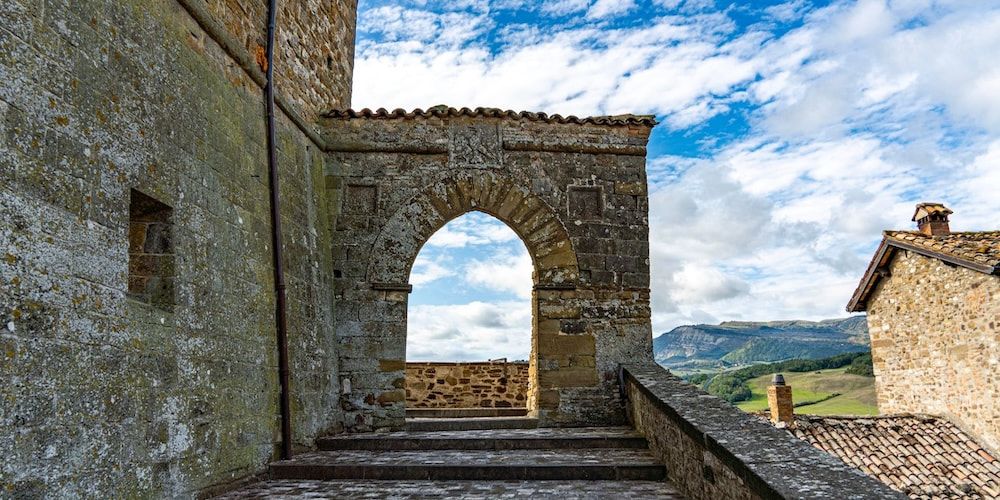
Image from itinerariodellabellezza.it
Leaving Gradara behind, we head inland into the heart of Montefeltro, reaching Monte Cerignone, a small village nestled in the Alta Val Conca area.
The Rocca of Monte Cerignone preserves the marks of different historical periods. Its origins date back to the Middle Ages, when it served to control a strategic position in the valley. In the 15th century, under the rule of the Montefeltro family, it was expanded and transformed according to the new principles of Renaissance architecture, with interventions attributed to Francesco di Giorgio Martini.
The uniqueness of the Rocca lies in its dual nature: a structure designed for defense, yet also a place intended for the daily life of the lords who inhabited it. Today, visitors can still admire the traces of its transformation from a military stronghold into a noble residence, following the evolution of a charming village that grew around its fortification.
To complete the discovery of Monte Cerignone, we explore the streets and small squares of the historic center, with their charming stone architecture and churches such as Santa Caterina and Santa Maria del Soccorso, which preserve important artistic treasures.
Before leaving the village, we reach the upper part of the settlement to admire the landscape of the Alta Val Conca, with green hills, mountain profiles, and views that reveal the peaceful beauty of the Marche countryside.
How to get to Monte Cerignone from Gradara?
By car, the route from Gradara is almost 40 km and takes around 45 minutes. The journey follows the Conca Valley along the SP17 and SP18 roads, then continues past Mercatino Conca on the SP2 until reaching the destination.
What to see and do in Monte Cerignone:
- Rocca di Monte Cerignone;
- Historic center.
Stop 3. Sassocorvaro Auditore and the mysterious Rocca Ubaldinesca
🥇 Visit Italy’s brand partnership
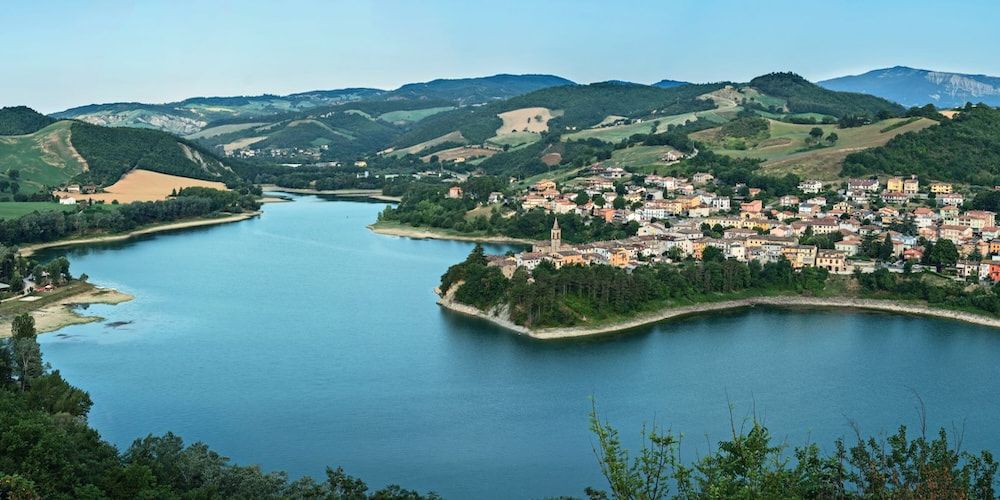
Castles and fortresses of Le Marche: Sassocorvaro Auditore, image by itinerariodellabellezza.it
Some fortresses impress visitors with their imposing appearance. The Rocca Ubaldinesca of Sassocorvaro, however, surprises because of what it hides. Seen from above, its layout reveals the shape of a turtle, a design filled with symbolic meanings and representing one of the most fascinating chapters of Renaissance architecture.
We are in Sassocorvaro Auditore, a Montefeltro village overlooking Lake Mercatale, whose most recognizable landmark is undoubtedly the Rocca.
Built in the second half of the 15th century based on a design by Francesco di Giorgio Martini for Ottaviano degli Ubaldini, it was a truly innovative fortress for its time. Its rounded forms, created to withstand the impact of early artillery, revolutionized the principles of military architecture.
At the same time, the building reflects the personality of its patron, who was passionate about astrology, alchemy, and esotericism. For him, the Rocca was more than a fortress: it was a true book of stone, where architecture, decorations, and symbols expressed his vision of the world through a language rich in meanings and mysterious messages.
Before leaving, take some time to stroll through Sassocorvaro Auditore and reach the shores of Lake Mercatale. The contrast between the silhouette of the Rocca, the waters of the lake, and the surrounding hills creates one of the most evocative landscapes along our itinerary.
How to get to Sassocorvaro Auditore from Monte Cerignone?
The drive from Monte Cerignone is around 15 km and takes approximately 20 minutes. The route crosses the Montefeltro landscape towards Mercatale, following the shores of the lake and its dam before reaching Sassocorvaro Auditore.
What to see and do in Sassocorvaro Auditore:
- Rocca Ubaldinesca;
- Historic center;
- Lake Mercatale.
Stop 4. Piobbico: Brancaleoni Castle and the wild nature of the Apennines
🥇 Visit Italy’s brand partnership
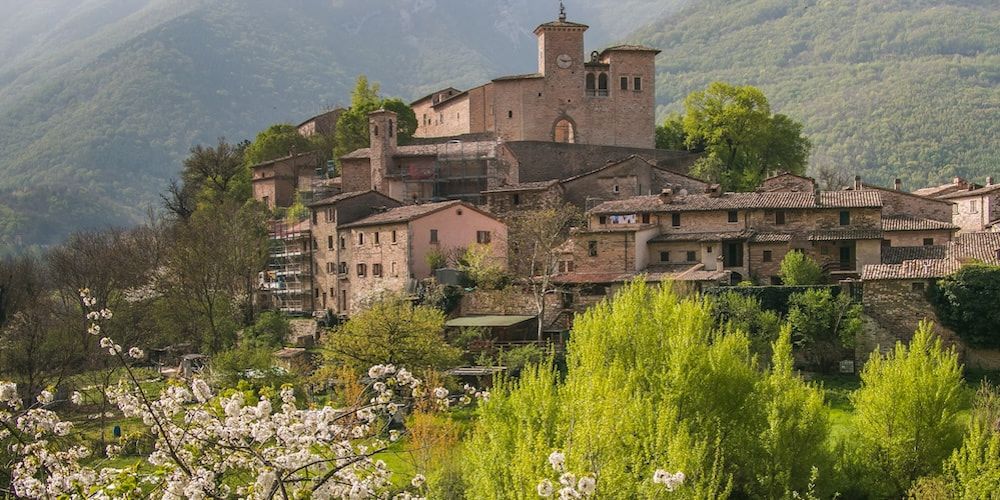
Between Mount Nerone and Mount Montiego, Piobbico appears almost hidden among the hills of the Marche Apennines. The landscape is the first thing that catches our attention: woods, mountains, and valleys surround a small village, with Brancaleoni Castle standing just steps from the heart of town.
More than a simple fortification, the castle reveals the evolution of a residence whose halls and courtyards tell the story of the prestige of the Brancaleoni family, who ruled Piobbico for a long time, transforming it into a place of power, culture, and court life.
Behind the walls are a succession of grand rooms, noble apartments, and richly decorated chambers, such as the beautiful Sala del Leon d’Oro and the Camera Romana. Walking through these rooms, we can retrace the history of the Brancaleoni through inscriptions in Greek, Latin, and the vernacular carved above portals and windows.
Among the most curious details is the ancient tower clock: on the side facing the village it shows a traditional clock face, while on the inner side the numbers are reversed and the hands move counterclockwise.
Before leaving Piobbico, let's take some time to stroll through the stone houses, charming corners of the town, and the silhouette of Mount Nerone on the horizon accompany our walk through the village, leaving us with one of the most evocative landscapes of the Central Apennines.
How to get to Piobbico from Sassocorvaro Auditore?
From Sassocorvaro Auditore, the drive is about 40 km and takes a little over 40 minutes. The route crosses the Marche countryside toward Urbania, then follows the Candigliano Valley to Piobbico, at the foot of Mount Nerone.
What to see and do in Piobbico:
- Brancaleoni Castle;
- Historic center.
Stop 5. Cagli: the Martiniano Tower and the secrets of a fortress city
🥇 Visit Italy’s brand partnership
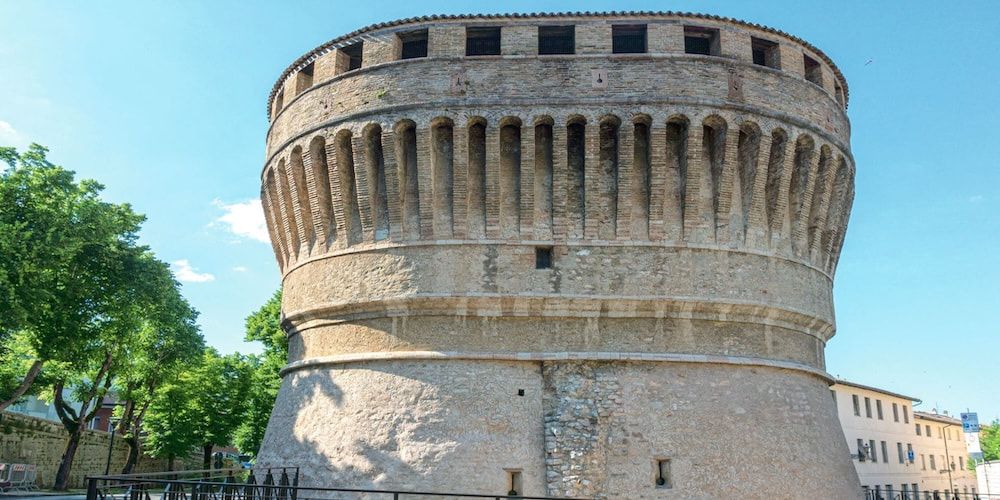
Image from itinerariodellabellezza.it
Cagli tells a different story compared to the other stops on our itinerary through the castles and fortresses of the Marche region. Here, the fortress has not survived intact over the centuries, but its legacy lives on in the Martiniano Tower, built in the 15th century based on a design by Francesco di Giorgio Martini.
A symbol of the city’s ancient defenses, the tower remains connected to the old fortress, now disappeared and replaced by the Capuchin Monastery, through the Soccorso coverto, a true hidden surprise beneath the stone. This ancient and fascinating underground passage, made up of 367 steps, allowed defenders to reach the fortress in case of need.
The Martiniano Tower also connects the past with the present, as it is home to the Contemporary Sculpture Center, established in the 1990s to transform the spaces of the fortification into a venue dedicated to art.
From the top of the tower, we can admire the village below, its orderly Roman-era urban layout, its squares, historic buildings, and the many churches that preserve important works of art, such as the Tiranni Chapel inside the Church of San Domenico, a masterpiece by Giovanni Santi, father of Raphael.
How to get to Cagli from Piobbico?
From Piobbico, the drive is about 25 km and takes just under half an hour. Follow the Candigliano Valley toward Acqualagna, then turn right onto the SS3 and reach Cagli after a few kilometers.
What to see and do in Cagli:
- Martiniano Tower;
- Soccorso coverto;
- Contemporary Sculpture Center;
- Views over the village.
Stop 6. Mondavio: living the Renaissance at the Rocca Roveresca
🥇 Visit Italy’s brand partnership
The penultimate stop of our journey through the fortified villages of the Marche region brings us to Mondavio, one of Italy’s Most Beautiful Villages and a recipient of the Orange Flag from the Italian Touring Club, nestled among the hills of the Pesaro hinterland. Here, time seems to have stood still: the town walls, the streets of the historic center and the Rocca Roveresca reveal the Renaissance identity of the village.
Commissioned by Giovanni della Rovere, a member of one of the most powerful families of the Italian Renaissance and lord of Mondavio from 1474, this fortress was built between 1482 and 1492, with a massive polygonal keep, corner towers and spaces arranged around the inner courtyard.
What makes the visit special is the way the Rocca immerses visitors in the military life of the past. Inside, you will find the Historical Reenactment Museum, which recreates rooms and scenes from life in a Renaissance fortress, and the Armory, with its fascinating collection of weapons, armor and war machines such as catapults and siege towers.
The presence of the ancient fortress can also be felt in the streets of Mondavio, where Renaissance history has left its mark on the buildings surrounding the town squares. Here, we discover another side of the village, quieter yet equally fascinating, with the Apollo Theatre, an 18th-century gem housed in the former Church of San Filippo Neri and featuring a still-functioning movable floor.
How to get from Cagli to Mondavio?
There are two options to reach Mondavio from Cagli: drive towards Fossombrone and take the SP49 after the Serrungarina exit. Mondavio is just beyond the village of Orciano di Pesaro. Alternatively, follow the SP424 from Cagli, passing through Pergola and San Lorenzo in Campo, and arrive after about 45 minutes (40 km).
What to see and do in Mondavio:
- Rocca Roveresca;
- Historical Reenactment Museum and Armory;
- Apollo Theatre.
Urbino: the grand finale in the land of the Montefeltro
🥇 Visit Italy’s brand partnership
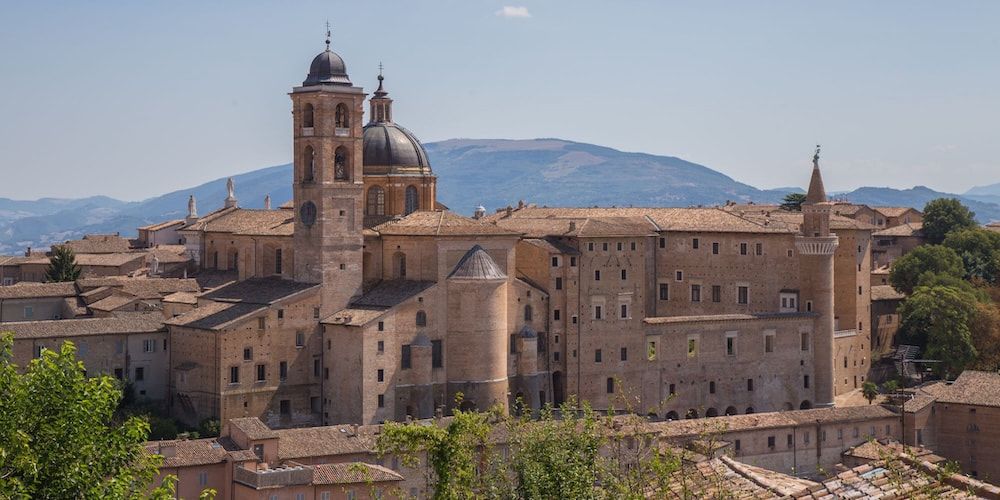
In Urbino, the history of the castles and fortresses of the Marche reaches the height of Renaissance splendor. This is also why it represents the perfect conclusion to our journey.
Nestled among green hills, Urbino preserves the legacy of the Montefeltro family, who in the 15th century transformed the ancient fortified town into one of Europe’s great cultural capitals. At the heart of this transformation stands the Ducal Palace, commissioned by Federico da Montefeltro as a symbol of his power and humanistic vision.
The palace became one of the most refined courts of its time, a place where architecture, art, and knowledge came together. Today it houses the National Gallery of the Marche, with masterpieces by artists such as Piero della Francesca and Raphael, who was born in Urbino. Nearby, we can visit Raphael’s Birthplace, now a museum dedicated to the memory of the great painter.
The city’s ancient defenses are also part of this story. Climbing up to the Albornoz Fortress, we reach one of Urbino’s most scenic viewpoints: built in the 14th century on Mount San Sergio and now surrounded by the Parco della Resistenza, it offers a privileged view over the city and the hills of Montefeltro.
It’s the perfect place to pause for a moment and say goodbye to this extraordinary land, which has accompanied us throughout our beauty route among the castles and fortresses of the province of Pesaro and Urbino.
How to get to Urbino from Mondavio?
From Mondavio to Urbino, the drive is about 40 km and takes approximately 45 minutes. We cross the hills of the Pesaro hinterland, passing through Fossombrone, Canavaccio, and Calpino.
What to see and do in Urbino:
- Ducal Palace and National Gallery of the Marche;
- Raphael’s Birthplace;
- Albornoz Fortress.
About the author
Written on 07/09/2026
Alessandro Savino
SEO Copywriter & web editor: I love transforming my passion for writing into engaging narratives, creatively and precisely exploring the beauty and complexity of our wonderful country.

Alessandro Savino
Explore the castles and fortresses of the Pesaro e Urbino area, on an itinerary through centuries of history that have shaped the soul of Le Marche.