
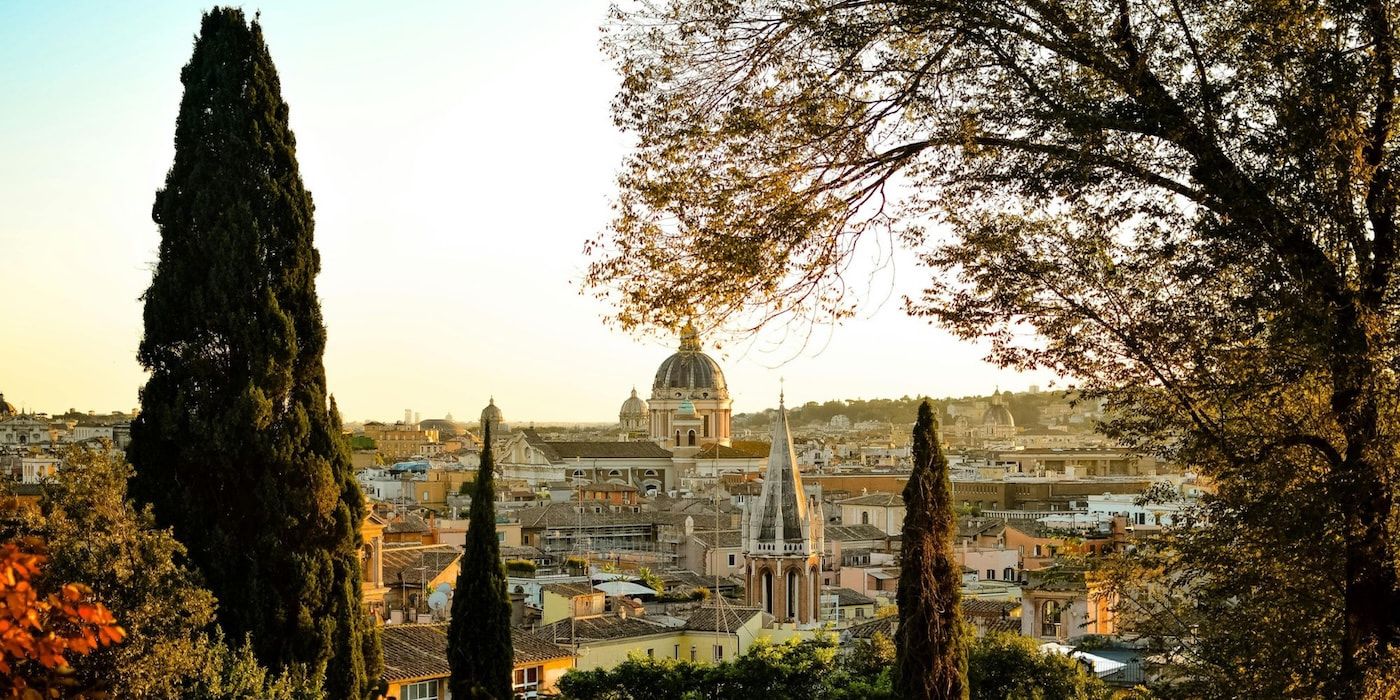

Via Francigena, especially along the stretch leading to Rome, still preserves a rare atmosphere today. It's a slow walk shaped by forests that guard ancient legends, volcanic lakes pulsing with energy, and abbeys where the echo of medieval prayers seems to challenge time itself.
From Radicofani to the Eternal City, this 10-stage itinerary crosses some of the most spiritual places in Central Italy, following the rhythm of the medieval pilgrimage route.
Among white roads, isolated parish churches, and the ever-changing landscapes of Tuscia, prepare to experience a journey that goes far beyond a simple walking trail, becoming instead an inner path shaped by contemplation, effort, and wonder.
Sacred places along Via Francigena: the Spiritual Path to Rome
🥇 Visit Italy’s brand partnership
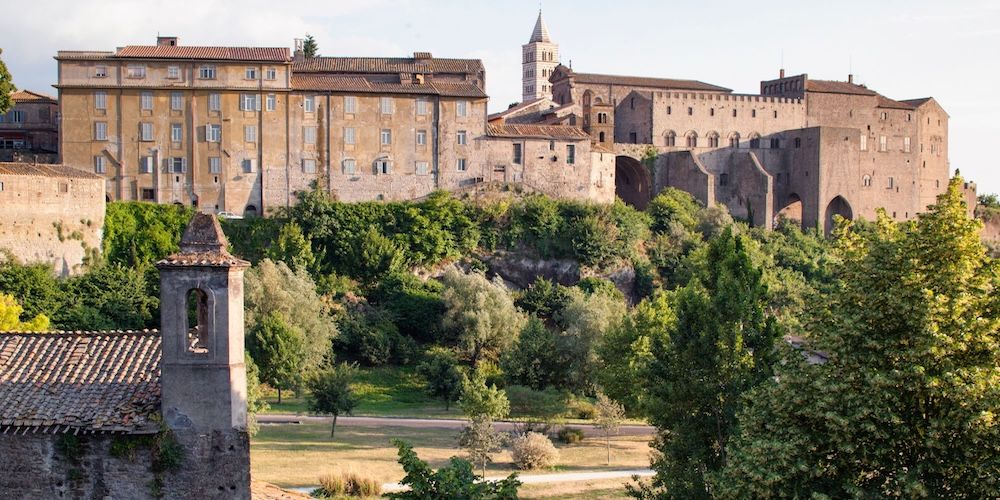
This part of Via Francigena, leading to Rome through Tuscany’s Tuscia region and Lazio, follows one of spiritual routes of the medieval European pilgrimage tradition.
Our journey begins in Radicofani, on the Tuscan border, and unfolds across a well-structured 10-stage itinerary, walkable on foot or by bicycle, with daily distances ranging from approximately 16 to 26 km. It’s a route that blends historic villages, the rural landscapes of Tuscia, and sacred sites that have guided pilgrims toward the Eternal City for centuries.
Along the way, you'll encounter some unique spiritual landmarks in central Italy, often accessible through short detours that enrich your experience: the Basilica of the Holy Sepulchre in Acquapendente, the Rocca dei Papi in Montefiascone, the Madonna del Parto, and the sacred sites within Veio Regional Park on the approach to Rome, among many others.
The moment of reaching the Capital carries a magic significance: it marks the historical conclusion of the European pilgrimage along Via Francigena, the traditional final destination for countless pilgrims journeying toward St. Peter’s.
Must-see sacred sites along the route:
- Acquapendente: Basilica of the Holy Sepulchre;
- Bolsena: Basilica of Santa Cristina;
- Montefiascone: Rocca dei Papi;
- Viterbo: Papal Palace;
- Sutri: Church of the Madonna del Parto;
- La Storta (north Rome): Sanctuary of the Vision of Saint Ignatius of Loyola;
- Rome: St. Peter’s Basilica (final destination of the medieval pilgrimage).
Discover more about Via FrancigenaThe spiritual essence of Via Francigena: ancient history and contemporary pilgrimage
Via Francigena was one of the great medieval pilgrimage routes connecting Northern Europe to Rome, made famous by Archbishop Sigeric’s diary, which recorded the stages of his return journey from the Eternal City at the end of the 10th century. It was a path of faith and hardship, lined with monasteries and sacred sites that sheltered pilgrims on their way to St. Peter’s tomb.
Today, that ancient route still preserves its spiritual dimension while embracing more contemporary meanings. Beyond its religious significance, Via Francigena offers an inner experience, an opportunity to slow down, step away from the pressures of daily life, and reconnect with a more authentic sense of self.
The abbeys and sanctuaries that appear along the way continue to shape the journey as places of contemplation, memory, and reflection, turning each stage into something far deeper than a simple crossing of landscapes.
It’s within this continuity between past and present that you can discover the truest and most distinctive essence of the Via Francigena in Italy — a route to follow, but also a deeply personal journey of reflection and transformation.
Listen to the podcast version of the article with the voice of Monna Lisa & Leonardo
Stage 1. Radicofani → Acquapendente: the symbolic threshold of pilgrimage
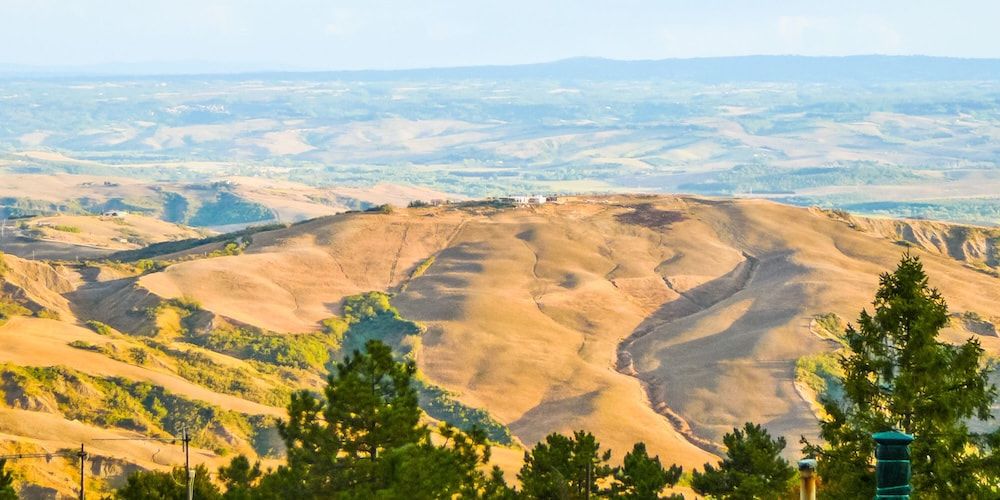
We start from Radicofani, a hilltop village dominated by its great medieval fortress, which for centuries has watched travelers crossing the Val d’Orcia along one of the historic routes of Via Francigena.
It’s during these 23 km of walking, among wind-swept hills and the first white roads descending toward Lazio, that you truly begin to feel detached from everyday life, while the landscape slowly seems to draw you into a quieter and lighter dimension.
The first stage to Acquapendente already carries something deeply meditative. Slowly, we make our way through open fields, wooded stretches, dirt roads, and long silent sections marked only by the sound of footsteps.
In Acquapendente we’ll find the Basilica of the Holy Sepulchre, with its crypt inspired by the Holy Sepulchre of Jerusalem, and we can sense the powerful atmosphere of a place that for centuries welcomed pilgrims traveling to Rome in search of faith, protection, or simply a pause from the outside world.
What to see and do:
- Radicofani Fortress and panoramic views over the Val d’Orcia;
- Historic stretches of the Via Francigena between Tuscany and Lazio;
- Basilica of the Holy Sepulchre in Acquapendente.
Stage 2. Acquapendente → Bolsena: the sacred lake of Via Francigena
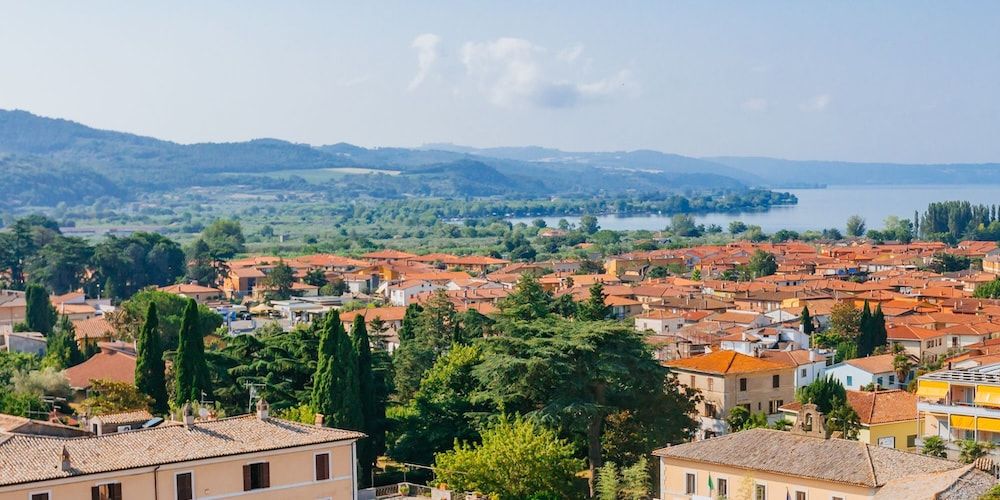
Let’s leave Acquapendente in the early morning hours and begin a second stage of about 23 km, moving through the quiet landscapes of Tuscia, among olive groves and volcanic countryside, heading toward Bolsena.
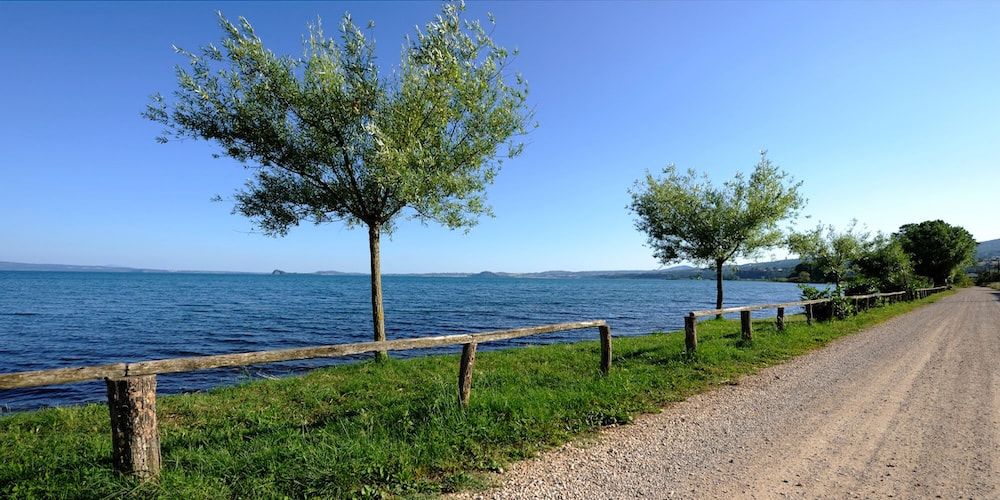
As the destination approaches, shortly after the small village of San Lorenzo Nuovo, the Lake of Bolsena suddenly appears. Its vast volcanic basin reveals one of the most striking views along the entire route, accompanying the final stretch of the stage and bringing a sense of almost hypnotic calm.
In Bolsena, the spirituality of Via Francigena becomes even more layered and intense. The Basilica of Santa Cristina stands on the site where, according to tradition, in 1263 a consecrated host is said to have bled during Mass, giving origin to the famous Eucharistic Miracle of Bolsena.
From here, we can descend into the crypt and the underground spaces, where early Christian catacombs, ancient columns, and the evocative Cave of Saint Christina.
What to see and do:
- Landscapes of the Tuscia countryside;
- Panoramic view over Lake Bolsena;
- Basilica of Santa Cristina.
Stage 3. Bolsena → Montefiascone: the slow ascent and the view over the lake
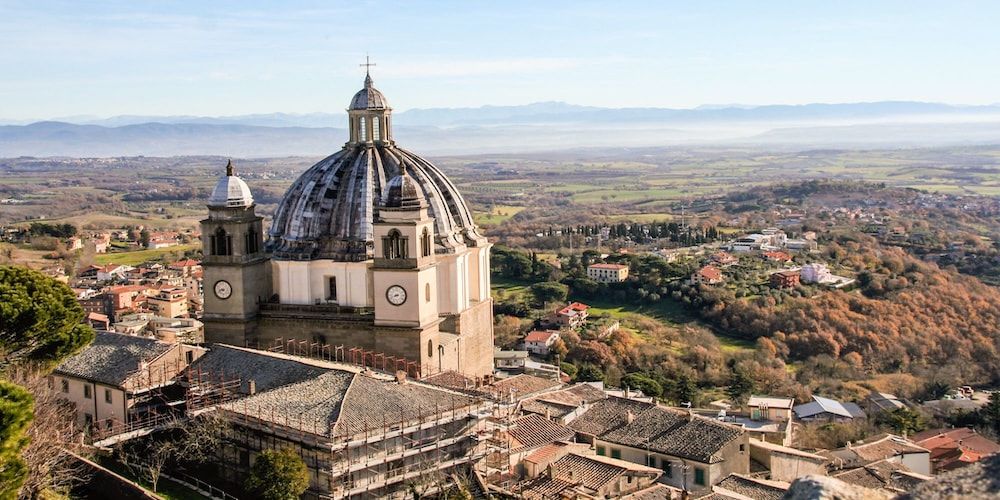
We continue to follow the shores of Lake Bolsena for a while before beginning a gradual ascent toward the hills of Tuscia. This is a stage of about 16 km, one of the shortest in the itinerary, yet also one of the most physically demanding and immersive.
We steadily climb along trails that slowly move away from the lake’s surface. At this point, our walking pace naturally slows down, and the journey becomes almost a form of moving meditation in the heart of nature.
When we finally reach Montefiascone, the lake reappears from above with a completely different and spectacular perspective, in a setting that, especially at sunset, feels truly idyllic.
At the top of the village, the Fortress of the Popes marks one of the most symbolic and fascinating points along Via Francigena in Lazio. Once a papal residence, it still dominates the landscape today and recalls the passage of medieval pilgrims heading toward Rome, who found here one of their last major stops before descending toward Viterbo.
What to see and do:
- Panoramic stretch along the ascent from Bolsena to Montefiascone;
- Views over Lake Bolsena from the Tuscia hills;
- Fortress of the Popes in Montefiascone.
Stage 4. Montefiascone → Viterbo: entering the city of the Popes
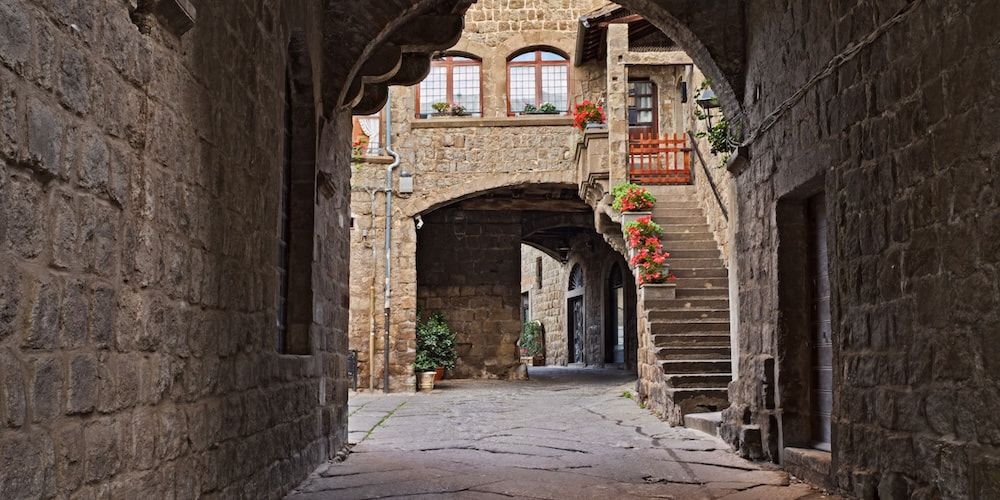
From Montefiascone, we gently descend along the hills of Tuscia on a 17 km stretch to Viterbo, passing from the environment of the lake to the more urban atmosphere of the Lazio section of Via Francigena.
The entrance into the city leads directly to one of the best-preserved medieval hearts in Italy: the San Pellegrino district, an enchanting maze of narrow alleys and ancient stone houses.
This area is particularly striking because it clearly shows Viterbo’s role as a key stop for medieval pilgrims. Everything here feels designed for those arriving on foot, from hospices to churches and resting points that still preserve a sense of welcome.
Inside the city, we also encounter the impressive Palace of the Popes complex, a symbol of papal power in the 13th century and the setting of major events in Church history, including the conclave held between 1268 and 1271, the first officially recognized papal election and the longest in history.
What to see and do:
- Descent from the Tuscia hills toward Viterbo;
- Viterbo: San Pellegrino district, Palace of the Popes.
Stage 5. Viterbo → Vetralla: the forests of Tuscia and hidden hermitages
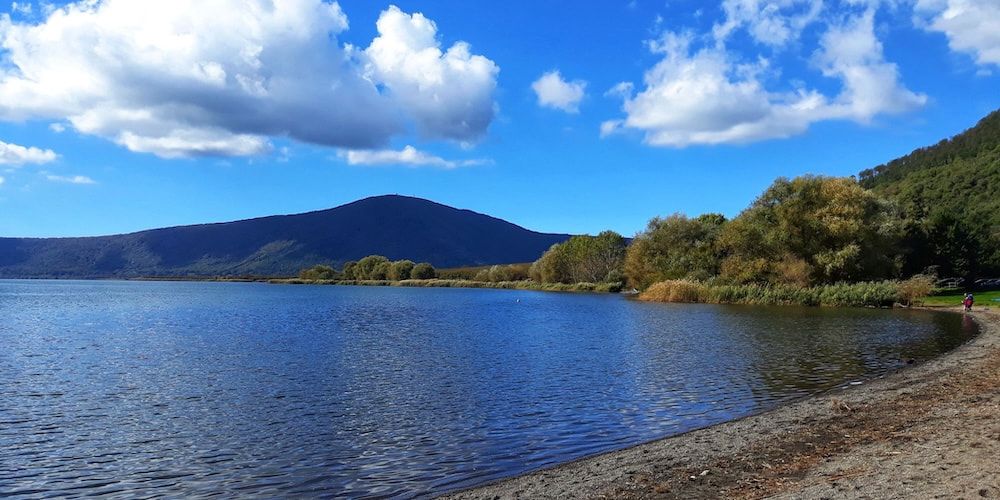
In this fifth stage we will walk about 22 km from Viterbo to Vetralla, following ancient paths carved into tuff stone and old volcanic-stone roads that cross the forests of Tuscia, an area that for centuries has attracted hermits and religious communities seeking solitude.
With a short detour toward the Lake Vico area, we can reach the Hermitage of San Girolamo, a small retreat set deep in the greenery of the Monte Fogliano beech forest. It is reached via a pleasant uphill trail that gradually leads into the woods.
Rather than the structure itself — a small space carved into the rock with a simple altar — what stands out is the atmosphere along the way. It is one of those places where you can truly experience a sense of spiritual isolation and contemplation.
Once in Vetralla, we enter a historic center that still preserves its medieval character, with alleys and churches tied to local tradition. This is also a section crossed by one of the historic segments of Via Francigena, where pilgrims once found hostels and rest points on their way toward the now near Rome.
Things to see and do:
- Tuscia forests;
- Hermitage of San Girolamo;
- Historic center of Vetralla.
Stage 6: Vetralla → Sutri: history emerging from the tuff stone
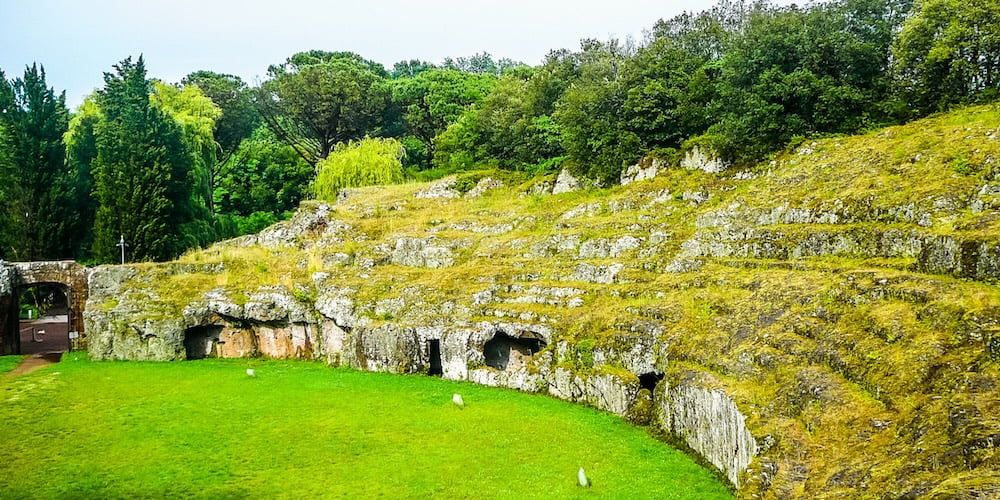
We leave behind the quiet forests of the Cimini Mountains and enter a landscape that slowly changes shape, as nature gives way to increasingly visible traces of ancient history.
Today’s walk covers about 24 km. A gentle route that leads us to one of the most striking places along the Lazio section of Via Francigena: the town of Sutri.
In Sutri, an extraordinary archaeological park awaits, including an Etruscan necropolis with underground tombs dating back to pre-Roman times, and a remarkable Roman amphitheater entirely carved into the tuff rock. Inside, you can still see the seating tiers where spectators once sat and the passages used to enter and move around the arena.
Not far away lies another essential stop: the Church of the Madonna del Parto, set inside an ancient rock-cut underground space. Over the centuries it was reused and transformed into a Christian place of worship, and today it still preserves beautiful frescoes and a uniquely evocative atmosphere.
What to see and do:
- Sutri: Etruscan necropolis, Roman amphitheatre, Church of the Madonna del Parto.
Stage 7. Sutri → Campagnano di Roma: the Treja Valley
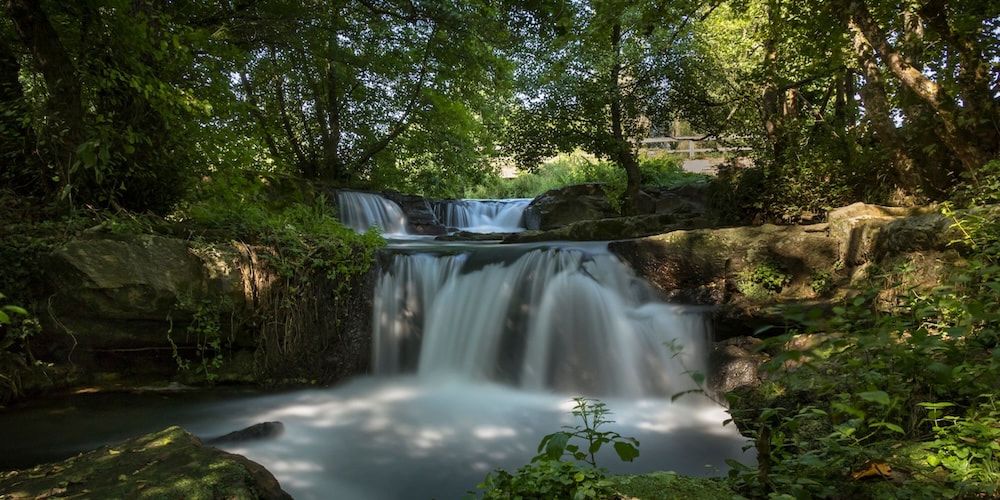
Departing from Sutri, we follow quiet country roads for a while. After a rather uneventful first stretch, we pass through the village of Monterosi and continue toward the Treja River valley until we reach the waterfalls of Monte Gelato.
The scenery here becomes far more captivating: water flows through small cascades, old mills, and dense vegetation, creating a surprisingly peaceful setting that feels especially fresh and restorative during the summer months. It’s the kind of place where it’s worth stopping for a while, taking off your backpack, and catching your breath.
Just north of the Treja Park, a short detour from the official Via Francigena route (23 km from Sutri to Campagnano di Roma), leads to the Hermitage of San Famiano, a secluded retreat that many pilgrims discover almost by chance in the heart of the woods.
The path leading there is not the easiest to access, but that’s part of the experience’s charm. All around, you hear only the sound of the river and the surrounding vegetation, while the small hermitage, simple and intimate, still preserves an atmosphere of authentic spirituality.
What to see and do:
- Monte Gelato waterfalls;
- Hermitage of San Famiano.
Stage 8. Campagnano di Roma → La Storta: Veio Park and St. Ignatius of Loyola
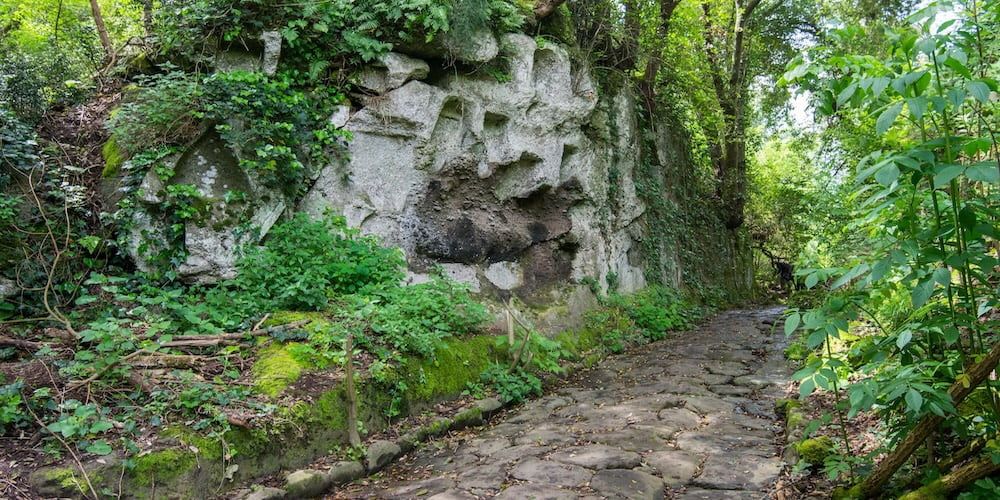
The roughly 23 km stage from Campagnano to La Storta takes us into Veio Park, a green stretch on the edge of Rome where nature and history blend together, among hedges, oak trees, and trails seemingly made for slow walking and for putting one’s thoughts in order.
Small archaeological sites and ancient Etruscan and Roman remains give the landscape an almost sacred depth, while panoramic viewpoints over the countryside and the muffled sound of the forest encourage reflection and quiet observation.
Just beyond Veio Park, we gradually enter the Roman outskirts. In La Storta, near the railway station, we find a discreet yet highly significant religious site: the Chapel of the Vision of St. Ignatius of Loyola. According to tradition, in 1537, while walking towards Rome, St. Ignatius had a vision here in which God pointed him toward Christ as his guide.
The episode deeply marked the founder of the Jesuits and turned La Storta into a spiritual landmark for pilgrims and travelers. Even today, this small chapel along the Via Cassia retains a quiet, intimate atmosphere, set in contrast to the traffic and urban expansion that now surround Rome.
What to see and do:
- Veio Park;
- Chapel of the Vision of St. Ignatius of Loyola.
Stage 9. La Storta → Rome: arrival at St. Peter’s
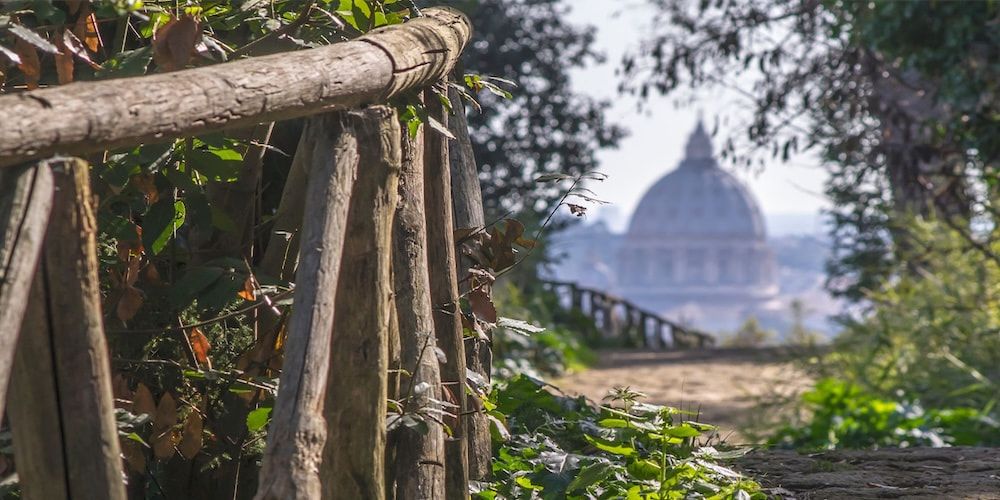
We are now at the gates of Rome, and following the ancient Via Cassia we reach the heart of the Capital.
This stage brings us to the final destination of the historical Via Francigena: the magnificent St.Peter's Basilica. For medieval pilgrims, Rome marked the end of the journey, closely linked to the visit of the tombs of the Apostles Peter and Paul and the major basilicas of Christianity.
Arriving in the city after many days of walking brings a unique sense of fulfillment, as fatigue fades into the awareness of having finally reached the end of the journey.
A key visual landmark of this final stretch of Via Francigena is the Monte Mario area, where the first view opens onto the Vatican and the dome of St. Peter’s Basilica, a traditional sign that the arrival is near.
And tonight, we can enjoy a well-deserved rest in the heart of the Eternal City, one of the most extraordinary places in the world in terms of culture, history, and spirituality.
What to see and do:
- Entry into Rome;
- Monte Mario area with views over the Vatican;
- Basilica di San Pietro and final arrival of Via Francigena.
Stage 10. Rome → Castel Gandolfo: the breath of the Alban Hills
Nostalgia for our journey along the Via Francigena? Not yet, because there is still one final stage to complete our adventure. Rome marks the end of the historical route, but the modern Francigena path continues beyond the capital, heading south along the Via Appia and towards the Alban Hills.
About 26 km separate the urban edge from the relaxed atmosphere of Castelli Romani. For a walk like ours, shaped by a strong spiritual dimension, it feels natural not to stop in the middle of the city, but letting the landscape guide us once again.
The woods, vineyards, and viewpoints of the Alban Hills offer an open setting, where the volcanic nature of the terrain blends with the small towns built on the ridges, and long linked to agricultural life and the passage of travelers.
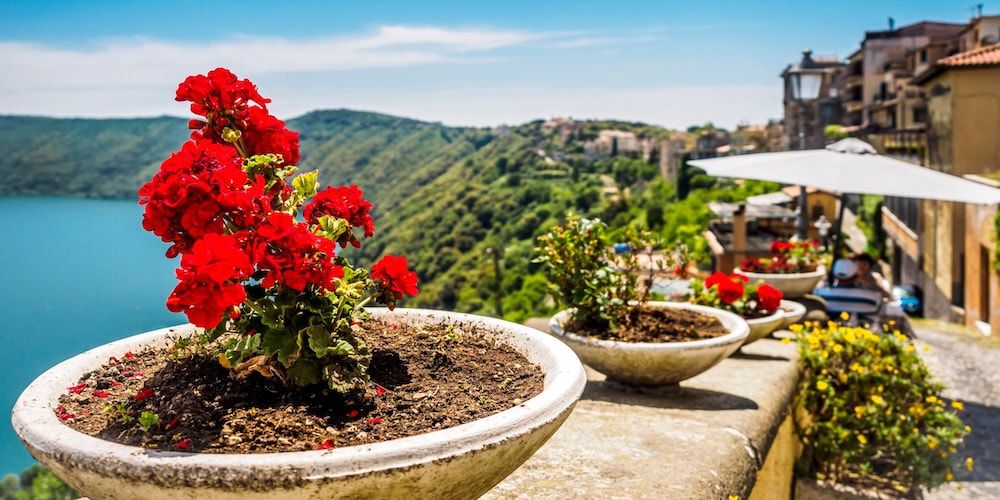
Our day ends in Castel Gandolfo, in front of the Apostolic Palace, the former papal summer residence, or on the terrace overlooking Lake Albano.
Seated on the ridge in this striking setting, we reflect on what the journey has given us. And from here, without haste, we decide whether to linger a little longer or to set off again with a lighter gaze.
What to see and do:
- Landscape of the Alban Hills
- Castel Gandolfo: Apostolic Palace and terrace over Lake Albano.
The 10 stages of the spiritual journey along the Via Francigena in Lazio
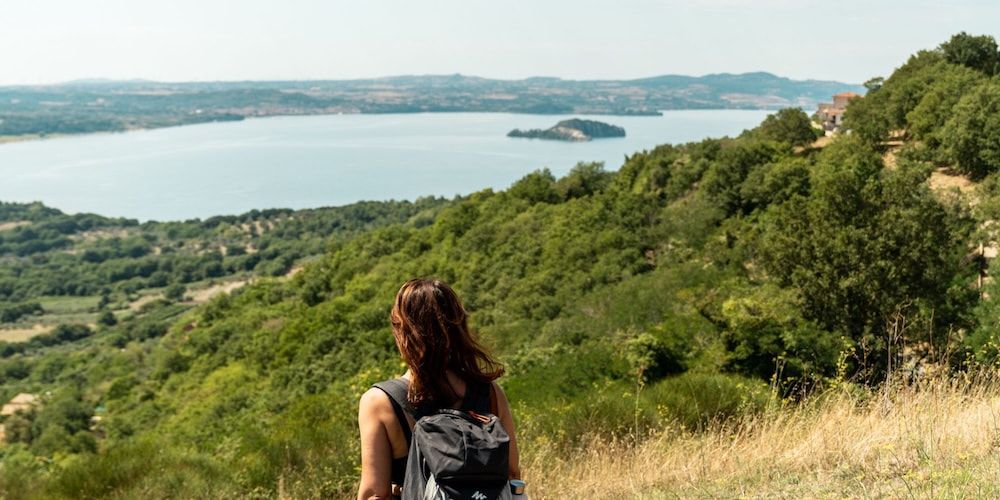
The official stages of Via Francigena in Italy are far more numerous than the 10 we have followed in this themed itinerary. Our journey has focused on a specific and particularly meaningful section, the one that enters Lazio from southern Tuscany and leads us all the way to Rome.
Historically, this was the most anticipated destination for pilgrims undertaking this route with a spiritual purpose. Below is a brief recap of the stages and distances covered over these 10 days:
STAGE → KM
1 Radicofani → Acquapendente 23,6
2 Acquapendente → Bolsena 22,8
3 Bolsena → Montefiascone 16,5
4 Montefiascone → Viterbo 17,6
5 Viterbo → Vetralla 21,9
6 Vetralla → Sutri 23,9
7 Sutri → Campagnano di Roma 23,8
8 Campagnano di Roma → La Storta 23,0
9 La Storta → Roma 19,4
10 Roma → Castel Gandolfo 26,1
About the author
Written on 26/05/2026
Alessandro Savino
SEO Copywriter & web editor: I love transforming my passion for writing into engaging narratives, creatively and precisely exploring the beauty and complexity of our wonderful country.

Alessandro Savino
A soulful journey along Via Francigena: follow the spiritual itinerary to Rome through ancient abbeys, forgotten sanctuaries, and mystical landscapes