

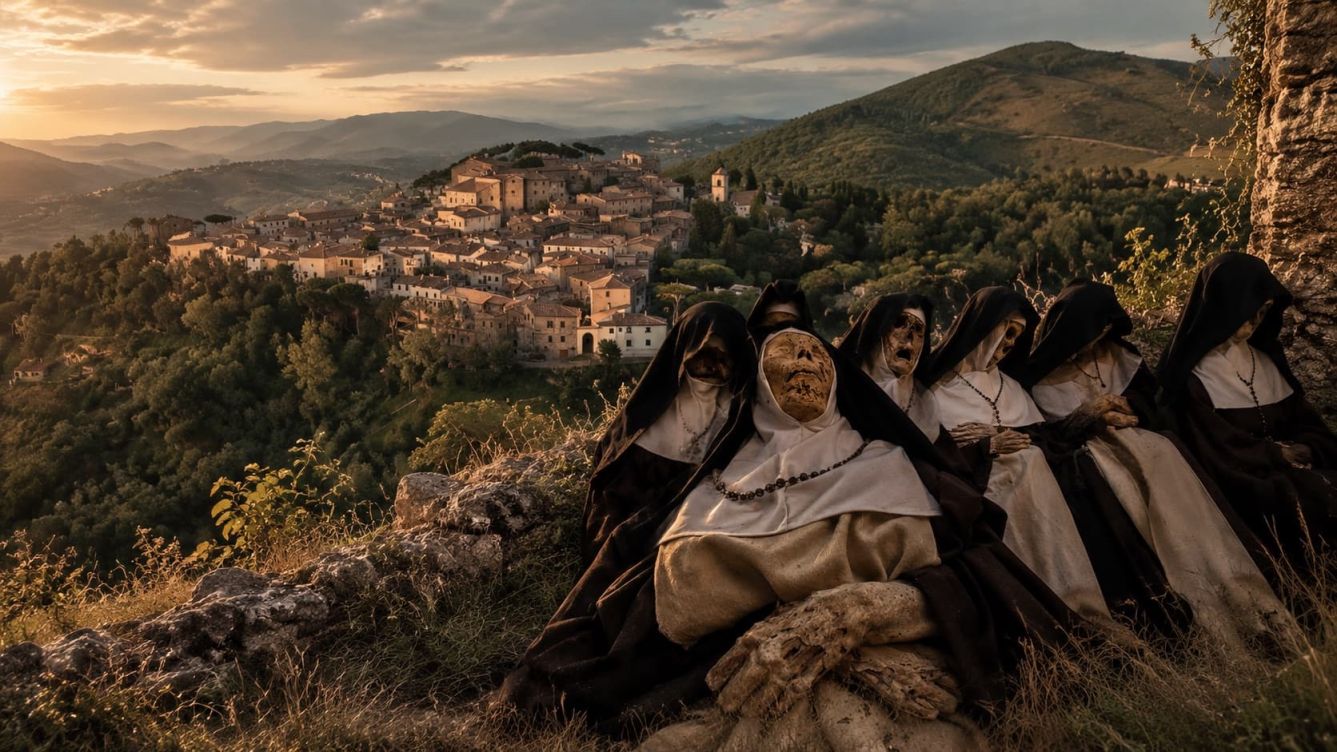

Seventeen mummified nuns, a centuries-old monastery and a museum devoted to silence: just 45 kilometers from Rome, in the hilltop town of Fara in Sabina, there is one of Italy’s most unusual places hides a story where faith, science, and the mysteries of the past meet behind ancient walls.
The monastery, known in Italy as the Monastero delle Clarisse Eremite, it is also home to the Museo del Silenzio, or Museum of Silence. Through everyday objects associated with prayer, cooking, sewing, and work, the museum reconstructs a world that existed largely behind closed doors.
Although the bodies have sometimes been described as incorrupt, scientific literature refers to them as natural mummies. Their preservation is documented, but its precise causes remain a subject for investigation till nowadays.

The 17 mummified nuns: what really happened?
According to the monastery’s documents, the bodies were discovered toward the end of the XVIII century, when burial niches were opened to transfer the deceased to the municipal cemetery. The sisters reportedly found the remains unusually well preserved and interpreted their condition through their religious beliefs.
However, modern scientific publications do not independently confirm the exact date or circumstances of the discovery. The monastery’s traditional story should therefore be distinguished from established historical evidences.
The Monastery of Clarisse Eremite: from medieval stronghold to place of contemplation
The monastery occupies the site of an early medieval castle. According to Italy’s General Catalogue of Cultural Heritage, the property was granted to monks connected with Farfa Abbey in 1082. After destruction and reconstruction, it passed through several noble families.
Its transformation into a monastery was associated with Cardinal Francesco Barberini and Sister Francesca Farnese, whose network of enclosed communities inspired a network of enclosed communities. Construction began in 1672, and the convent was inaugurated in 1676 by Pope Clement X.
The complex suffered heavy bombing in 1944 and was restored during the 1960s and 1970s under Mother Beatrice Mistretta. Today, its historic spaces include a fifteenth-century kitchen, a seventeenth-century choir, a former refectory, library rooms, and the Museum of Silence.
The museum of silence: an experience built around darkness and light
Inaugurated in 2004, the Museum of Silence explores monastic life through an exhibition built around darkness, sound, light, and everyday objects. Visitors enter a darkened space where a recorded voice introduces the community’s Constitutions. Display cases then illuminate one after another, revealing objects connected with prayer, discipline, sewing, pharmacy, and work.
The twenty-one display cases encourage visitors to focus on individual objects rather than absorb an entire collection at once. The exhibition also occupies part of the ancient Church of Santa Maria in Castello, where a historic fresco of the Madonna della Misericordia survives.
Rather than presenting silence as an abstract idea, the museum makes it tangible. After learning about the preserved bodies, visitors are invited to consider the lives that came before: hours spent praying, preparing food, maintaining garments, and following the community’s rules.
The objects and rooms of monastery behind the enclosure
The monastery’s historic rooms add depth to the museum experience. The kitchen, choir, former refectory, and library reveal how the sisters organized practical activities and spiritual life.
Cooking, sewing, and preparing remedies were essential tasks within a secluded community. The objects associated with these activities may appear modest, yet they preserve evidence of practical knowledge and daily routines.
Together with the textiles and burial objects connected to the mummies, these artifacts offer two complementary perspectives on the monastery: the extraordinary survival of human remains and the ordinary material traces of women’s lives.
What did silence actually mean to the Clarisse Eremite?
For modern visitors, silence may suggest tranquillity or a temporary escape from everyday distractions. Within the Clarisse Eremite community, however, it was a spiritual and institutional principle shaping prayer, work, relationships, and separation from the outside world.
Historical rules governed communication and enclosure, although their application changed over time. Silence was not simply the absence of sound; it helped structure the community’s understanding of time, discipline, and religious life.
The museum offers a glimpse into this world without pretending that a short exhibition can reproduce the experience of living for years under monastic rules.
Fara in Sabina beyond the Monastery and the Museum of Silence
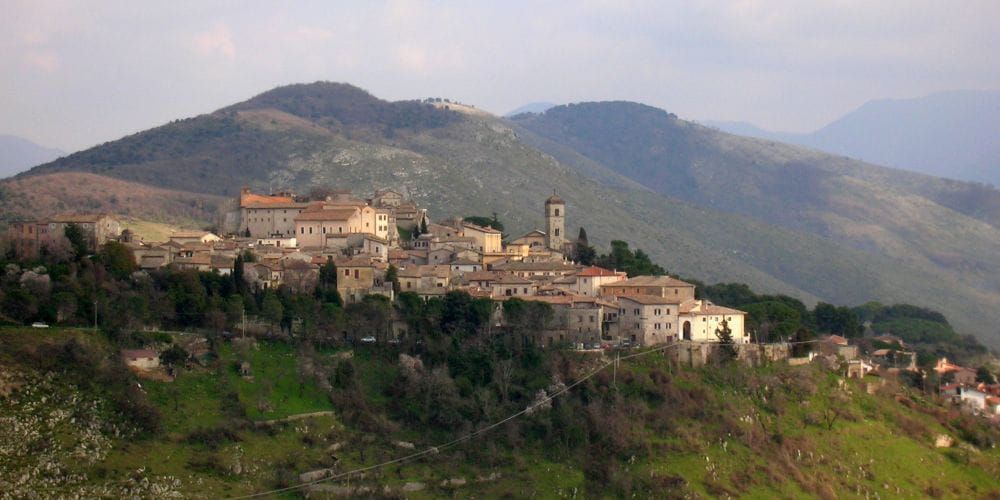
Fara in Sabina is a historic hilltop town surrounded by olive groves and the landscapes of Lazio’s Sabina region. Its narrow streets, historic palaces, Piazza del Duomo, and Collegiate Church of Sant’Antonino invite visitors to explore at a slower pace.
The Civic Archaeological Museum of the Sabina Tiberina, housed in Palazzo Brancaleoni, presents archaeological finds and artefacts from the region’s ancient communities. Farfa Abbey, in the wider Sabina area, offers another opportunity to explore the territory’s religious and architectural heritage.
How to visit the museum of silence on a day trip from Rome
Approximately 45 kilometers from Rome, Fara in Sabina makes a possible day trip for travellers seeking cultural experiences beyond the capital. Visits to the monastery should be planned in advance.
The guided itinerary may include the historic kitchen, former refectory, choir, library, room containing the 17 mummified nuns, and Museum of Silence. Confirm the current route, availability, and booking arrangements directly with the monastery before travelling.
For practical information, consult the official website of the Monastery of the Clarisse Eremite: opening times, ticket prices, and tour arrangements may change.
With sufficient time, the monastery can be combined with a walk through the historic centre and a visit to the archaeological museum. Farfa Abbey may also fit into a longer itinerary, depending on transport and opening times.
Explore Rome with Visit Rome PassFAQs about the museum of silence
What is the Museum of Silence in Italy?
The Museum of Silence (Museo del Silenzio) is a unique museum inside the Monastery of the Clarisse Eremite in Fara in Sabina, Lazio, about 25 miles (40 km) from Rome.
Why is it called the Museum of Silence?
The museum takes its name from the silence that has long been central to the monastic life of the Clarisse Eremite.
What happened to the 17 nuns?
The monastery preserves the naturally mummified bodies of 17 nuns who lived during the 18th century. Their remains were discovered within the monastery, where they have remained remarkably well preserved.
Can you visit the monastery in Fara in Sabina?
Yes. The Monastery of the Clarisse Eremite offers guided visits that can include its historic rooms, the area where the 17 nuns are preserved, and the Museum of Silence. Visits should be arranged in advance.
Where is Fara in Sabina?
Fara in Sabina is a historic hilltop town in the province of Rieti, in the Lazio region of central Italy. Located approximately 25 miles (40 km) northeast of Rome, it overlooks the Tiber Valley and the Sabine countryside.
Is Fara in Sabina worth visiting?
Absolutely. Fara in Sabina offers a quieter, more intimate side of Lazio, away from Rome's busiest tourist routes. Visitors can explore the Monastery of the Clarisse Eremite and its unusual Museum of Silence, discover local history at the Civic and Archaeological Museum, stroll through the medieval town centre, and enjoy views across the surrounding countryside.
About the author
Written on 29/10/2026
Elisa Verrazzo
Copywriter, globetrotter, photo-addicted. In love with Italy, its culture and its cuisine.

Elisa Verrazzo
Discover the museum of silence in Fara in Sabina, one of Italy’s most fascinating monasteries, which houses the bodies of 17 mummified nuns.