
These unusual places in Italy defy easy categorisation. Monumental labyrinths, gardens populated by magical creatures, impossible buildings, landscapes that turn into open-air museums: each seems as if drawn from a dream.
From Parma to the wilds of Maremma, winding through the Apennines and Umbria, our chosen destinations map out a “geography of imagination” across a lesser-known and dreamlike Italy. And they promise a beautifully unconventional cultural trip this summer.
7 unusual and surreal places in Italy to discover right now
In the places we've chosen, landscape is never a mere backdrop. At times, it’s the main character.
Here, art intrudes on nature, bends it, reimagines it, and conjures something surreal: a bamboo maze, a garden of mythic figures, a city sprung from fantasy, a castle stitched from distant eras and tongues.
Every place feels like you’re moving through an inner world. Most of them are fun for adults as well as children.
They are part of an alternative cultural map of Italy designed to make you see another side of the boot-shaped country.
We’ve gathered some of Italy’s most unusual destinations, the ones that truly amazed and impressed us (and where we can’t wait to return). They’re perfect for a cultural trip beyond the classic itinerary.
Here are 7 of Italy’s most surreal cultural landscapes not to miss:
– Labirinto della Masone, Emilia-Romagna
– Bomarzo Park, Lazio
– Tarot Garden, Toscana
– La Scarzuola, Umbria
– Rocchetta Mattei, Emilia-Romagna
– Peccioli's Giants, Toscana
– MAACK, Casacalenda, Molise
7. Labirinto della Masone, Fontanellato, Emilia-Romagna
🥇 Visit Italy’s brand partnership
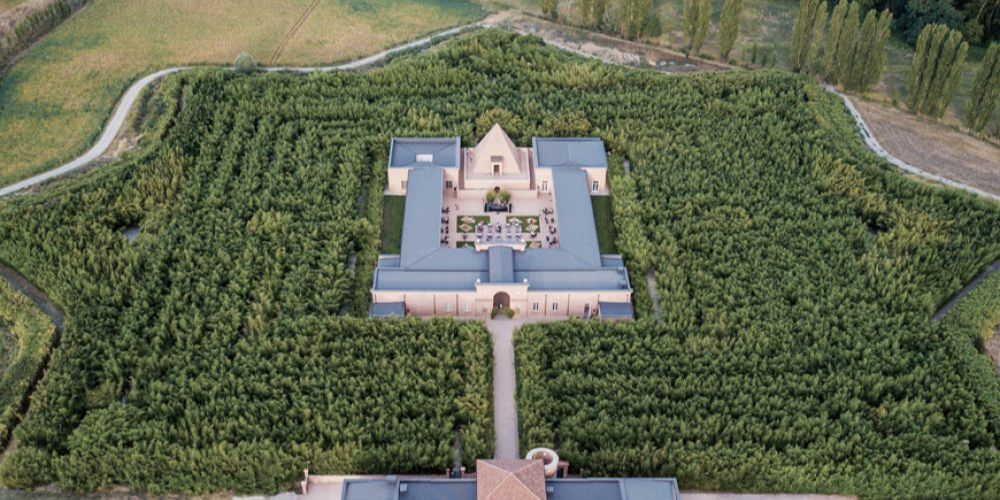
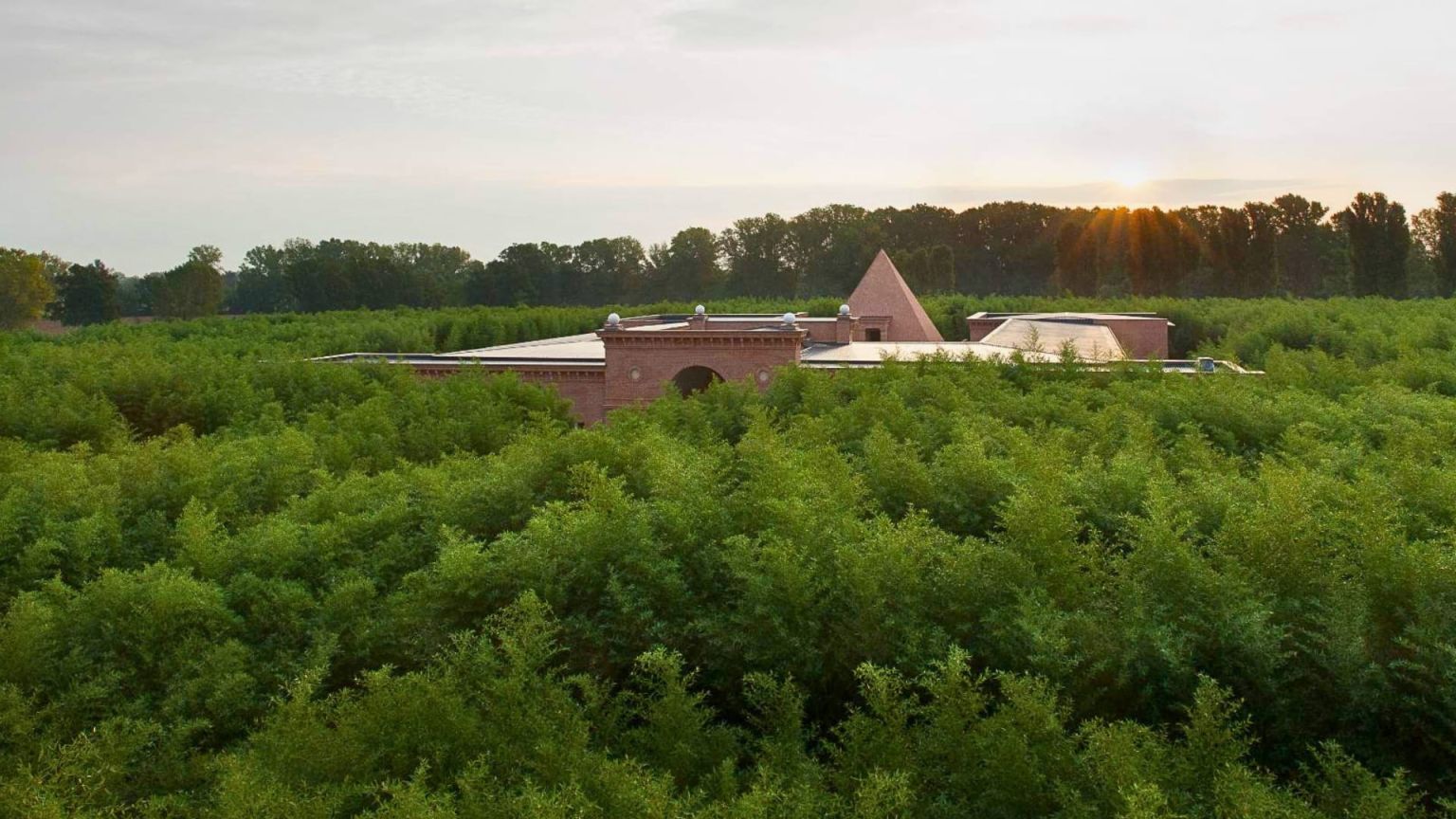
Just outside Parma, Labirinto della Masone is one of Italy’s most astonishing cultural destinations.
Conceived by publisher, collector and bibliophile Franco Maria Ricci, it’s much more than a maze: part museum, part monumental garden, part exhibition space and editorial workshop, all integrated into a single vision.
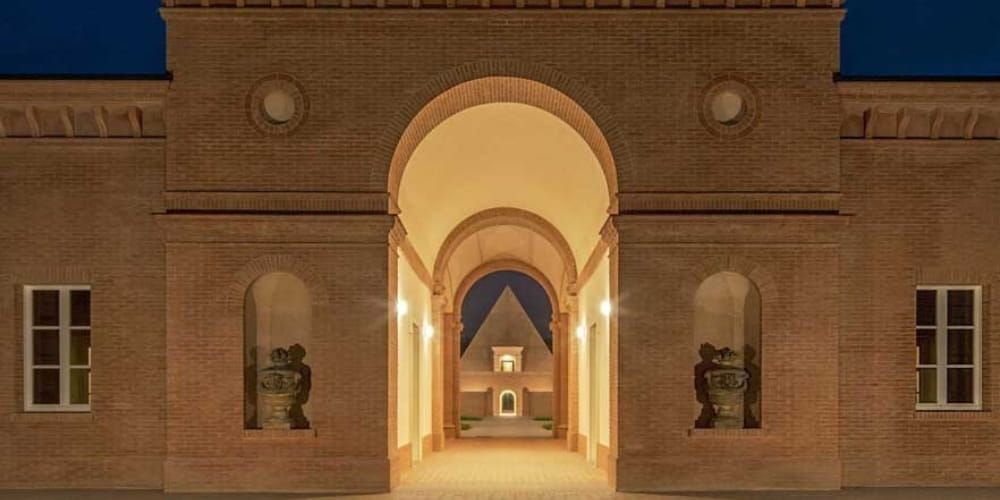
The complex’s striking buildings, designed by architect Pier Carlo Bontempi, draw inspiration from neoclassical utopias and are constructed from a mano bricks typical of the Po Valley.
At its heart is the world’s largest bamboo maze, made from some 300,000 plants: a homage to the labyrinth’s many incarnations, from ancient Crete to the elaborate gardens of the Renaissance.
Visitors can even immerse themselves fully in the Masone experience, with the chance to stay overnight in one of two elegant suites tucked within the grounds.
– Opening info: 10.30am–7pm, closed on Tuesdays.
More info on Labirinto della Masone6. Parco dei Mostri di Bomarzo, Lazio
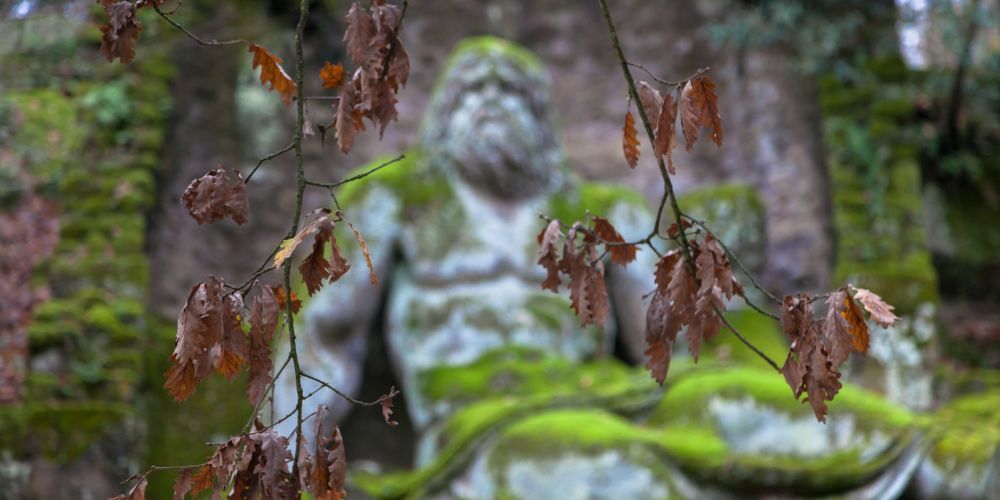
Deep in the wilds of Lazio’s Tuscia region, Parco dei Mostri, the “monsters’ park” near Viterbo, is a garden that gleefully tramples over every rule of Italian landscaping.
In the curving paths through a forested valley, colossal stone creatures loom from the undergrowth, their faces frozen in mid-roar or locked in a silent riddle.
Commissioned in the 16th century by the flamboyant Prince Pier Francesco Orsini, the park seems like a surreal open-air stage set, where mythological beasts, grotesques and impossible buildings crop up at every turn, as if conjured from a Renaissance dream.
Parco dei Mostri bewilders and delights in equal measure, and if you’re travelling with children, few spots spark the imagination just like this one.
– Opening info: open daily, 9am–5pm (November to February); 9am–7pm (March to September).
5. Tarot Garden, Capalbio, Toscana
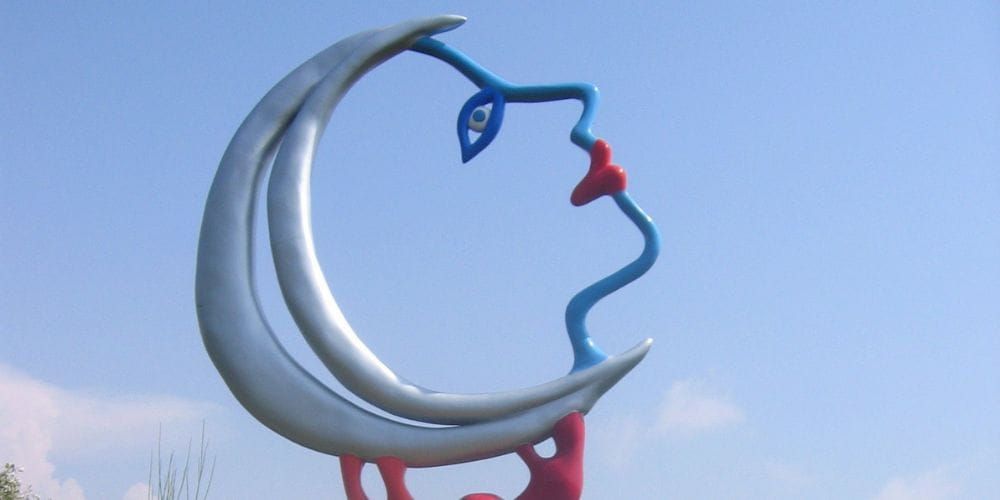
Tucked among the rolling hills of southern Tuscany lies a place in which reality gives way to riotous imagination.
The Tarot Garden is the life’s work of Franco-American artist Niki de Saint Phalle, who spent more than two decades creating this visionary park inspired by the Major Arcana of the tarot.
It’s impossible not to feel transported: giant sculptures are clad in shards of mirror, kaleidoscopic ceramics, and glittering mosaics make the landscape a whirling carnival of shapes and colour.
It’s like a waking dream, somewhere between Gaudí’s Barcelona and contemporary public art, but with a spirit that’s entirely Saint Phalle’s own.
A wonderland for adults and children, Giardino dei Tarocchi leaves an impression as bright and unforgettable as its sculptures.
– Opening info: daily, 2:30pm–7:30pm (1 April–15 October).
4. La Scarzuola, Montegabbione, Umbria
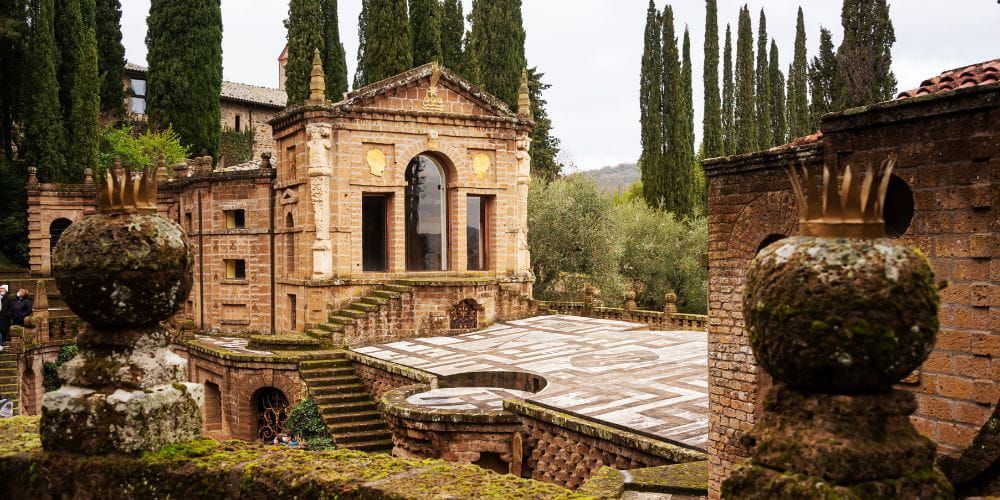
At first glance, La Scarzuola looks like a film set dropped in the middle of the Umbrian countryside. But this place is far stranger, and far more beguiling, than anything Hollywood could dream up.
Conceived in the 1950s by Milanese architect Tomaso Buzzi, what started as a Franciscan monastery has become a sprawling “ideal city”, a surreal maze of theatres, monumental staircases, temples, statues and towers, all stitched together in a feverish mix of allegory, esotericism and art history.
You’ll find yourself slipping amid reality and reverie, as buildings seem to converse with each other in a landscape that’s part dream, part riddle.
Every turn reveals a new puzzle or reference. Enigmatic, eccentric and utterly absorbing, La Scarzuola blurs the line between the world as it is and the world as it could be.
– Opening info: visits are by guided tour only; advance booking is essential.
3. Rocchetta Mattei, Grizzana Morandi, Emilia-Romagna
Set high in the Apennine hills near Bologna, Rocchetta Mattei looks like the setting for a fairy tale that took a detour through a few different continents.
Built from the mid-1800s by Count Cesare Mattei, the eccentric inventor of “electrohomeopathy”, the castle is a madcap medley of architectural styles: medieval turrets jostle with Moorish arches, Eastern flourishes and Art Nouveau curves.
The outcome is an elaborate arrangement of towers, courtyards, theatrical staircases and lavishly decorated halls.
Born of one man’s imagination and not limited by the rules of tradition, Rocchetta Mattei is an off-the-beaten-path destination that casts its spell with a singular mixture of romantic intrigue and Arabian Nights fantasy. After a painstaking restoration, the castle is once again open to visitors.
– Opening info: entry is available on selected days and times; advance online booking required.
2. Peccioli’s Giants, Toscana
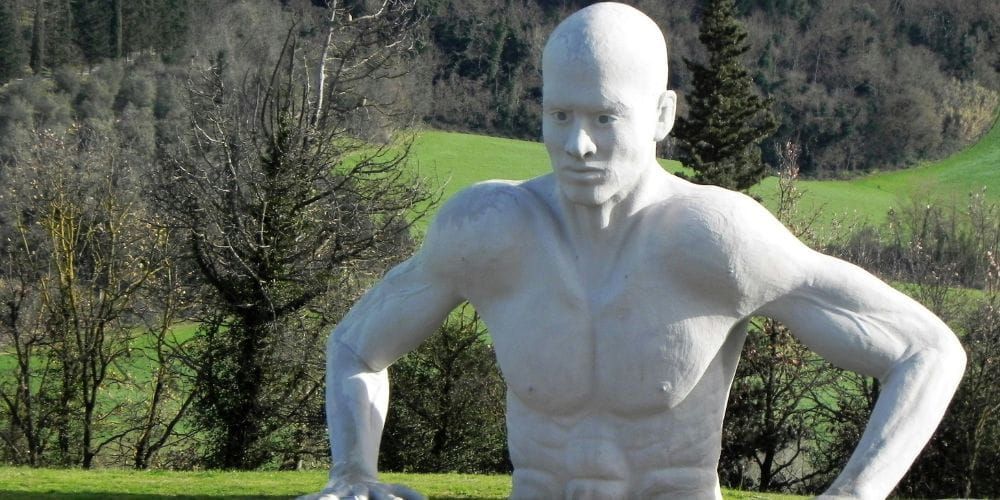
A quiet hilltown near Pisa, Peccioli has reinvented itself as an open-air contemporary art lab, and it’s now a luminous example of how culture can reshape a landscape.
In recent years, the town has become famous for its Giants, monumental human figures created by the Naturaliter collective.
Two tower over the former Legoli landfill, another commands the Fonte Mazzola amphitheatre, while a fourth surveys the rooftops from the town’s business incubator.
Reaching up to 9 metres high, these mute sentinels have transformed unlikely corners into art destinations, gazing out over the rolling Tuscan hills.
The Giants are just the tip of the iceberg: Peccioli now boasts more than 70 open-air installations, bringing visitors, photographers and art-lovers from across Europe.
– Opening info: installations are freely visible year-round; the Legoli Giants can be viewed Monday–Friday, 9am–5pm, and Saturday, 9am–1pm, by advance booking only. On the third Sunday of each month, a treasure hunt for children runs from 10.30am to 5pm.
1. MAACK – Kalenarte Open-Air Museum of Contemporary Art, Casacalenda, Molise
In the last few years, the village of Casacalenda in Molise has gained visibility as an open-air gallery.
Since 1990, MAACK – Museo all’Aperto di Arte Contemporanea Kalenarte has turned the town and the rural surroundings into a living exhibition.
The project, the brainchild of architect Massimo Palumbo, brings together interventions by Italian and international artists who have chosen to work in direct dialogue with the territory.
Sculptures and installations pop up along streets, in public squares and across fields. There’s no single destination: the MAACK reveals itself gradually, as you wander through Casacalenda.
Four dedicated art trails now link the artworks scattered between Casacalenda and the nearby village of Provvidenti.
It’s a model of cultural experimentation, and a testament to how contemporary art can shape and be shaped by its setting.
– Opening info: the open-air installations are accessible year-round; Galleria Libertucci in Via De Gennaro Emilio 83 is open free of charge, Monday to Friday.
About the author
Written on 16/07/2026
Lorena Calise
I'm a content writer for magazines and websites. I also explore Italy through my writing for Visit Italy and Visit Naples.

Lorena Calise
Our pick of the best unconventional destinations for a fun cultural experience in Italy.