
In partnership with
Camping has changed. Or perhaps it is our perception of it that needs to change.
Forget, for a moment, tents to pitch, sleeping bags and spartan holidays: in recent years, open-air hospitality has begun to speak the language of architecture, design and wellbeing, transforming contact with nature into a contemporary form of luxury defined by space, silence, freedom, time spent outdoors and comfort that follows you even when you choose to sleep beneath a pine forest just a few steps from the sea.
It is on the slender peninsula of Cavallino-Treporti, suspended between the Adriatic Sea and the Venetian Lagoon, that this evolution finds one of its most compelling expressions. Here, beaches seem to stretch towards the horizon, dunes give way to pine forests, and just a few kilometres are enough to leave the open sea behind and find yourself facing the stillness of the lagoon. The Cavallino-Treporti coastline extends for around 15 kilometres through golden beaches, dunes, pine forests, vegetable gardens and lagoon landscapes, within the area recognised by UNESCO together with Venice and its Lagoon.
This is where Marina di Venezia is located: a five-star Camping Village covering around 80 hectares and one of the largest in Italy. It perfectly illustrates just how far the new concept of luxury open-air hospitality has moved beyond the traditional idea of camping, offering a privileged vantage point from which to understand how the experience of a holiday immersed in nature is changing.
Luxury camping is one of the fastest-growing travel trends
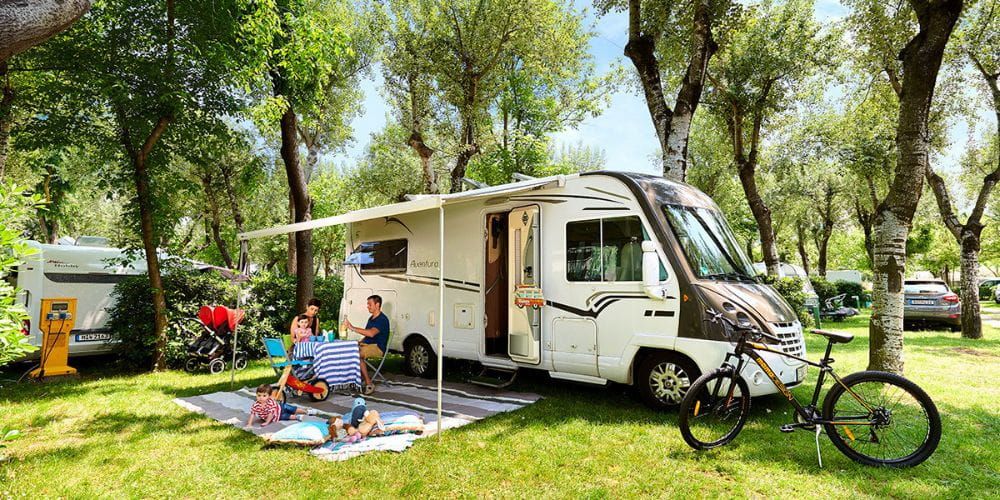
The appeal at the heart of camping has never disappeared: waking up surrounded by greenery, spending most of the day outdoors, slowing down and reconnecting more directly with the place around you. What has changed are travellers’ expectations.
Today, more and more people are looking for nature without wanting to give up quality accommodation, privacy, good food or services designed to make a holiday easier, especially when travelling with children. This is where Luxury Open Air Hospitality comes in, bringing together two worlds that once seemed almost opposite: the freedom of camping and the comfort of a resort.
The growth of glamping and high-end open-air accommodation reflects precisely this search for balance. For families and international travellers, the appeal is no longer simply about sleeping close to nature, but about truly experiencing it while maintaining high standards of comfort, with private spaces, carefully designed services and experiences that become as much a part of the journey as the destination itself.
Alongside the more traditional camping holiday, there are now designer bungalows, lodges with private gardens, hot tubs, refined restaurants, large areas dedicated to play and sport, and architecture conceived to engage with the surrounding landscape. At Marina di Venezia, for example, traditional pitches sit alongside a wide range of accommodation options, from Garden Villas immersed in the pine forest to Aqua Lodges and Marina Lodges with private Jacuzzis.
For families, above all, this means being able to spend far more time outdoors without giving up the convenience of a holiday designed around their needs. In this new way of travelling, luxury means having space and nature all around you without having to choose between freedom and comfort.
Why Cavallino-Treporti is much more than a beach destination
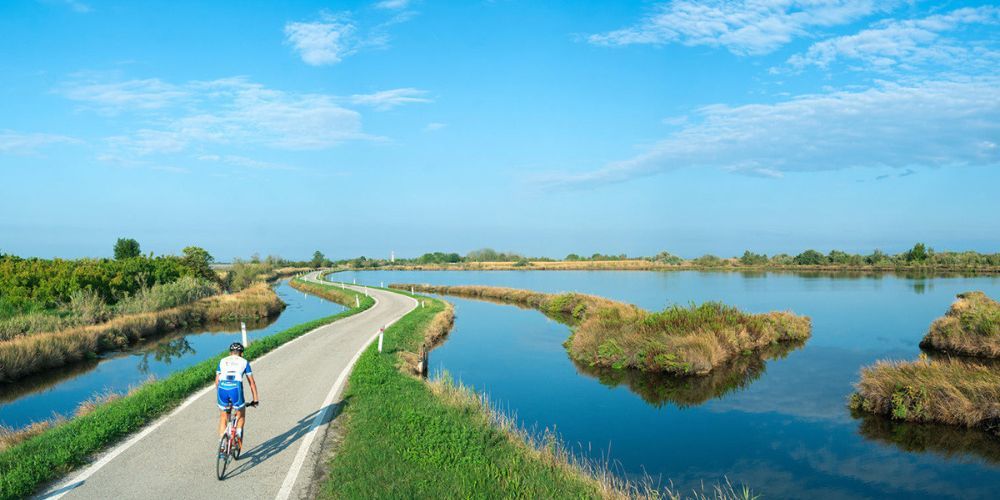
Cavallino-Treporti is a long strip of land suspended between two worlds of water: the Adriatic Sea on one side and the Venetian Lagoon on the other. Sea and lagoon lie remarkably close to one another, yet they create completely different landscapes, and it is precisely this dual identity that gives the area its unmistakable character.
Along the seafront, kilometres of golden sand unfold through wide beaches, fossil dunes and pine forests. Right in front of Marina di Venezia, the beach reaches its greatest depth in Cavallino-Treporti, stretching up to 255 metres. Behind the shore, coastal vegetation and two pine forests open to the public reveal the more natural side of this stretch of the Venetian coast.
Turn towards the lagoon and the landscape seems to slow down: canals, salt marshes, fishing valleys, small rural settlements and vegetable gardens begin to appear. Venice remains in the background, close enough to reach with ease, yet far enough away for the day to unfold at an entirely different pace.
Cycling is perhaps the best way to experience this transition. More than 40 kilometres of cycle paths cross the area, making it easy to move slowly and pleasantly between sea, lagoon and countryside. One of the most spectacular routes is the Via del Respiro, the cycle and pedestrian path along Via Pordelio: seven kilometres beside the Venetian Lagoon, with sections suspended above the water, connecting Cavallino with Punta Sabbioni.
The sea may be the starting point, but beyond the coastline lies a landscape that invites you to cycle, stop at a local farm, watch birds over the lagoon or reach small villages along roads where traffic finally gives way to silence.
The resort that is changing the meaning of camping
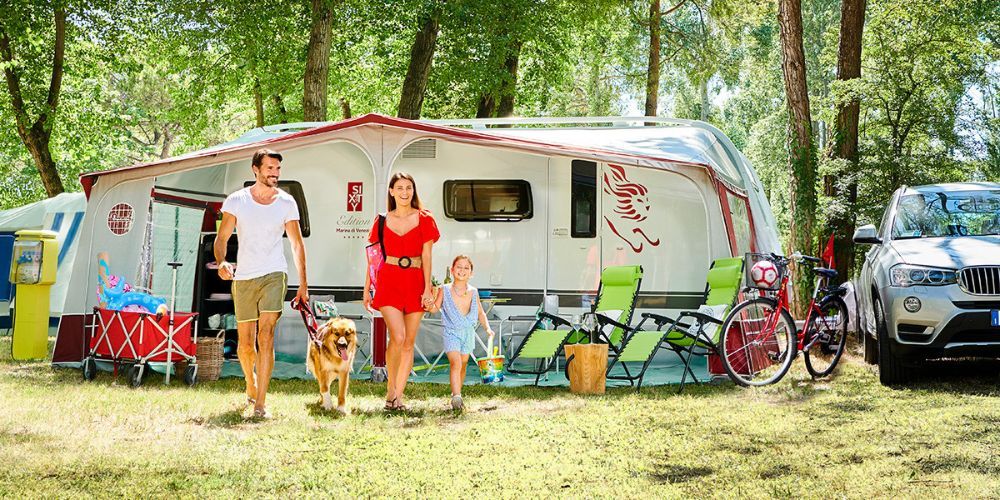
Covering around 80 hectares, Marina di Venezia is one of the largest camping village in Italy. A key part of its concept lies in balancing scale with the quality of the guest experience, with accommodation, pitches and services distributed among expansive green spaces and mature trees.
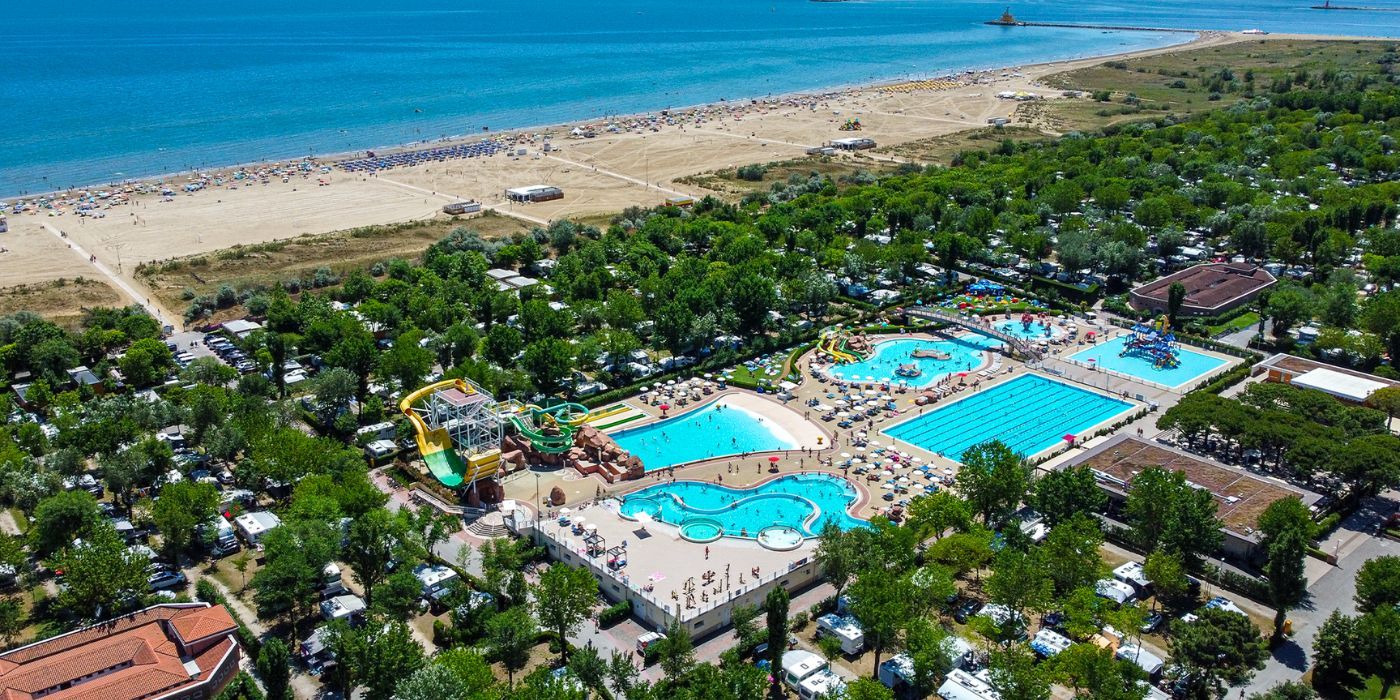
Nature remains at the heart of everything. Marina di Venezia overlooks the widest stretch of beach along the Cavallino-Treporti coastline, while behind it pine forests and green areas form part of everyday life at the resort.
For families, this means being able to enjoy very different kinds of days without necessarily having to use the car. You can start by the sea, spend a few hours at AquaMarina Park, home to ten pools including children’s areas, heated pools, relaxation spaces and swimming pools, and then walk back through the greenery to your pitch or lodge. It is one of the features that makes Marina di Venezia an interesting example of a family resort in Italy: the holiday remains closely connected to outdoor living, while a wide range of services makes the experience easier and more comfortable.
But there is more. Among its environmental initiatives are the recovery of around 20,000 cubic metres of water from AquaMarina Park each year for non-potable uses, through a system connected to 300 toilets, a recycling rate of over 70%, electric mobility within the resort, and measures designed to reduce consumption and emissions. Marina di Venezia also operates an integrated management system based on ISO 9001, ISO 14001 and ISO 45001 standards.
Its collaboration with Ca’ Foscari University of Venice also includes birdlife monitoring and conservation efforts focused on the Kentish plover, a protected bird that nests along the coastline. Here, nature is not simply something to admire from a terrace, but an essential presence with which hospitality must continually negotiate its place.
Where architecture, nature and fine dining meet
Since 2016, Marina di Venezia has collaborated with Matteo Thun & Partners on a design journey that has involved the entrance buildings, commercial areas, restaurants and high-end bungalows, as well as new service facilities. The design philosophy is immediately apparent: existing trees are not treated as obstacles to build around, but become part of the geometry of the architecture itself. In the bungalow project, the studio describes an approach guided by the Genius Loci, with pine trees helping to define the layout; in the commercial areas, pavilions are arranged around the trees, creating courtyards, squares and green spaces.
The same principle can be found in the resort’s premium accommodation. The Garden Villas are immersed in the pine forest and designed around private green spaces, while the Aqua Lodges overlook expansive gardens and feature a private Jacuzzi on the terrace.
Around the accommodation, greenery becomes part of the experience through seasonal blooms, aromatic plants, shade and birdlife. The gardens change over time, making each stay feel different depending on the season.
The resort’s gastronomy reflects the same evolution. The traditional idea of a “camping restaurant” gives way to venues with distinct identities, where Italian cuisine and local ingredients are interpreted in different ways. Marina di Venezia has five restaurants, as well as bars and gelaterias, spread across the pine forest, internal squares and beachfront.
Calici e Mare, right on the sand, focuses on creative cuisine and seasonal ingredients from the Cavallino-Treporti area, complemented by a wine selection designed as an integral part of the experience. Elsewhere, dinner takes on a different atmosphere with jazz evenings, while PiacerMio, designed by Matteo Thun, combines large windows, indoor and outdoor spaces, aromatic vegetation and a menu that also features Adriatic fish and locally grown vegetables.
Beyond the resort: discover the authentic side of Cavallino-Treporti
To truly understand Marina di Venezia, however, at some point you need to venture beyond the resort itself. By bike, you can join the network of cycle and pedestrian paths that crosses Cavallino-Treporti, follows the lagoon and leads towards the countryside, historic fortifications and small settlements. The Via del Respiro is only one of several possible routes: others wind through fishing valleys, vegetable gardens and the rural landscape that still defines this beautiful stretch of the Venetian coast.
Along the way, you can stop at local farms and agritourism businesses to discover produce grown in a landscape whose history has been shaped by the complex relationship between water and soil.
One of the places that best reveals this lesser-known side of the area is Lio Piccolo: narrow roads run between canals and salt marshes, vegetable gardens alternate with stretches of water, and the bell tower of the tiny village rises almost alone on the horizon.
The archaeological project Vivere d’Acqua, coordinated by Ca’ Foscari University together with other scientific partners, continues to investigate the Villa Romana del Sale, an important site for understanding the Roman presence in the Northern Lagoon and the activities connected with the use of its natural resources. The research is reconstructing an ancient landscape in which living, fishing, production and life on the water were already closely interconnected.
This is perhaps the side of Cavallino-Treporti that most surprises visitors drawn here by its proximity to Venice: a destination where, within just a few kilometres, you can move from a long Adriatic beach to a road suspended above the lagoon, from a pine forest to cultivated gardens, and finally to a Roman archaeological site almost hidden by the water.
September and October are the perfect time to visit
If July and August belong to the height of beach season, September and early October reveal Cavallino-Treporti in a distinctly different way.
The intensity of peak season begins to fade, cycling along the lagoon becomes more enjoyable, and the beach regains that sense of space that is one of the true privileges of this stretch of the Adriatic. The light softens, shadows lengthen across the dunes, and nature once again takes centre stage.
It is also the ideal time to combine the sea with exploring the surrounding area: one day can begin on the beach and continue by bike towards Lio Piccolo; another can be dedicated to Venice, easily reached from Punta Sabbioni, before returning in the evening to the quiet of the pine forest.
If you are travelling as a family, the weeks outside the height of the summer season also offer a more relaxed pace and quieter spaces, while still allowing you to spend much of the day outdoors.
In 2026, Marina di Venezia remains open until 12 October, giving guests the chance to experience the resort beyond the traditional Italian summer. And if you are already imagining your 2027 trip, Cavallino-Treporti offers a less predictable perspective on the Adriatic coast: Venice within easy reach by vaporetto, but also a destination that deserves to be chosen and experienced in its own right.
About the author
Written on 04/09/2026
Flavia Cantini
Freelance Content Writer with over a decade of specialized experience in tourism, culture, and creative/artistic activities. I assist magazines, web agencies, and end clients in managing blogs and crafting standout articles

Flavia Cantini
Marina di Venezia reinvents camping with design, nature and comfort in the unique landscape of Cavallino-Treporti, near Venice.