
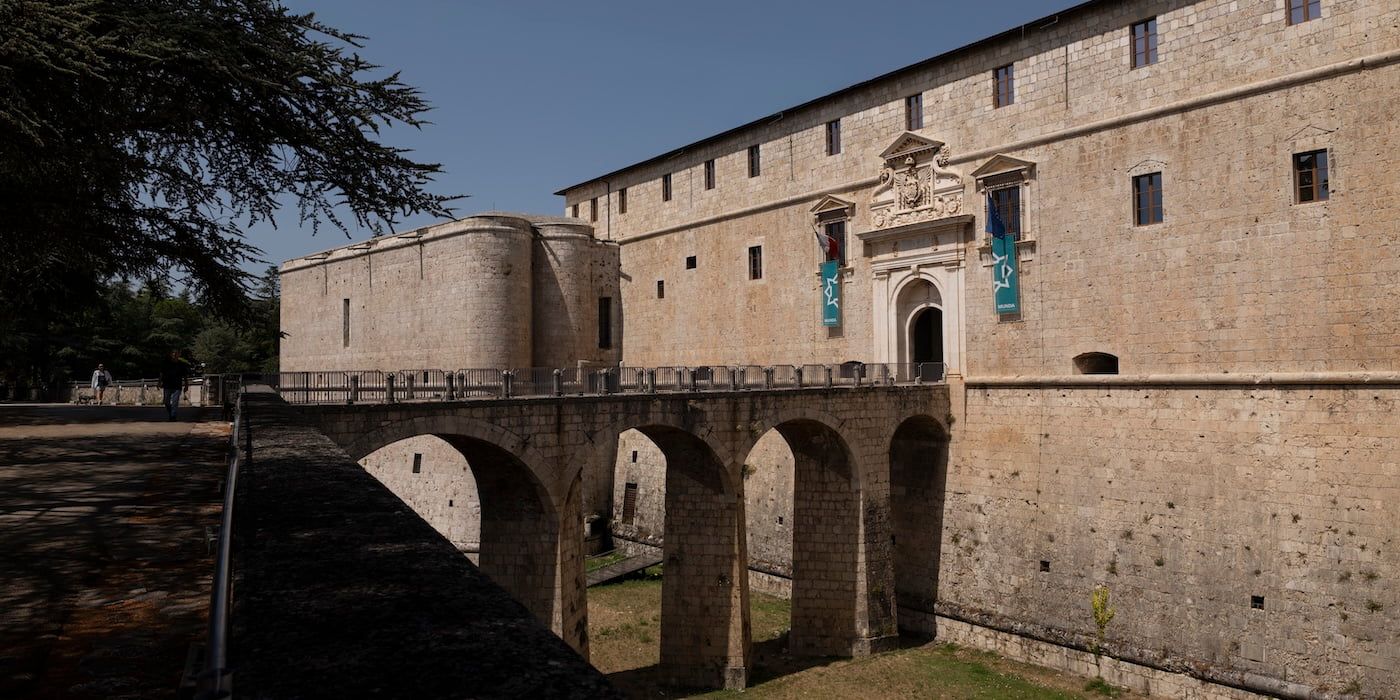

Massive and geometric, the Spanish Fort in L’Aquila, known locally simply as “the Castle,” is a structure that dominates the scene and stands out for its strict design and military symmetry, still clearly visible today in its imposing forms.
Its curtain walls and bastions tell the story of the city and its urban transformations, while from the outside the profile of the Gran Sasso mountain range provides a striking backdrop, perfect for a photograph that already feels like a memory.
Amid the greenery of the surrounding park and the Mammoth housed inside the Abruzzo National Museum, every corner of the fortress opens like a window onto L’Aquila’s identity, shaped by stone, resilience, and a surprising sense of humanity.

The Spanish Fort: one place, a thousand stories
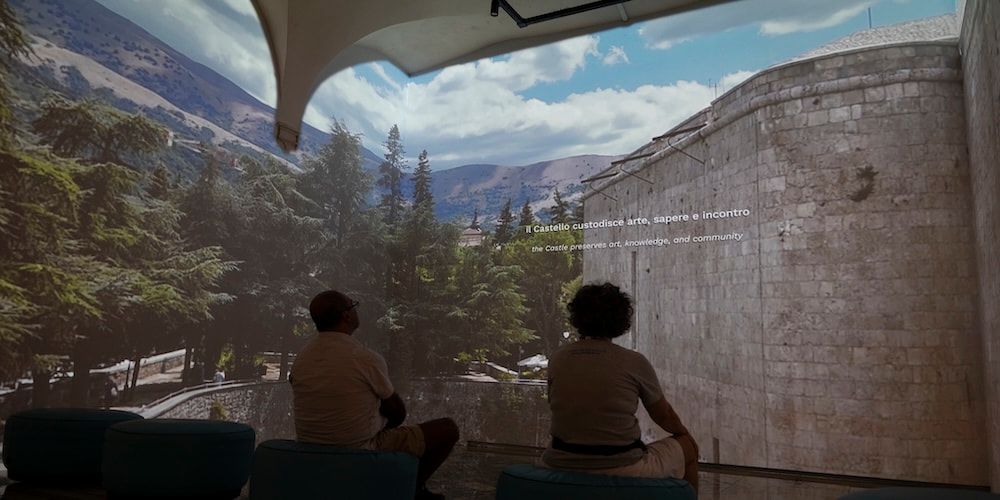
Behind its compact appearance, the Spanish Fort unfolds into different layers, from its military origins to its architectural form, from its role in the city to its interior spaces and its current visitor experience. The structure follows its history, even though its role in L’Aquila’s urban landscape is now very different from the past.
The museum inside tells an important part of the region’s history and identity, with artifacts ranging from prehistory to more recent times, including the famous Mammoth, one of the symbols of the complex. Outside, the Fort continues to function as an urban space, crossed daily by locals and used as a place of passage and meeting.
The fort is a landmark of the Abruzzo capital because it brings together different functions in a single place: historical memory and a modern cultural space, making it one of the must-see sites to explore the authentic side of L’Aquila.
A fortress to control the city: the origins of the Spanish Fort
The Spanish Fort dates back to the 16th century, when L’Aquila came under firm Iberian rule. Its construction specifically began in 1534, when it was built on the highest point of the city, in a strategic and dominant position.
The fortress was designed as a military stronghold, with a function not only linked to defense but also to the control of the territory and the maintenance of power within L’Aquila.
Over the centuries, the building was never used in actual combat operations. Instead, it first became a barracks and later took on different roles, eventually being adapted for cultural use and housing a museum, as it still does today.
The geometry of the Spanish Fort: a perfect defensive machine
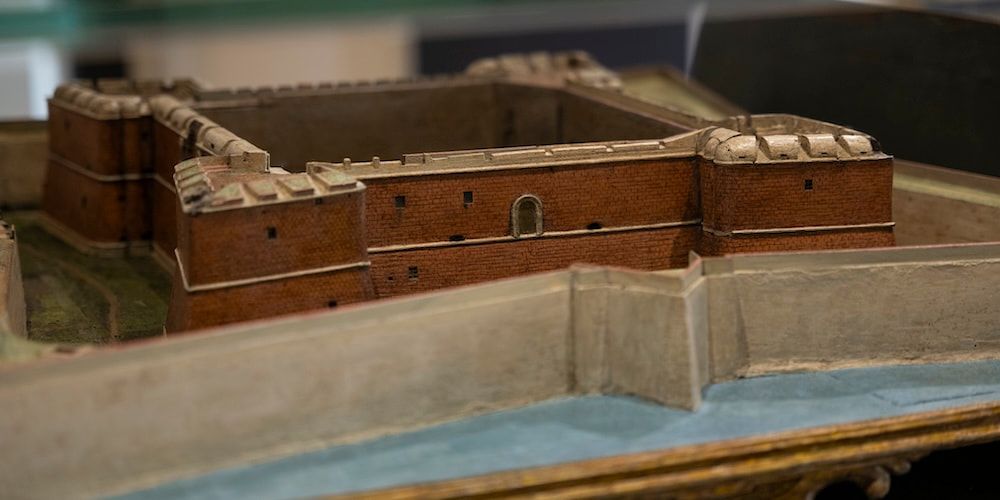
The fort’s plan is square, with massive arrow-shaped bastions attached at the four corners, designed to ensure complete coverage of the outer sides. Their arrangement allows for crossfire control of the different fronts, so that each sector of the fortification can be protected by the others.
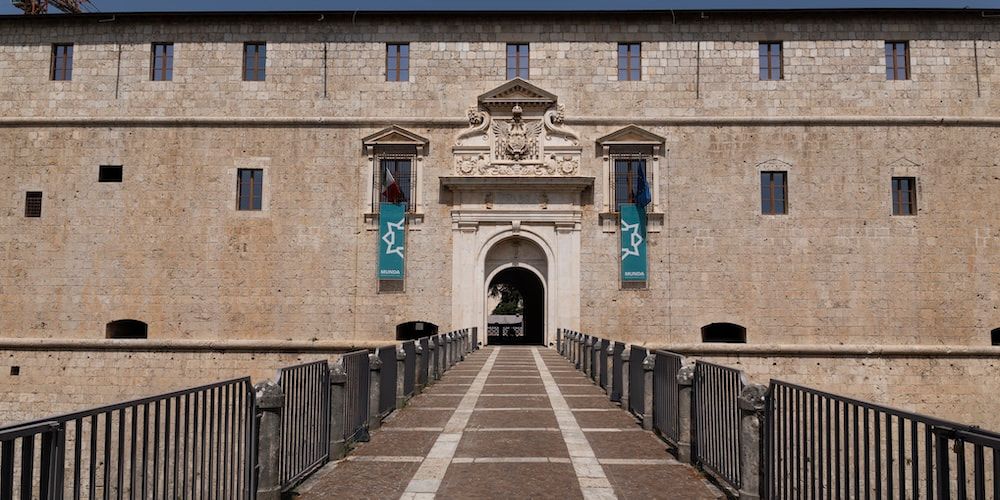
A moat runs around the structure, separating its perimeter and reinforcing its defensive character, while access is provided by a masonry bridge leading to the main entrance.
The entire system responds to the needs of 16th-century fortifications. At the time, the introduction of firearms radically changed the way defenses were designed. Walls became lower and more massive, taking on a more complex form with bastions and recesses, and the entire structure was designed to reduce blind spots and better distribute defensive coverage.
Inside the Fort: from defense to memory
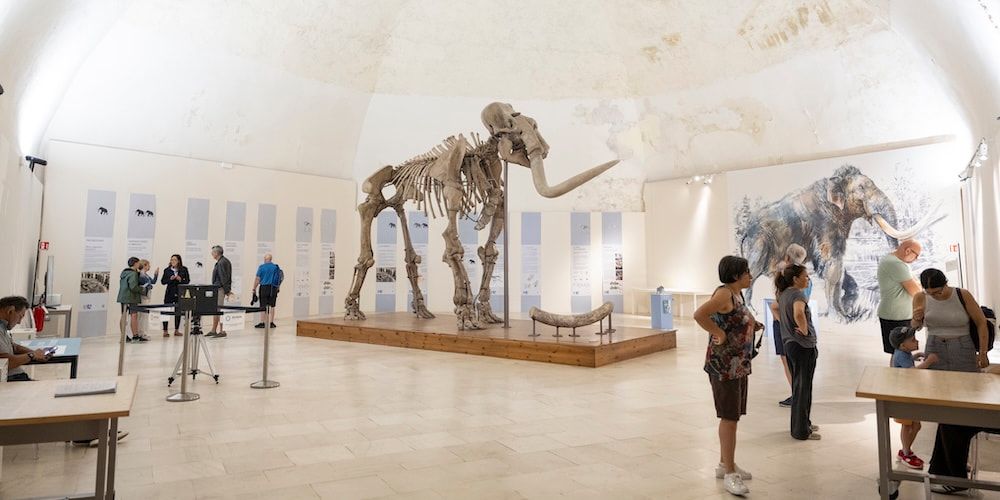
The interior of the fort completely overturns the impression we might have formed by observing it from the outside.
The main reason is that the spaces are no longer linked to their military function. Instead, they now host the Abruzzo National Museum and its exhibition routes, which guide visitors through different historical periods, bringing together fragments that tell the long story of the region and creating a true journey through time.
One of the most striking highlights is undoubtedly the Mammoth, one of the most complete skeletons ever found in Europe, discovered in 1954 near Scoppito and later assembled for display inside the fort’s bastion.
It’s a fascinating presence for visitors of all ages. Above all, it also stands as a symbol of the connection between the Abruzzo region and its ancient, millennia-long history.
From boundary to meeting point
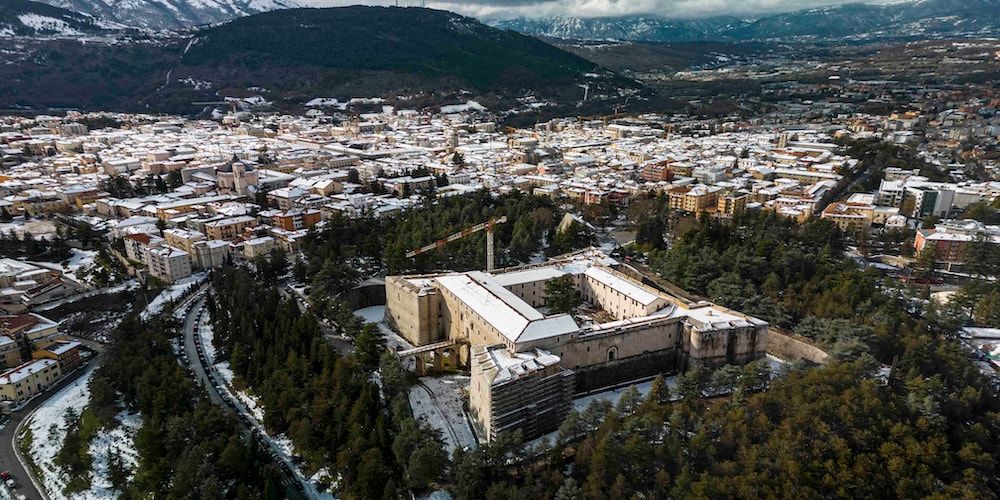
For centuries, the fort was associated with a function of control, but today its relationship with L’Aquila is completely different. Around its walls lies one of the most frequented areas of the city, an open space used daily by residents, students, families, and visitors.
The surrounding park has turned the fort into a true urban landmark, a place to meet, walk, or simply take a break outdoors.
It’s also an excellent viewpoint from which to observe the bastions emerging among the trees, the moat, and the walls, with the Gran Sasso mountain range in the background, which on clear days completes one of the most photographed views of L’Aquila.
How to get to the Fort: a walk through L’Aquila
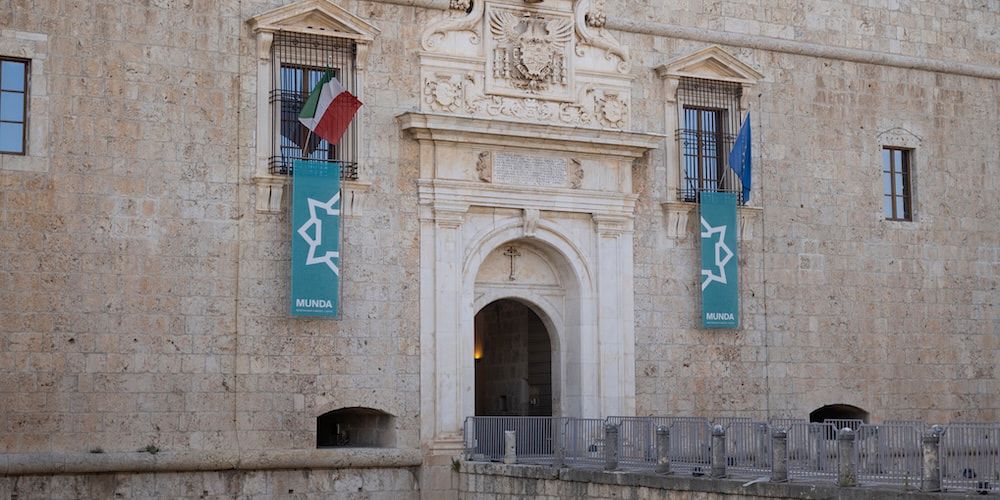
Reaching the Spanish Fort is easy, whether you are already in the historic center or arriving in the city by train.
From the main squares of the historic center, it takes only a few minutes on foot to reach the complex, which is easy to spot thanks to its imposing structure and the large park that surrounds it.
From Piazza Duomo, we can walk up Corso Vittorio Emanuele and continue toward Fontana Luminosa and Piazza Battaglione degli Alpini, from where the fort becomes visible thanks to its slightly elevated position and the wide green area around it. The walk is just under one kilometer.
Visitors arriving from the train station can use public transportation to reach the historic center and then continue on foot.
If you arrive in L’Aquila by car, there are several parking areas around the fort. Alternatively, it’s better to leave the vehicle in the northern area of the historic center.
About the author
Written on 24/08/2026
Alessandro Savino
SEO Copywriter & web editor: I love transforming my passion for writing into engaging narratives, creatively and precisely exploring the beauty and complexity of our wonderful country.

Alessandro Savino
Explore L’Aquila Spanish Fort, where history takes shape among its walls, the park, the museum, and the unique backdrop of Gran Sasso.