
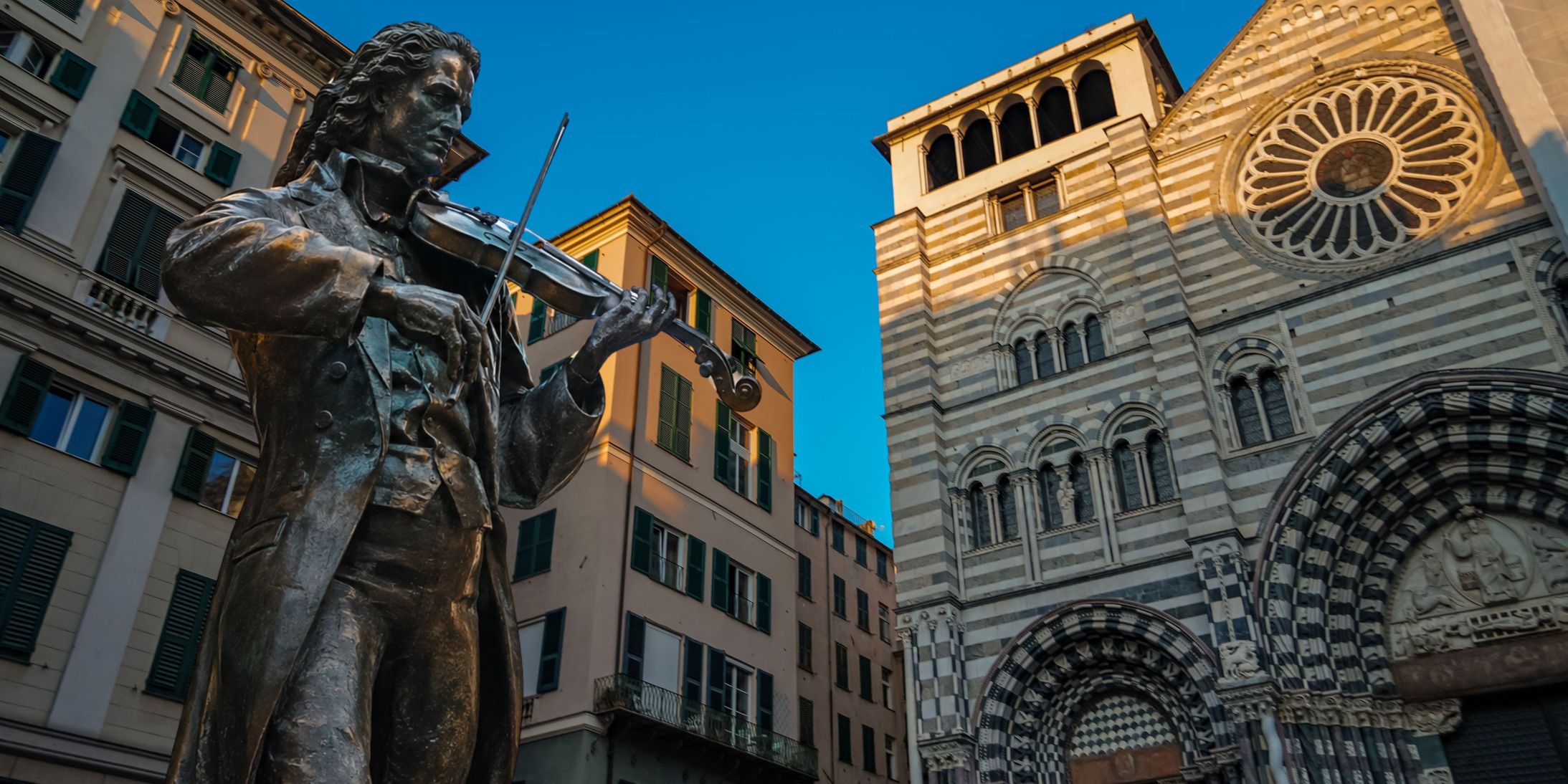

Long before he became a legend of the violin, Niccolò Paganini was a young Genoese musician performing in the churches and theatres of his hometown. It was in Genoa that he got his start, learned how to win over an audience and built the reputation that would eventually take him to the most prestigious stages of his time. Today, you can quite literally step into that story, visiting the places where the memory of the devil’s violinist remains remarkably vivid.
The Paganini tour through Genoa is an engaging and often unexpected journey, beginning with his early years and leading, in a sense, right up to the present day. Ottobre Paganini 2026, Genoa’s festival celebrating the great musician from October 2 to November 8, is the perfect excuse to discover the city through his eyes – and follow in his footsteps.
The Paganini itinerary in Genoa: the musical walking tour to explore this year
Niccolò Paganini is the unlikely guide on this unusual tour through a cultured, down-to-earth Genoa. A rock star in his day, with extraordinary talent and a life marked by excess and eccentricity, Paganini is everywhere in his hometown: in the church where, aged 11, he gave his first solo performance; in the theatres that launched his career; in the Grimaldina Tower, where his story took a decidedly less glorious turn; in the rooms of Palazzo Tursi, home to his favourite violin.
In 2014, the Amici di Paganini association brought these places together in a 12-stop trail tracing the stories, memories and events surrounding the Genoese musician who charmed the world.
The stops on the Paganini tour through Genoa:
1. Teatro Falcone (Palazzo Reale): Paganini performed here before King Carlo Felice and the royal family on 9 November 1827.
2. Church and Oratory of San Filippo: On 26 May 1794, aged just 11, he gave his first solo performance.
3. Palazzo Tursi – Paganini Rooms: Where you can admire Il Cannone, the violin Paganini bequeathed to Genoa.
4. Basilica of Santa Maria delle Vigne: A concert was held here on 1 December 1794, just a few months after his first solo performance.
5. Teatro Carlo Felice: Paganini performed here for the first time on 30 November 1834, on his return from his European tour.
6. Palazzo Pammatone (now the Courthouse): On 27 August 1835, Paganini visited the hospital with his son Achille to see victims of the cholera epidemic at what was then Genoa’s main public hospital.
7. Palazzo Ducale and Torre Grimaldina: He spent a few days in the tower, which was then used as a prison, in May 1815.
8. Church of San Donato: This is where the earliest document connected with Paganini is preserved: his baptismal record.
9. Teatro della Tosse: The theatre stands on the site of the former Teatro Sant’Agostino, where he gave his first public academy on 31 July 1795.
10. Church of San Salvatore (now the Aula Magna of the School of Architecture): Paganini was baptised here on 28 October 1782, the day after his birth.
11. Villetta Di Negro: On 28 July 1835, a marble bust of Paganini, sculpted by Paolo Olivari, was unveiled here.
12. Passo di Gattamora (formerly Via delle Fosse del Colle): Paganini’s birthplace.
More on Genoa1. Teatro del Falcone: the starting point of the Paganini itinerary
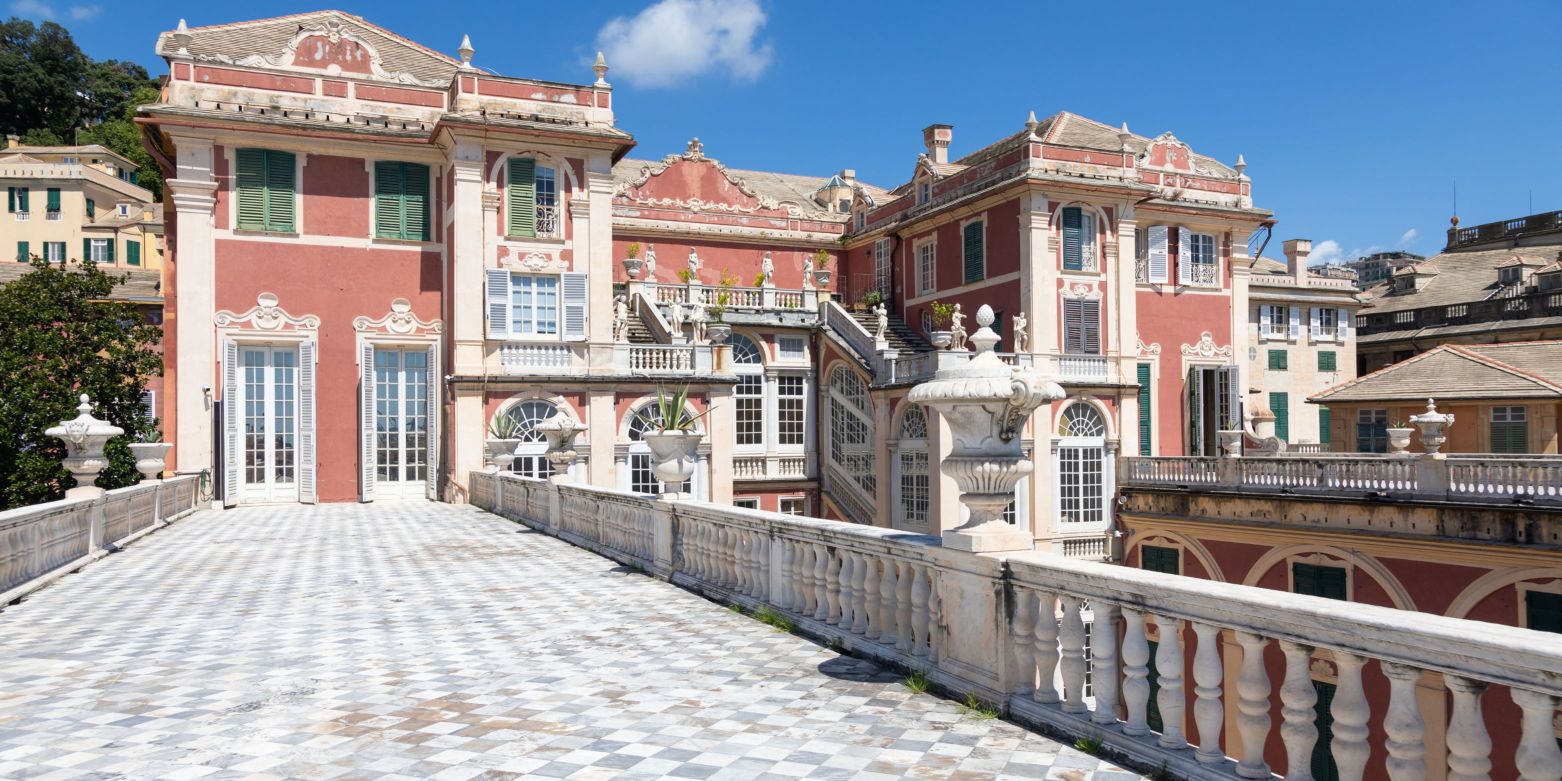
The tour begins at Palazzo Reale on Via Balbi. In the very spaces now used for exhibitions and events, Paganini performed on 9 November 1827 before Carlo Felice and the royal family. He was 45, already an international star, with a reputation that expanded far beyond Genoa.
At the time, the prestigious Teatro del Falcone was one of the key venues in Genoa’s musical life: opened in the 17th century, it was among the first Italian public theatres to stage opera.
Paganini arrived here as a star in his own right, just months before leaving Genoa for Vienna and embarking on the European tour that would reinforce his fame once and for all.
It is the perfect place to begin tracing Paganini’s Genoese story backwards and forwards.
Related story - Italy's most surprising art city explained
2. San Filippo Church and Paganini’s first Genoese audience
From the stage of the Teatro del Falcone, the itinerary winds back more than 30 years to 26 May 1794. The second stop is the Church of San Filippo on Via Lomellini, where Niccolò Paganini performed as a soloist for the first time.
He was just an 11-year-old boy, but his talent was already so striking that it earned him a place before a real audience during the celebrations for the feast of San Filippo. He would perform there again the following year.
There, Paganini began to move beyond the private sphere of musical study and discover what it meant to perform for an audience.
3. At Palazzo Tursi for Paganini’s violin
The trail continues to Palazzo Tursi, home to one of the most treasured objects linked to the Paganini legend: Il Cannone, a Guarneri del Gesù violin crafted in Cremona in 1743. Paganini considered it his favorite instrument and ensured it would remain in Genoa after his death.
The violin is displayed in the last of the three Paganini Rooms, alongside other personal belongings and mementos from his life. The name – Italian for cannon – is apt: Paganini chose it for the sheer power of its sound, remarkably intense for a stringed instrument.
The Cannone is still played on special occasions, including the prestigious Paganini Prize, with the next edition scheduled in Genoa from 11 to 24 October 2027 (see the other upcoming events).
4. Santa Maria delle Vigne and Paganini’s childhood encore
The next stop is in the heart of the old town. This church has ancient roots: founded in the 10th century, it was extensively remodelled in the 1700s and enriched with works by leading figures of the Genoese school of painting.
Among the details worth seeking out is a 15th-century bas-relief of St Eligius, shown working a chalice on an anvil. This is where the story leads us back to Paganini.
On 1 December 1794, aged 12, he performed in the church during the feast of St Eligius, patron saint of the University of Goldsmiths, one of the most important guilds in Genoa at the time.
5. Carlo Felice Theatre and Paganini’s triumphant return
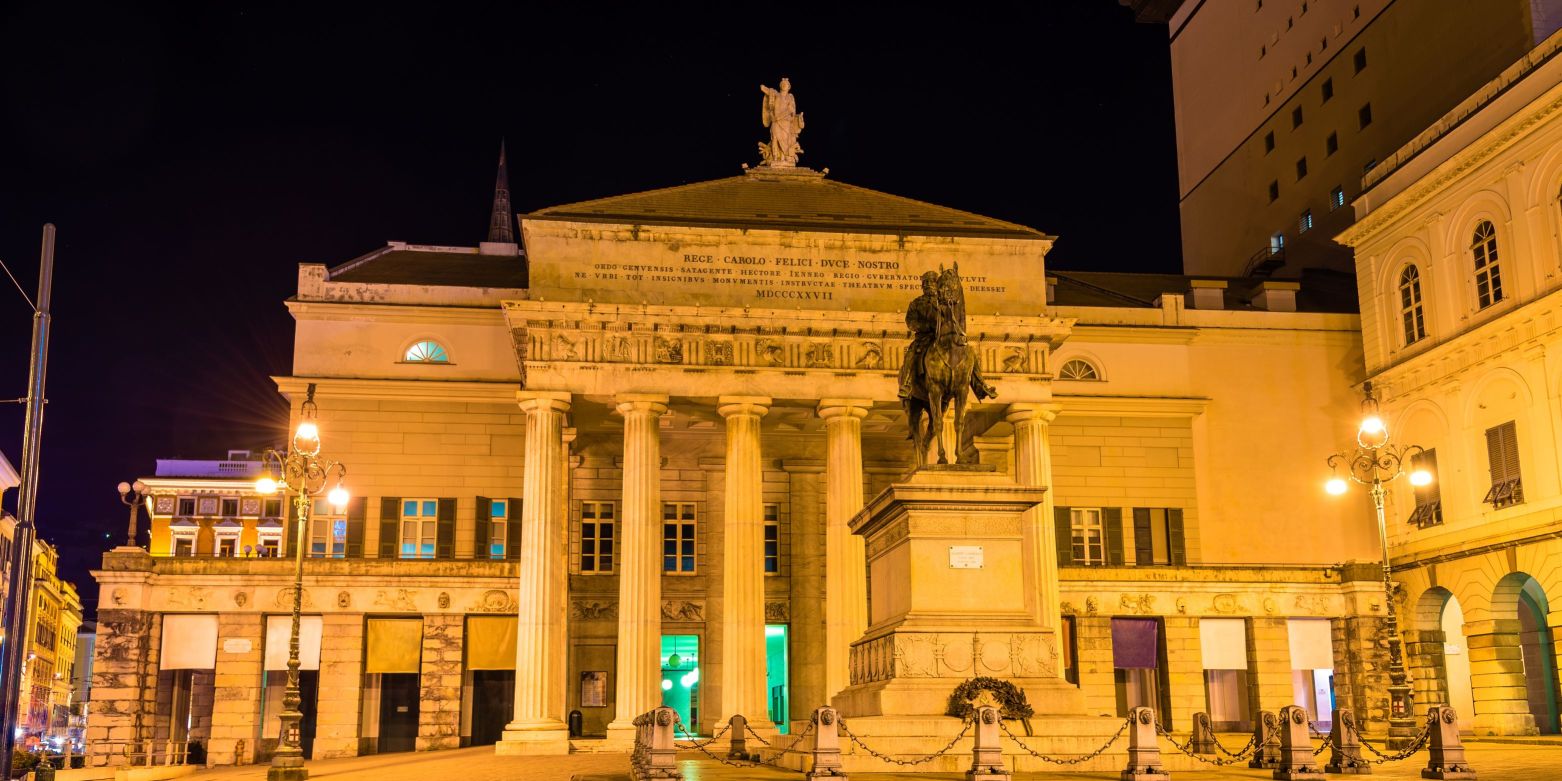
Arriving at the Teatro Carlo Felice in Piazza De Ferrari, the first figure you encounter is Paganini himself. A large bronze statue by Livio Scarpella greets visitors at the theatre’s entrance, beneath the dramatic luminous cone that has become one of the building’s defining features.
On 30 November 1834, Paganini performed at the Teatro Carlo Felice for the first time, just months after completing his long European tour. He returned to Genoa a bona fide star, and the new theatre, opened in 1828, was the perfect stage for his triumphant homecoming.
A few days later, on 5 December, he performed again in a concert to raise funds for the city’s low-income families.
6. Palazzo Pammatone
Palazzo Pammatone, Genoa’s former main public hospital, is now home to the city’s courthouse. In the summer of 1835, as a cholera epidemic hit Genoa, Paganini visited the patients there with his son, Achille, and donated money to help those most in need.
This lesser-known episode reveals a very different Paganini from the cursed, larger-than-life figure shaped by years of legend. Only the courtyard and colonnade remain from the old hospital, but a plaque still commemorates the event that occurred on 27 August 1835.
7. The Grimaldina Tower: from a prison cell to the stage
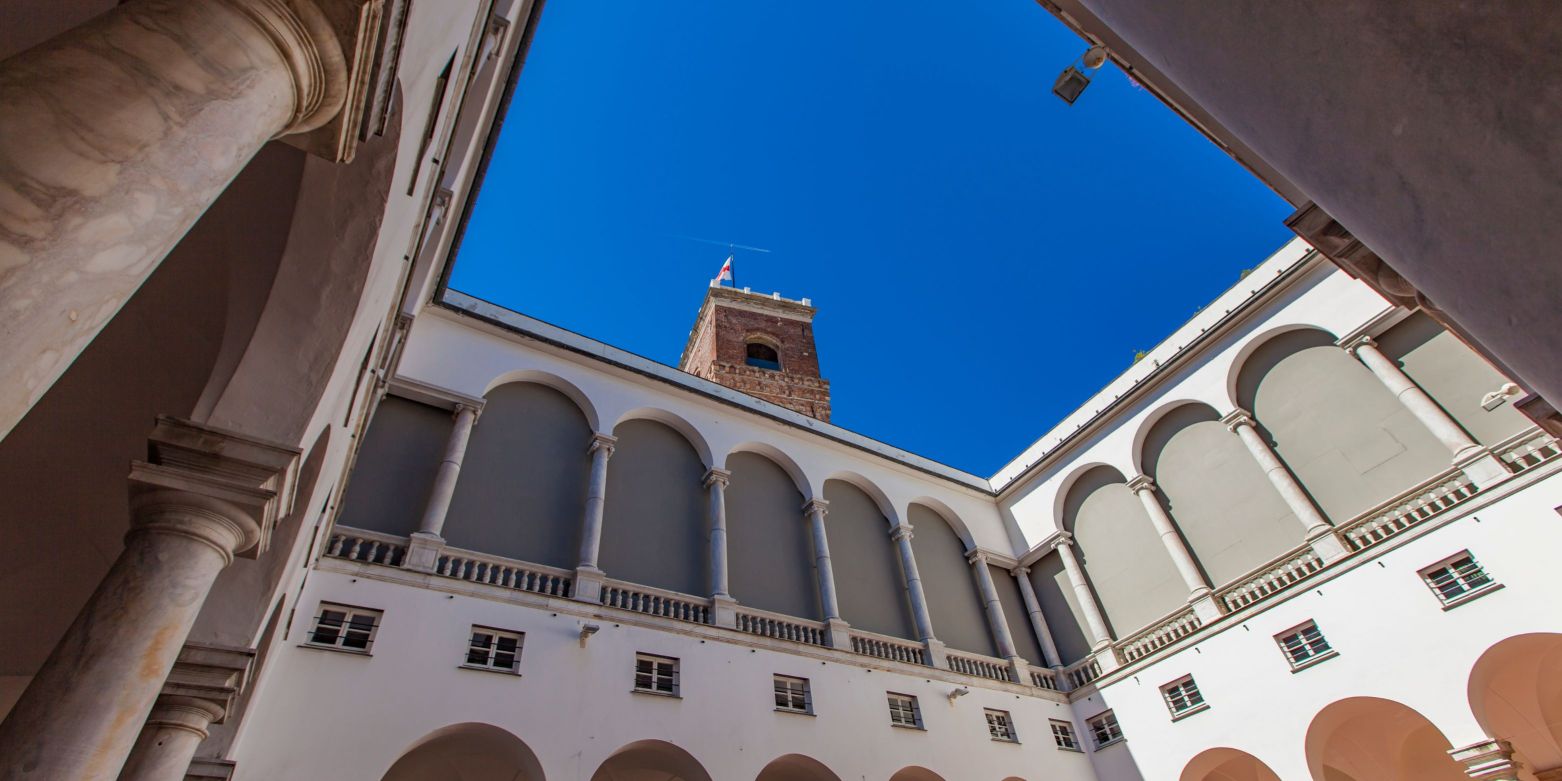
From the old Pammatone Hospital, the route leads to Palazzo Ducale. In the cells of the Grimaldina Tower, Paganini spent several days in custody in May 1815, accused of taking a young woman, Angiolina Cavanna, away from her family. He was released a few days later, but the dispute dragged on until 182, and it remains one of the most controversial episodes of his life.
Twenty years later, everything would change. On 2 January 1835, Paganini returned as the star attraction, performing at a reception hosted by Genoa’s governor at Palazzo Ducale. From a prison cell to the stage, all in the same place: now that’s a theatrical stop!
8. San Donato and the first Paganini trace
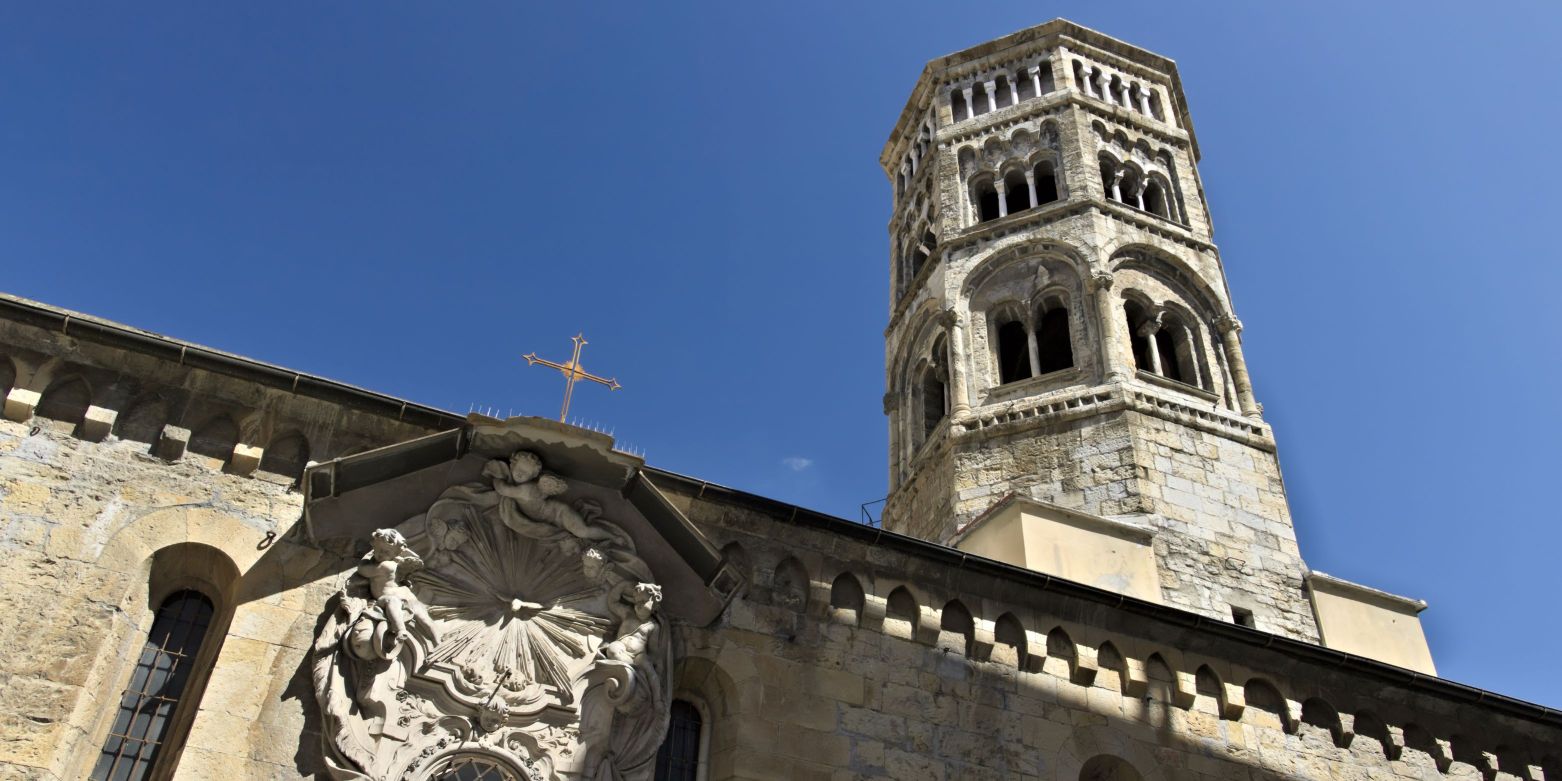
The Church of San Donato, an atmospheric Romanesque corner in Genoa’s old town, is the next stop on our Paganini tour. The earliest document connected with him – his baptismal record – is preserved inside these walls. The musician was born nearby, on Via delle Fosse del Colle, and baptised at the Church of San Salvatore.
San Donato has a few surprises of its own. The first is on a column by the entrance: a carving of a sailing ship, traditionally attributed to one of Christopher Columbus’s sailors.
Then there’s the ghost in the purple cloak: according to a legend, every autumn, the nobleman Stefano Raggi returns to wander around the church, wrapped in his distinctive purple cloak.
9. The Sant’Agostino Theatre
In Paganini’s day, the current Teatro della Tosse in Piazza Renato Negri was the site of the historic Teatro Sant’Agostino, then one of Genoa’s top stages. On 31 July 1795, aged 12, Paganini gave his first public concert here, organised to raise money for his studies in Parma with Alessandro Rolla, one of Italy’s finest violin teachers.
The present-day Teatro della Tosse, which has been based here since 1987, has helped make this corner of the old town one of Genoa’s best-known hubs for theatrical research and experimentation.
10. San Salvatore, where Paganini was baptised
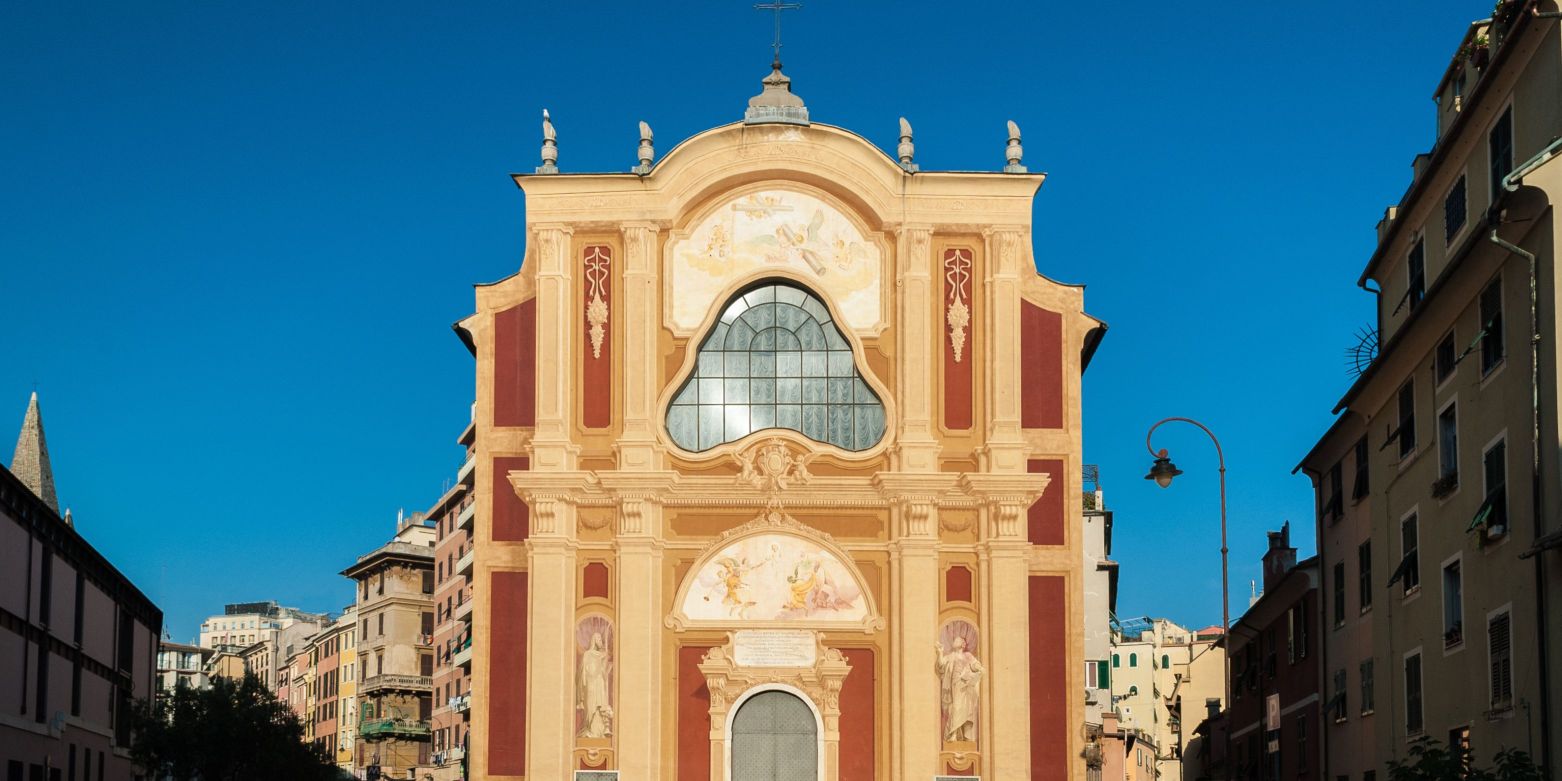
Just a few steps from Teatro della Tosse stands the former Church of San Salvatore, in Piazza Sarzano, whose origins date back to 1141. On 28 October 1782, only one day after his birth, Paganini was baptised in this very building. Since then, it has undergone a complete transformation.
Seriously damaged by bombing in 1942 and left in ruins for many years, the church was eventually restored and completely remodelled to accommodate the Aula Magna of the Faculty of Architecture. The vast nave can seat up to 340 people and is also used for concerts.
11. Villetta Di Negro, Genoa’s social salon
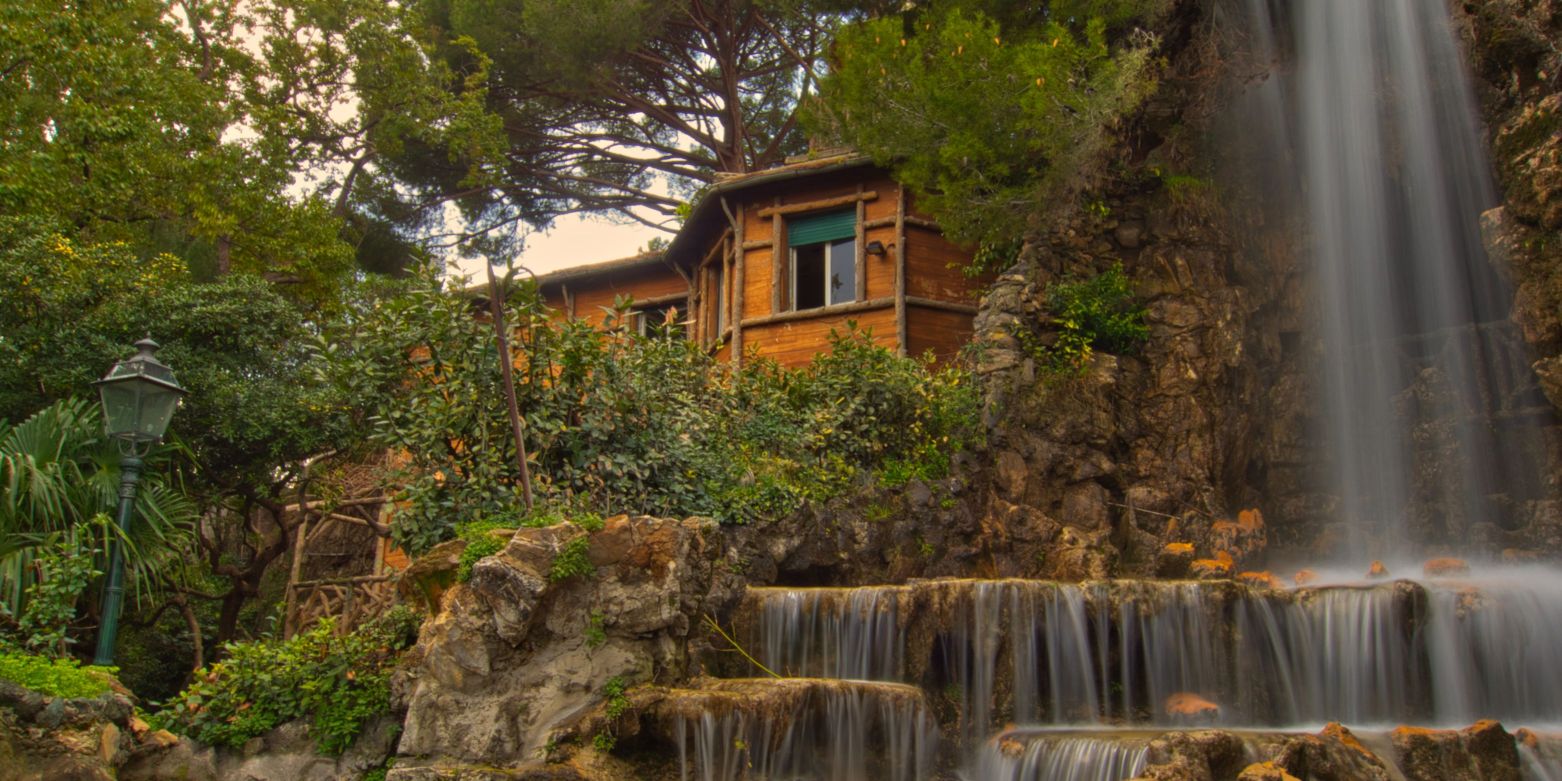
Next stop: Villetta Di Negro, the social salon of 19th-century Genoa. Marquis Gian Carlo Di Negro, a longtime supporter of Paganini, had turned his villa into an elegant meeting place for artists and intellectuals.
On 28 July 1835, during a celebration, a marble bust of Paganini by sculptor Paolo Olivari was unveiled. This tribute came while Paganini was still alive, a public honour for a musician Genoa already regarded as one of its most celebrated figures.
The place is now home to the Edoardo Chiossone Museum of Oriental Art.
12. Passo di Gattamora, where it all began
The final destination is the most personal on the Paganini trail: 38 Passo di Gattamora, formerly Via delle Fosse del Colle, in the so-called Colle area, where the musician was born on 27 October 1782.
His birthplace was demolished in 1971, when a major redevelopment project erased the old Cheullia neighbourhood to make way for Genoa’s new business district.
A plaque marks the site of the old building, where a young Niccolò received his first music lessons from his father, Antonio, and learned to play the mandolin and violin. The place is a clear reminder of how much Genoa has changed since Paganini’s time.
Paganini’s legacy becomes a European Cultural Route
Niccolò Paganini’s artistic and cultural legacy received a prestigious recognition in 2026: the European Paganini Route was certified as a Cultural Route of the Council of Europe.
Launched in 2023 and based in Genoa, the project now brings together 10 countries – Spain, France, the United Kingdom, Belgium, Italy, Austria, Hungary, Bulgaria, Albania and Croatia – and 21 partners working to celebrate the life and work of the great Genoese violinist through a programme of events, exhibitions, educational activities and artistic productions.
Genoa’s Ottobre Paganini and the Paganini Philharmonie in Vienna, a newly established orchestra dedicated to Paganini’s music, are among the initiatives developed through this cultural network.
This is the second Cultural Route of the Council of Europe dedicated to music, following the European Mozart Ways, which were certified in 2004.
Ottobre Paganini: Genoa plays host to a month of Paganini
From 2 October to 8 November 2026, Genoa celebrates one of the greatest musicians of all time with the first edition of Ottobre Paganini, a month-long programme of music, talks, concerts and events dedicated to Niccolò Paganini at venues across the city.
The programme opens with Aperitivi Paganini (1–6 October), featuring live music and flash mobs in the historic centre. Among the highlights are the Paganini e Stradivari Gala at Palazzo Ducale (2 October), the rare occasion to see the Cannone violin brought out of its case at Palazzo Tursi and played by Reiko Watanabe (3 October), and the international conference L’arco di Paganini (8–9 October) at Palazzo Ducale.
The programme continues with concerts, masterclasses, guided tours and talks, culminating in the Paganini Day on 27 October, the composer’s birthday. The day will feature concerts across the city – including performances at Brin and Principe stations – and free admission to the Paganini Rooms. Also worth noting is the European Paganini Route Day on 29 October, dedicated to the new Cultural Route of the Council of Europe.
And there’s more: on 22 October, violinist Kevin Zhu, winner of the 2018 Paganini Competition, opens the symphonic season at Teatro Carlo Felice with Violin Concerto No. 2, La campanella. Then, on 26 October, Giuseppe Gibboni, winner of the 2021 Paganini Competition, performs the complete Caprices.
Discover the full Ottobre Paganini 2026 programme and browse the official booklet for all the details.
What to know about the Paganini tour in Genoa – FAQs
Which Paganini sites are worth seeing in Genoa?
Among the most interesting places are Palazzo Tursi, home to the famous Cannone violin, Teatro Carlo Felice, Teatro del Falcone, the Oratory of San Filippo and the Church of San Donato. For those who want to delve deeper, the Amici di Paganini association has created a complete 12-stop trail through Genoa’s old town.
How long does the Paganini tour in Genoa take?
It depends on how much time you want to spend exploring. The full route can take up to around two and a half hours, but choosing just a few stops lets you create a shorter itinerary focused on the old town.
When is the best time to visit Genoa for Paganini events?
Autumn is the ideal time, particularly during Ottobre Paganini, the festival Genoa dedicates to its beloved violinist. The inaugural edition takes place from 2 October to 8 November 2026, with concerts, talks, masterclasses, guided tours and other events. But you don’t have to wait until October to follow in Paganini’s footsteps: the places on the trail can be visited all year round.
About the author
Written on 30/09/2026
Lorena Calise
I'm a content writer for magazines and websites. I also explore Italy through my writing for Visit Italy and Visit Naples.

Lorena Calise
Paganini in Genoa: 12 places to discover the man behind the legend in his hometown. The places to go (before Ottobre Paganini 2026).