
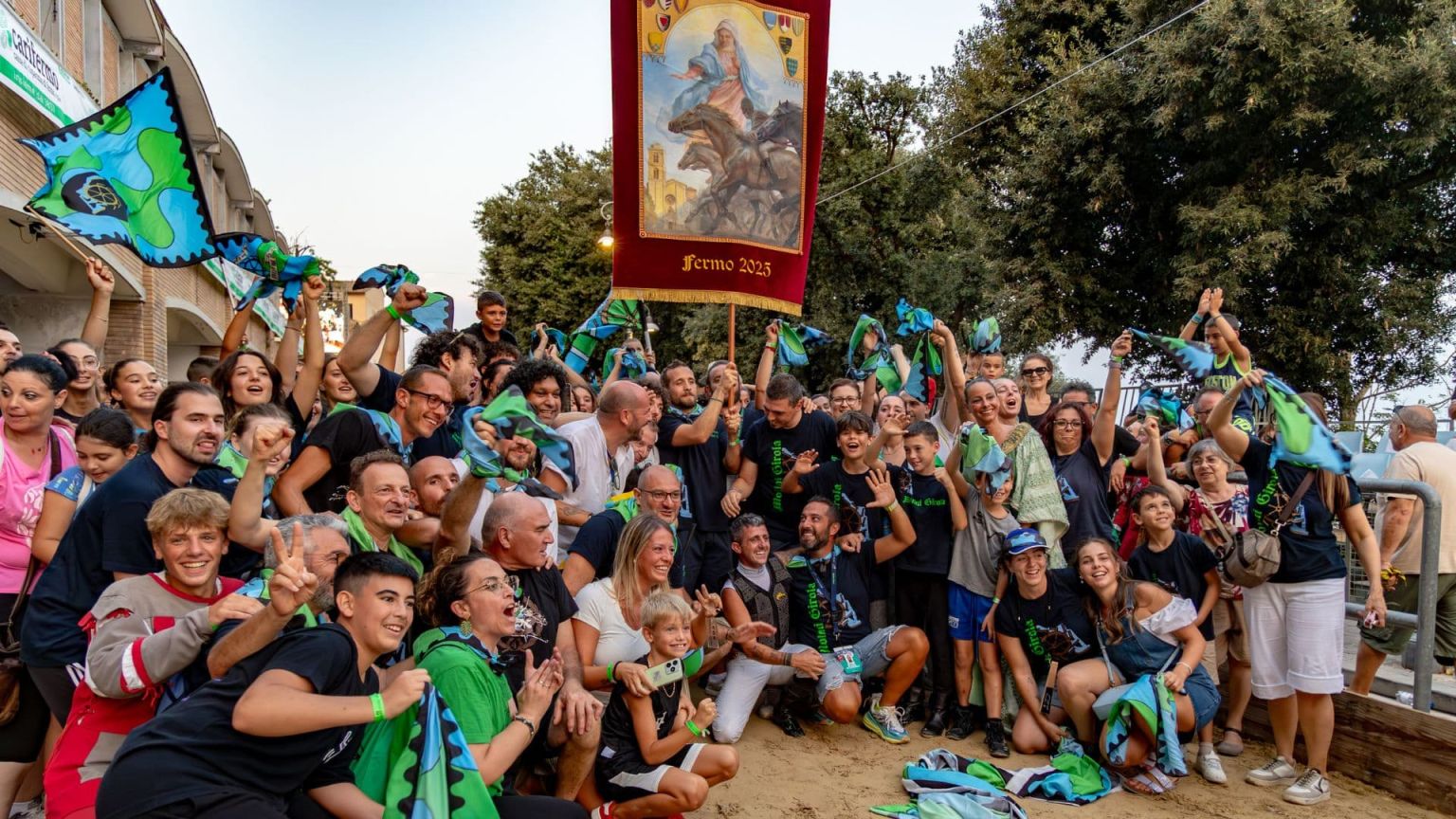

Fermo is one of those cities that doesn't simply preserve its history, it lives it every single day of the year. Every August, during the Cavalcata dell'Assunta, the city's medieval heart becomes an open-air stage where faith, local identity and collective passion come together in a centuries-old ritual. Yet what makes this event truly unique isn't just what happens on August 14 and 15. It's everything that surrounds it: before, during and after.
It's the hands sewing medieval costumes, the contrade preparing for the celebration, the children learning to wave flags and play drums, and the families gathering together. This is an immersive journey into the heart of the Fermo community, revealing how an entire city lives the anticipation and excitement of the Cavalcata.
An Anticipation That Begins Almost a Year in Advance: How Fermo Prepares for the Cavalcata
In Fermo, preparations for the Cavalcata never really stop. As early as winter, the tailoring workshops of the city's contrade begin their quiet, meticulous work of repairing and creating medieval costumes. Inspired by 15th-century fashion, these garments are made with fine fabrics and handcrafted embellishments. Every year, each costume is carefully inspected, restored or newly made for those taking part in the historical procession for the first time.
But the preparations go far beyond costumes. They are emotional, cultural and deeply rooted in the community. From spring onwards, the calendar fills with pre-Cavalcata events involving the entire city. A perfect example is the series of cultural initiatives dedicated to the history of the reenactment, including lectures, presentations and educational workshops in local schools. Through the project Il Palio si corre... a scuola ("The Palio Begins... at School"), developed in collaboration with Fermo's schools, children discover the history of the Cavalcata in the classroom, becoming young ambassadors of this centuries-old tradition. Every year, exactly one hundred days before the Palio, Piazza del Popolo fills with their miniature historical parade, officially marking the beginning of the countdown.
Meanwhile, the flag throwers and musicians of the Cavalcata Historical Group spend months training to deliver flawless performances. The spectacular flags soaring between Fermo's medieval towers are the result of years of apprenticeship, discipline and a tradition handed down from master to student according to the rules of the Scuola Picena. July officially opens the festivities with the arrival of the Palio—the painted banner created by a different artist each year—carried in procession by delegations from the surrounding castles, just as it was centuries ago.
Find out more about Cavalcata di FermoLife in the Contrade: Identity, Rivalry and Community Spirit
Understanding the Cavalcata dell'Assunta is impossible without understanding the contrade. Each district of Fermo has its own history and motto, telling the story and spirit of that particular part of the city. At the head of every contrada is the Priore, the figure who bridges tradition and the organisation of the event. Around them, dozens of volunteers work throughout the year: some manage the Hostarie, others prepare the teams competing in the various contests, some oversee everything related to the horses, while others take care of communications or welcome visitors.
The Contrade Hostarie are perhaps the most authentic expression of community participation. From the beginning of August, Piazza del Popolo transforms into one enormous communal banquet, with each contrada setting up its own open-air tavern serving traditional dishes from Fermo and the Marche region. Vincisgrassi, olive ascolane, ciauscolo, pizzette and local wine help ease the tension as sporting rivalry gives way to conviviality. Local families bring relatives and friends visiting from afar, travellers discover genuine regional flavours, and children run between the tables proudly wearing the colours of their contrada.
The rivalry between the contrade, however, goes far beyond folklore. It is deeply rooted in local identity. Every competition—from the Tiro al Canapo and the Tiro per l'Astore to the Gallo d'Oro Trophy for drummers and the Bandiere al Vento Trophy for flag throwers—is experienced as a matter of collective honour. Victory or defeat is never just personal: it belongs to an entire neighbourhood and to a shared history passed down through generations.
The Heart of the Reenactment: August 14 and 15 Between Processions, Faith and the Palio
On the evening of August 14, time seems to stand still in Fermo. The streets of the historic centre fill with a palpable sense of anticipation. Then come the drums.
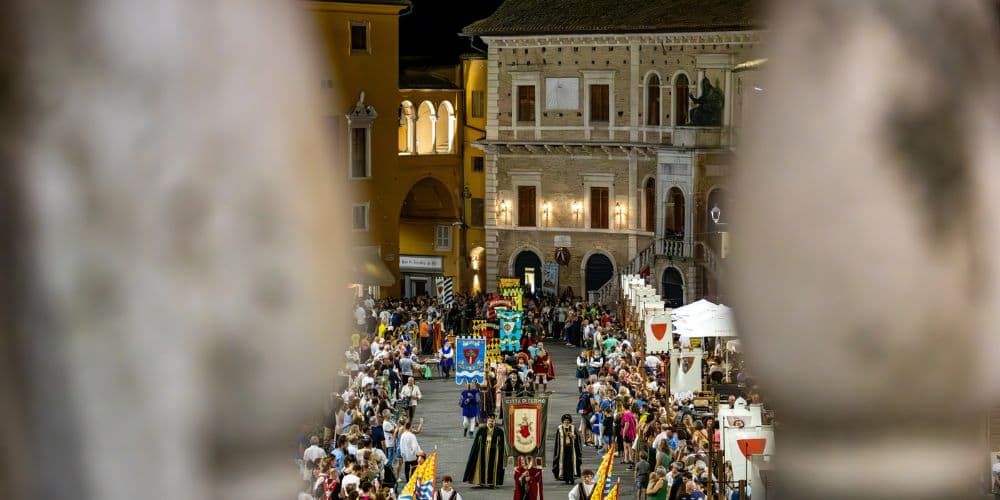
The historical procession takes shape as more than 1,000 participants dressed in magnificent 15th-century costumes parade through the city, recreating both the power of medieval Fermo and the devotion of the city and its surrounding castles to the Assumption of the Virgin Mary. It is a moment of extraordinary visual beauty, but above all one of profound historical significance. Every element of the procession is based on authentic historical documents, beginning with the Missale De Firmonibus of 1436, which preserves the earliest known visual representation of the procession.
On the morning of August 15, the city experiences its most spiritual moment. First comes the ceremonial presentation of the Giubba by the Priori to the jockeys who will defend the colours of their contrade in the Palio, followed by the solemn Mass in the Cathedral of Santa Maria Assunta on the Girfalco hill, the highest point in Fermo. This collective act of devotion reflects the deepest roots of the Cavalcata, making it the only historical reenactment in Italy that still preserves a genuine and actively practised religious foundation.
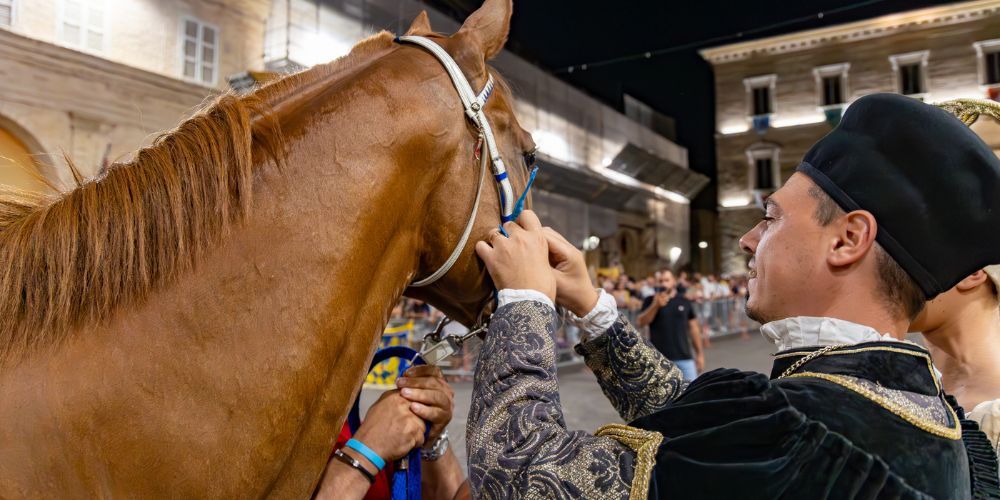
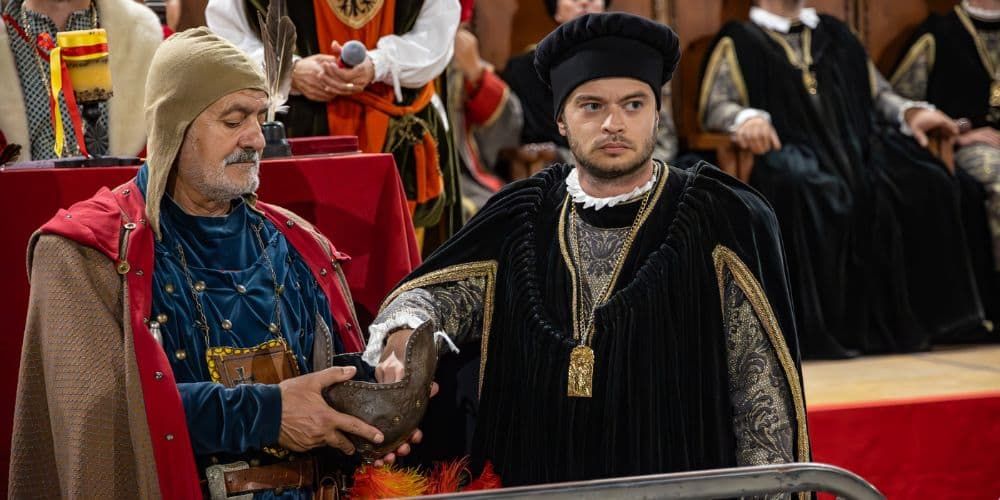
The afternoon of August 15 belongs to the Palio. Yet the excitement begins even earlier, on August 12, with the Tratta dei Bàrberi—the ceremony during which horses are assigned to the contrade by lottery. It is one of the most captivating moments of the entire celebration. The Podestà draws the name of a contrada from the helmet of the captain representing the previous year's winning district, while the Priore then draws the name of the horse from the helmet of the Captain of Arms of the Cernita. It is destiny unfolding before everyone's eyes. Just a few seconds that can change the history of an entire contrada.
The horse race takes place on a course through the city streets. After two qualifying heats, the five fastest contrade compete in the final race to win the coveted painted banner.
After the Palio: How the People of Fermo Preserve and Pass On Their Tradition
When the banner is finally awarded to the winning contrada, the Cavalcata doesn't truly come to an end. For the people of Fermo, the days after the Palio are a time for reflection and shared memories. The contrade gather to look back on the season, photographers and videographers work to preserve every moment, and images of the reenactment spread across social media, becoming a collective album that strengthens local pride. At the same time, the countdown to the following August 15 quietly begins once again.
Yet the most important legacy is passed on within families and schools. The children who marched in the "100 Days to the Palio" parade grow up carrying this tradition within them. Young people who learn to play the drums or wave the flags become next year's participants, and eventually the masters who will teach future generations. It is a living chain of practical knowledge and cultural identity that continues to thrive because it belongs not only to books, but to people.
The Cavalcata dell'Assunta is therefore not a spectacle that comes to life in summer only to fade away after August 15. It is a rhythm that shapes the life of an entire community throughout the year. Visiting it means stepping into Fermo not simply as a spectator, but as a welcomed guest in a city that has chosen to make its history the measure of its present. And every year, as reliably as the August sun, it rediscovers itself in the folds of a medieval costume, in the beat of a drum, in the gallop of a horse and in the flight of a flag above its ancient stone rooftops.
About the author
Written on 31/07/2026
Redazione Visit Italy
Visit Italy is a cultural platform dedicated to illuminating hidden places, untold stories, and overlooked beauty. Because every corner of Italy deserves discovery.

Redazione Visit Italy
The Cavalcata dell'Assunta is almost here. Step inside the contrade and discover how Fermo lives this unique tradition.