
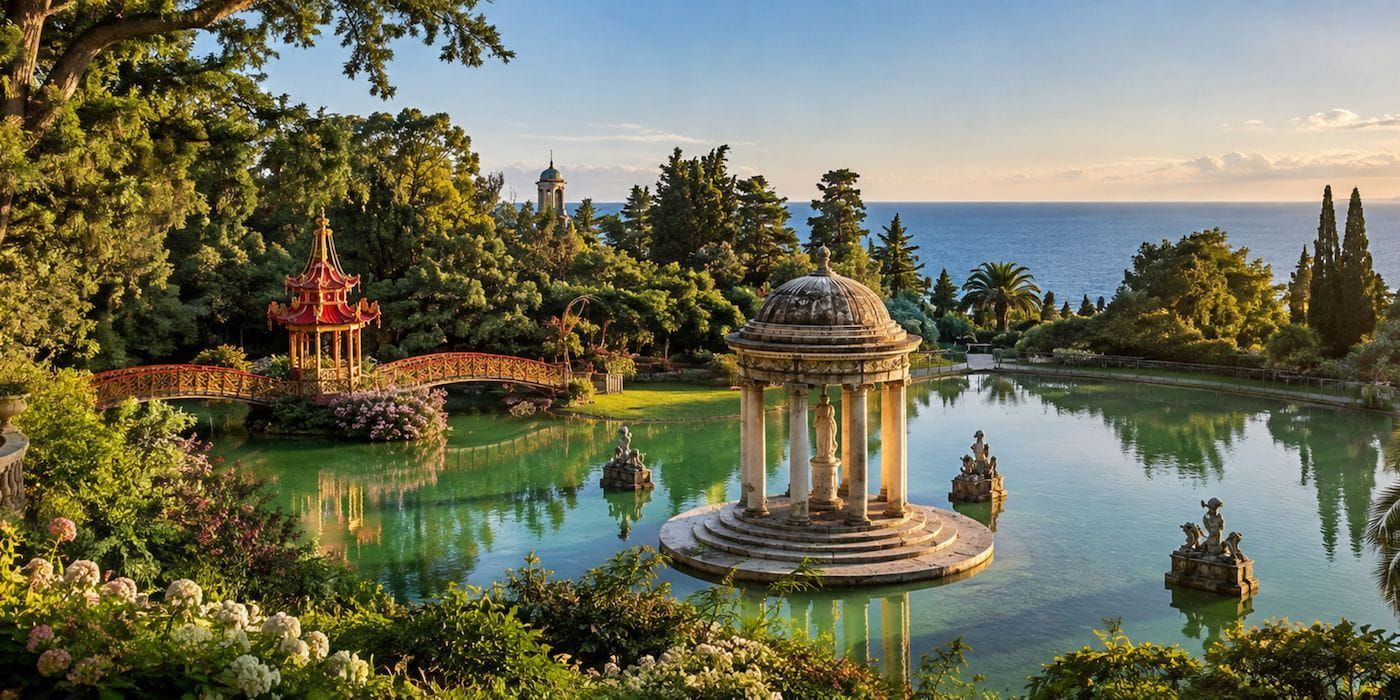

At first glance, it looks like any other garden. Then the curving paths appear, followed by caves, lakes, castles, obelisks, pagodas, esoteric symbols – and suddenly it feels as though you’ve wandered onto a film set. Villa Durazzo Pallavicini is, in fact, a historic Romantic park designed in the 19th century as a theatrical journey, with each turn disclosing a new scene.
With its exotic touches, unexpected views, and corners that seem caught in time – yet just a short distance from Genoa’s historic centre – a stroll here feels more like a small adventure. This is our guide to one of Italy’s most surreal gardens.

Villa Durazzo Pallavicini: the surreal Genoa garden that feels like a dream
It doesn’t take long to realise that Villa Durazzo Pallavicini is no ordinary park. The paths, planting and buildings have all been designed to surprise, drawing visitors deeper into a fascinating story with every step.
Created between 1840 and 1846 at the request of the Marquis Ignazio Alessandro Pallavicini, the garden develops as a surreal theatrical tale, winding uphill across more than eight hectares of hillside.
The man behind it was Michele Canzio, a set designer at Genoa’s Teatro Carlo Felice, who approached the park much as he would a stage production: there’s a prologue, a prelude, three acts – each divided into four scenes – and a final epilogue.
This dreamlike landscape, with its hints of esoteric and Masonic symbolism, is filled with ponds and streams, rare plants and fantastical buildings, elaborate caves and even an underground lake.
But the magic isn’t just in what you see, or in the beauty of the park itself. It lies in the idea behind it. Villa Durazzo Pallavicini was conceived as a kind of initiation journey, a symbolic route through different experiences, with the visitor moving from scene to scene towards an eventual transformation.
If you’re planning to spend a few days in Genoa, you might want to add Villa Durazzo Pallavicini to your itinerary, especially if you’re looking for a place a little off the beaten path.
Don’t miss:
– Museo di Archeologia Ligure: Housed in the villa, it features Ligurian archaeological finds from prehistory to the Roman period.
– Orto Botanico Clelia Durazzo Grimaldi: Created in 1794 at the Marchioness Clelia Durazzo's request, the botanical garden holds a rich collection of plants. It is currently closed for restoration.
– Grotte degli Inferi: One of the most striking sets along the route, with stalactites and stalagmites brought from natural caves across Liguria, plus a small underground lake.
– Lago Grande: One of the park’s most atmospheric views.
– Historic Camellia Garden: One of the oldest in Italy and one of the park’s botanical highlights, with around 150 specimens of Camellia japonica.
– The Castle and Captain’s Mausoleum: Two settings in the second act, ‘The Recovery of History’, which shifts the mood toward something distinctly medieval.
– Giardini di Flora: Part of the third act, ‘The Catharsis’, where the botanical side of the garden becomes intertwined once again with its symbolic themes.
More on Genoa and its attractionsAn enchanted garden in Genoa
It’s not just the landscape that makes Villa Durazzo Pallavicini so special. As far back as the 19th century, the park drew visitors from across Europe, captivated by a place magnetic in its own way: a Romantic garden, certainly, but also mysterious, theatrical, and deliberately eccentric.
Its appeal today lies in everything you discover along the way, and in the details designed to catch you off guard: the maze of paths, the elaborate network of waterways, and the many eclectic buildings that play with different eras and influences.
But there’s a hidden layer, too. The garden’s esoteric and Masonic symbolism adds a second, more philosophical way of reading the experience, with the route becoming an initiation of sorts. To reach the heart of the park, you first have to pass through the entrance gate, watched over by two menacing stone dogs, then make your way through dense woodland – a kind of Dante’s dark wood – before crossing the Arch of Triumph, where a Latin inscription invites you to leave civilisation behind and return to nature.
And that’s where the journey begins.
Related story - Genoa 2026: our ultimate guide
Act One: The Return to Nature
@italiaroute Villa Durazzo Pallavicini #genova #villadurazzopallavicini #giardini #italiaroute ♬ Paradise - Sade
From here, the trail leads into a green, green world and towards the first of the villa’s three acts. Once you’ve passed through the Arch of Triumph, turn around, and there’s the first surprise: what looked like a grand monument from the front becomes, from behind, a rustic building known as Romitaggio (the Hermitage).
The path then winds through lush, wonderfully theatrical planting, with palms, camellias and species brought here from all over the world.
Then the mood shifts again as you reach the fairytale Parco dei Divertimenti and its 19th-century amusements, followed by the Old Lake and, finally, the Spring, the small, recently restored waterfall that feeds the pond.
Act One: The Return to Nature
- Scene One – The Hermitage
- Scene Two – The Amusement Park
- Scene Three – The Old Lake
- Scene Four – The Spring
Act Two: Ruins, castles and the garden’s more mysterious side
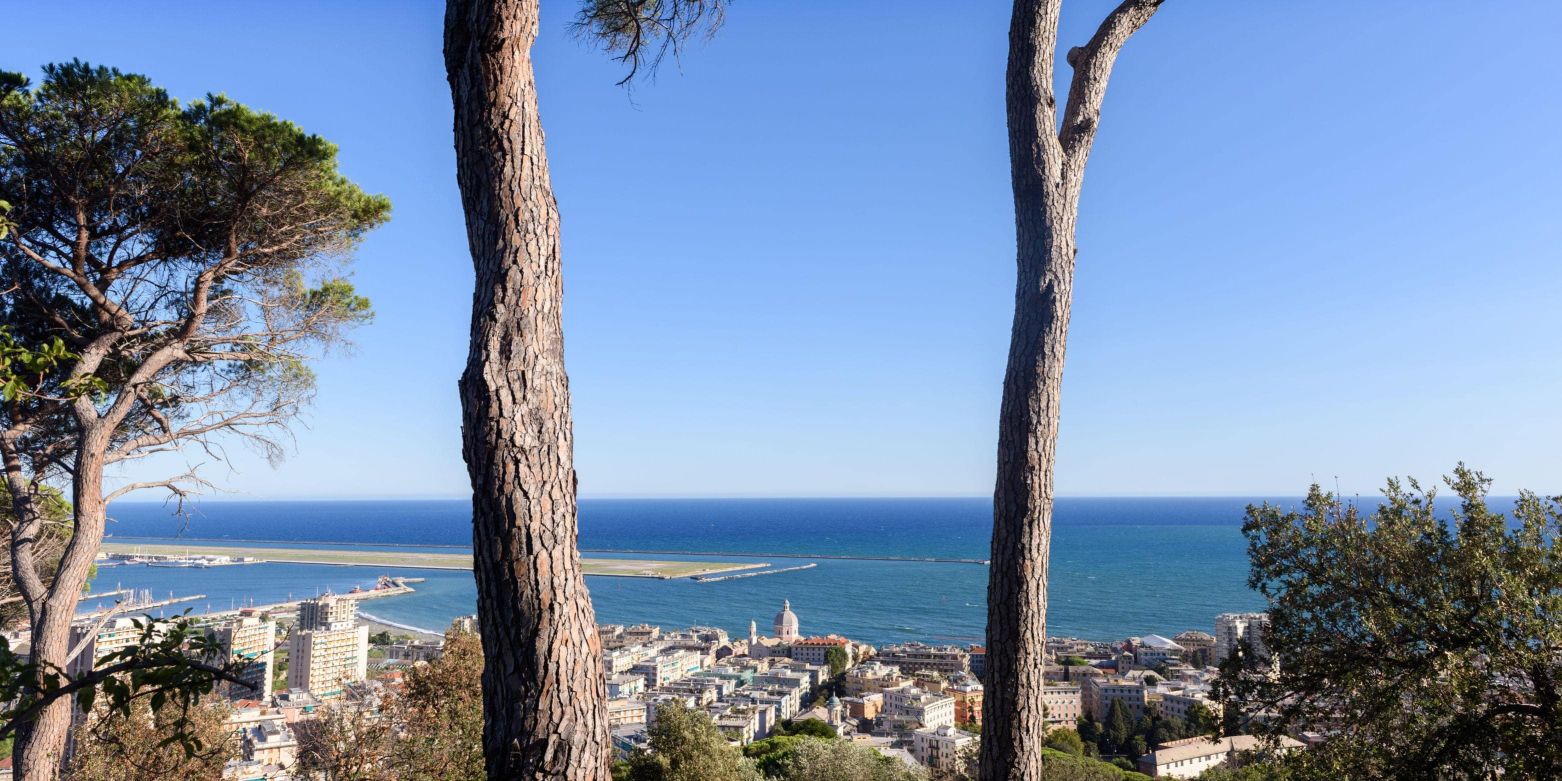
The itinerary continues higher into the park, and through the trees the sea gradually comes into view. This marks the beginning of the second act, The Recovery of History, introduced by a small Gothic chapel that signals the entrance to the medieval village, with its so-called Swiss Cottage.
At the top of the hill stands Il Castello del Capitano (the captain's castle). Canzio wanted it to be a true Medieval castle, so it comes with a tower, battlements and a drawbridge. On the opposite hill, a farm building has been given the appearance of an enemy fortress.
Under all this theatrical setting, there is an allegorical story. The Captain has built his own fiefdom, defended its borders and pursued power, wealth and glory. Yet by the time you reach the Mausoleum, the act’s final scene, everything takes on a different meaning. The castle lies in ruins, only a hut remains of the village, and its lord is gone too.
It’s the moment when the garden reminds us how fragile the things we think will last forever really are.
Act Two: The Recovery of History
- Scene One – The Chapel of Maria
- Scene Two – The Swiss Cottage
- Scene Three – The Captain’s Castle
- Scene Four – The Captain’s Mausoleum
The caves and the underworld hidden beneath the trees
The descent into the underworld is the most theatrical part of a visit to Villa Durazzo Pallavicini. You enter the caves, with their stalactites, stalagmites and passages cut into the rock, into a world that was once explored by boat in the 19th century, a kind of journey into the afterlife.
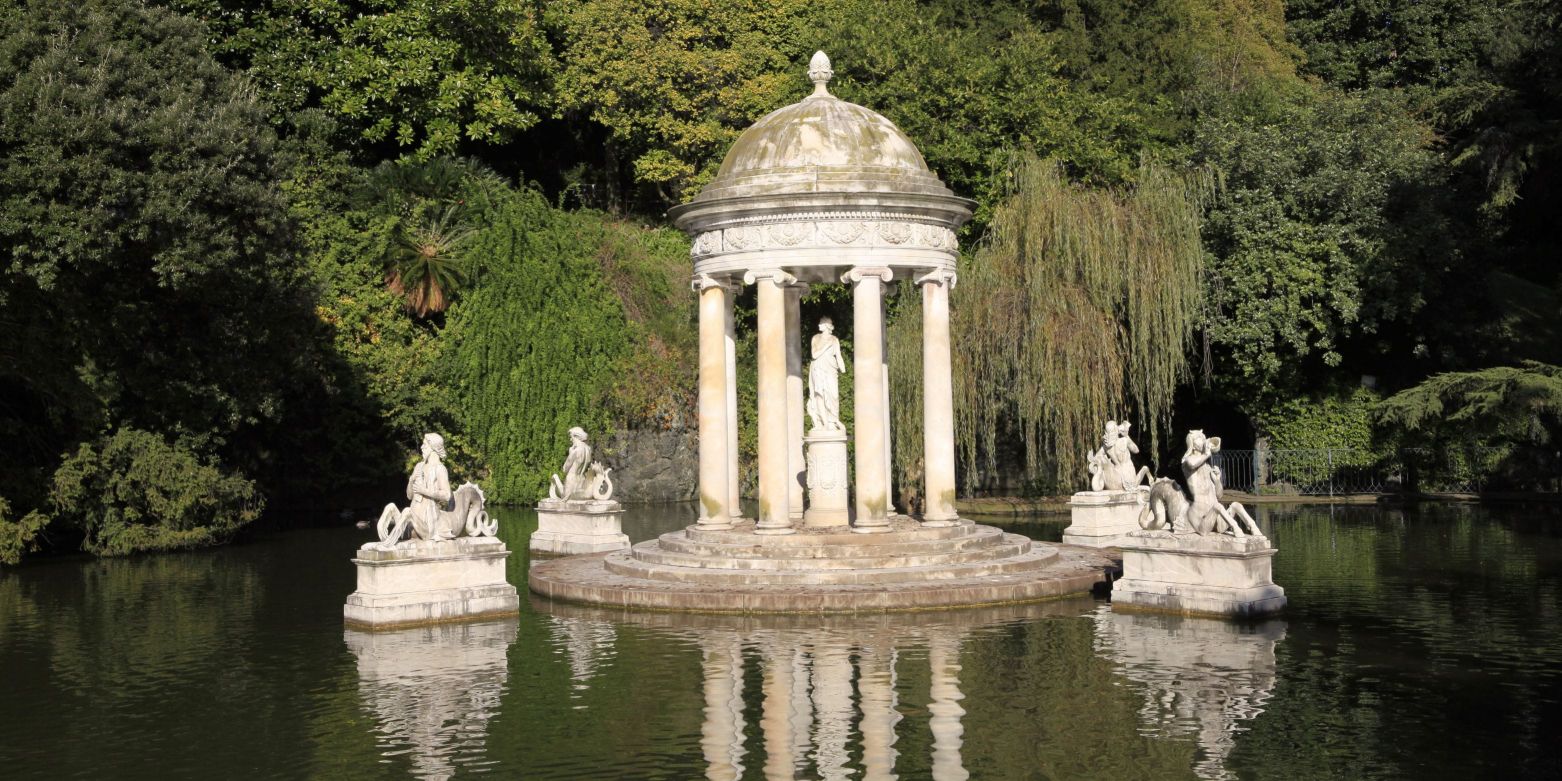
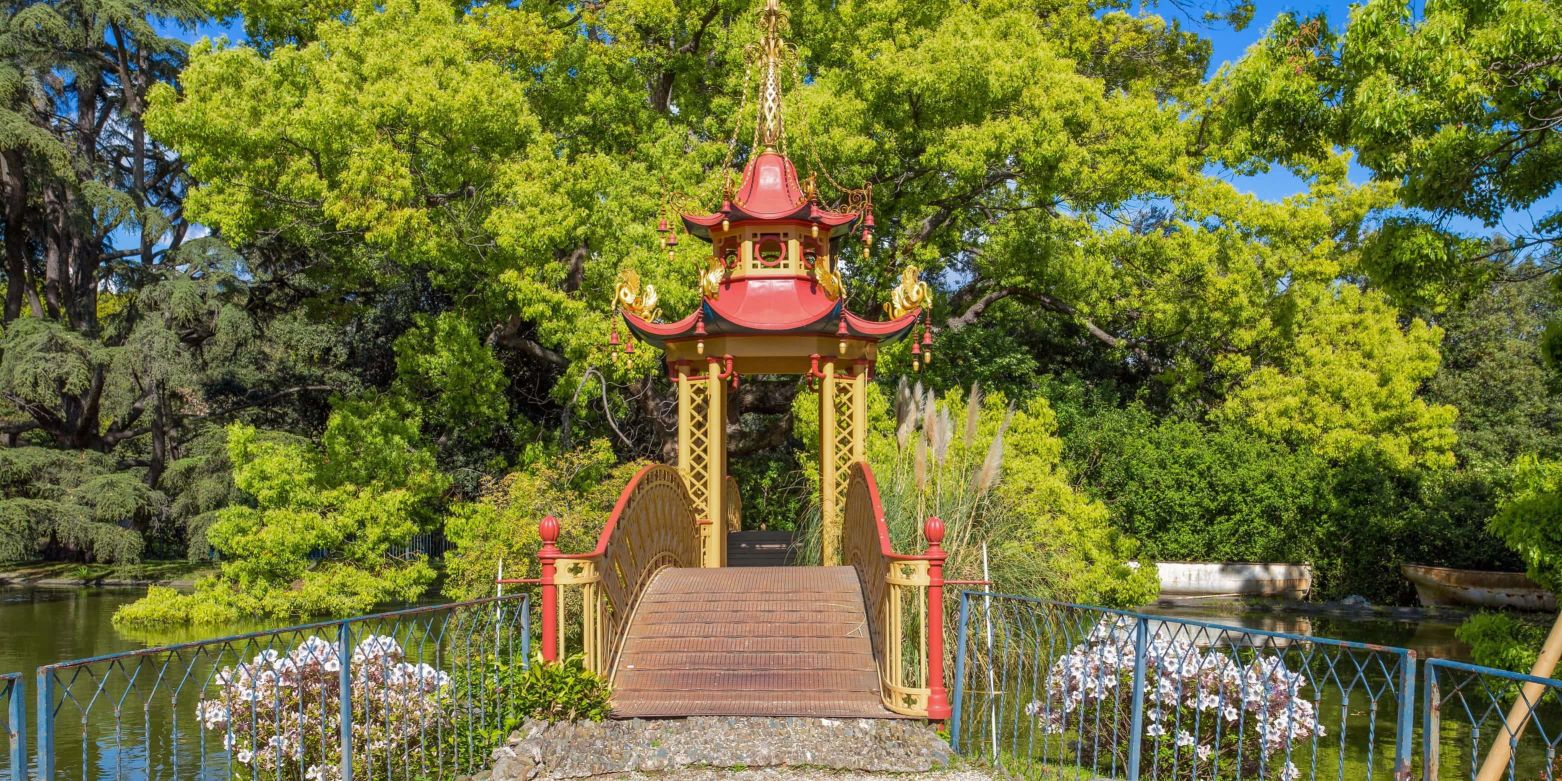
Eventually, the caves give way to the Lago Grande, the park’s version of paradise, surrounded by a pagoda, an obelisk, a bridge and a series of pavilions drawing on both Eastern and Mediterranean styles. At its centre stands the Temple of Diana. Opposite the caves, I Giardini di Flora gardens open out in a burst of light and lush planting.
This is the moment of catharsis: after passing through darkness and death, you emerge into light and nature with renewed harmony.
Act Three: The Catharsis
- Scene One – The Caves / Dante’s Inferno
- Scene Two – The Lago Grande
- Scene Three – The Giardini di Flora
- Scene Four – The Remembrance
The historic camellia garden, the most ancient in Italy
There’s also another reason to visit Villa Durazzo Pallavicini: the flowering of its historic camellia garden, between February and April.
Created in 1856, the avenue is home to 150 Camellia japonica plants, many of them more than six metres tall. Some of the oldest, including several more than a century old, are among the park’s most prized plants.
But the collection hasn’t stood still. More recently, new Camellia reticulata have been planted, including several scented varieties. During the flowering season, staff usually hold guided botanical walks on weekends for a closer look at one of the garden’s gentler treasures.
How long does it take to visit Villa Durazzo Pallavicini, and how should you plan it?
The route through Villa Durazzo Pallavicini covers around 2.5km and winds across almost nine hectares of hillside. You can explore the park on your own or join a guided tour. The visit takes around three hours, but there’s also a more in-depth tour exploring the garden’s esoteric and Masonic symbolism, which lasts around four hours.
The best approach? Follow the route in its natural order, from the entrance through to the final Epilogue, and give yourself time to take in the sets, planting and views along the way.
In summer, you can experience the garden in a unique way with guided evening visits and moonlit walks. During the flowering season, from late February to early April, you can also join a two-hour guided exploration of the historic camellia garden.
Special events take place throughout the year, like the atmospheric Ferragosto sunrise, when the villa opens its doors to watch the sun rise from the Captain’s Castle.
Related story - The most beautiful palaces to visit in Genoa this year
How to get to Villa Durazzo Pallavicini in Genoa Pegli
Getting to Villa Durazzo Pallavicini is fairly easy, especially by train. Genova Pegli railway station is right next to the park entrance, with regional trains running roughly every 15 minutes.
Alternatively, from the historic centre of Genoa, take AMT bus 1 and get off at the Lungomare 1-FS stop. You can also arrive via Navebus, which connects the Porto Antico with the Pegli district.
If you’re driving, take the Genova Pegli exit from the A10 if you’re coming from the west, or the A12 if you’re travelling from the east. The nearest car park is at Molo Archetti on the seafront, around a three-minute walk from the Villa Durazzo Pallavicini ticket office.
What to know before visiting Villa Durazzo Pallavicini in Genoa - FAQs
How much does it cost to visit Villa Durazzo Pallavicini?
A standard ticket costs €11 on weekdays and €13 at weekends and on public holidays. Reduced rates are available for various categories, as well as for children aged 6 to 12. Children aged five and under go free. There’s also a combined ticket for the park and Museo di Archeologia Ligure, costing €13 on weekdays and €16 at weekends and on public holidays.
How long do you need to visit Villa Durazzo Pallavicini?
A classic guided tour takes around three hours, while the walk exploring the garden’s esoteric and Masonic symbolism lasts around four hours. If you choose to explore independently, you can take as long as you like.
When is the best time to visit Villa Durazzo Pallavicini, and what are the opening hours?
The park is generally open from late February to early November, Tuesday to Sunday, with seasonal opening hours. In spring and autumn, it is usually open from 9.30 am to 6 pm, while in summer it stays open until 7 pm on weekdays and 7.30 pm on weekends and public holidays. Last admission is two hours before closing. For the latest opening hours, check the official website.
About the author
Written on 03/11/2026
Lorena Calise
I'm a content writer for magazines and websites. I also explore Italy through my writing for Visit Italy and Visit Naples.

Lorena Calise
In Genoa Pegli, a romantic 19th-century garden appears like an open-air theatre, with caves, lakes, waterfalls, and mysterious symbols.