
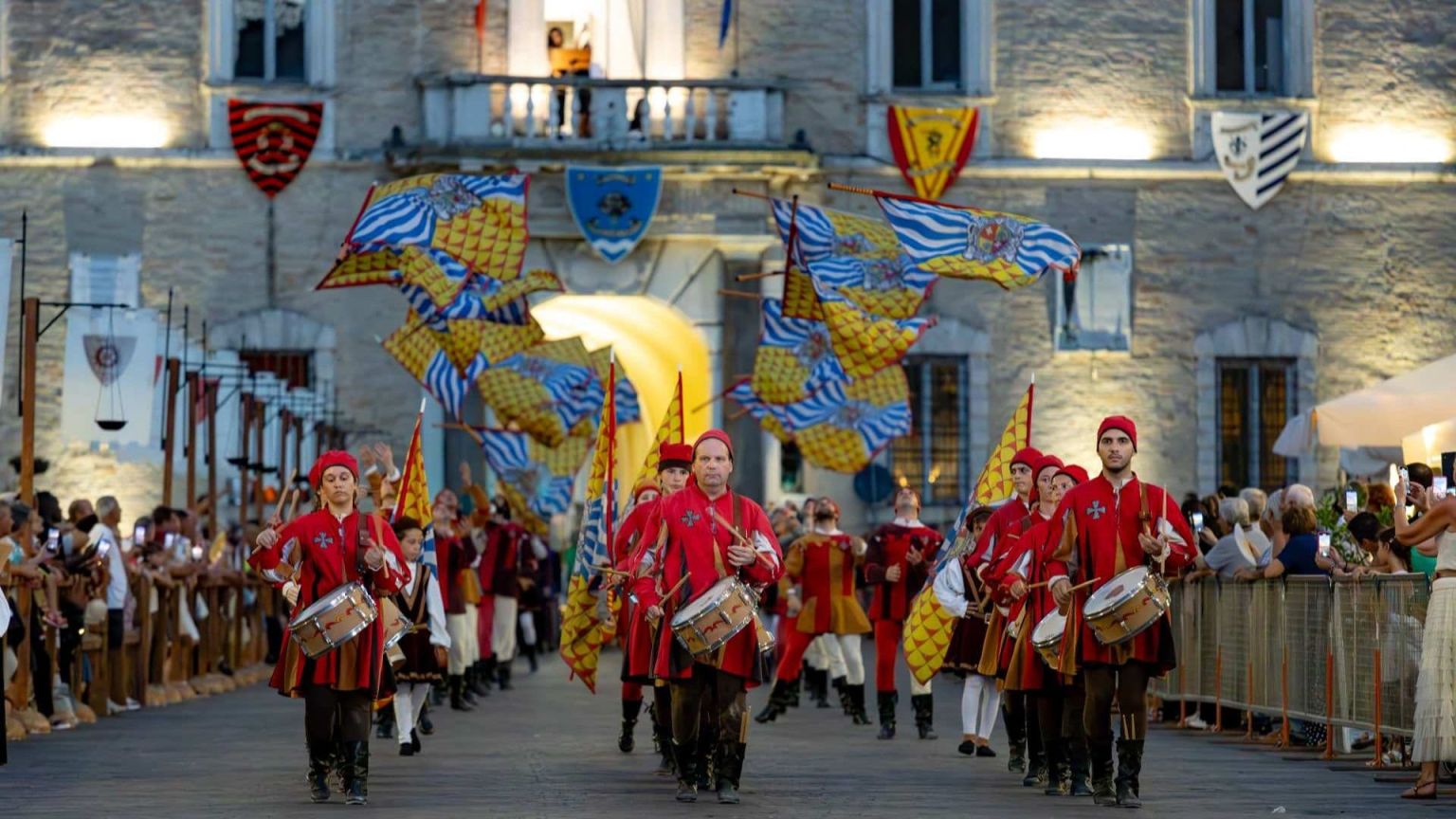

In Fermo, you know the days of the Cavalcata dell’Assunta are approaching the moment you hear a sound.
It is a deep, resonant beat rising from the narrow alleys, bouncing off the city walls, and slipping into the houses. The drums announce the coming of the Cavalcata. And in that instant, time seems to stop. Fermo moves backward along the timeline, becoming once again a medieval city, yet one that is still alive and welcoming.
During the days of the Cavalcata dell’Assunta, Fermo speaks an ancient language, marked by the rhythm of the drums.
Find out more about Cavalcata di Fermo
The drums: the heart of the Cavalcata dell’Assunta’s music
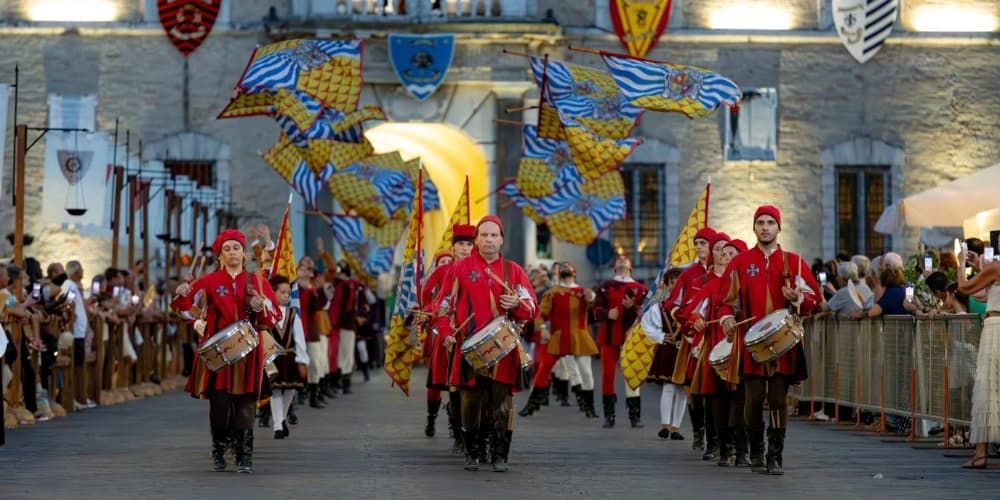
The drums are the first to be heard. They arrive in the late afternoon, when the heat fades and the squares begin to fill. Their rolls overlap, chase one another, and weave a sonic fabric that accompanies Fermo for hours.
It is a full, heavy sound, felt in the chest before it is heard in the ears.
Once, drums were used to prepare for battle or celebration. Today they still serve the same purpose: they announce. They warn the city and prepare those who arrive. Every strike seems to say: those long-awaited days are about to begin.
If you follow the rhythm through the alleys, you often find yourself in an open square where young drummers rehearse again and again, with focus and pride. The rhythm is never random; each district (Contrada) has its own “steps” (specific rhythms), designed to intimidate opponents and highlight the unity of the group.
The Clarions: the voice that calls
If the drums are the heart, the clarions are the voice of Fermo during the Cavalcata. Their sharp, solemn sound cuts through space.
The clarion is a long, straight brass instrument. As a natural wind instrument, the musician can only produce notes from the harmonic series by adjusting lip pressure. These powerful instruments once served to announce the start of hostilities (the horse race) and the entry of the Palio into Piazza del Popolo. Originally, they were used to transmit signals over long distances during battles or public ceremonies.
Today, especially for visitors, the clarions become an invisible guide. Without maps, they point to where something is happening. Following their sound inevitably leads you into the heart of the celebration.
The Flags: the sky enters the Cavalcata
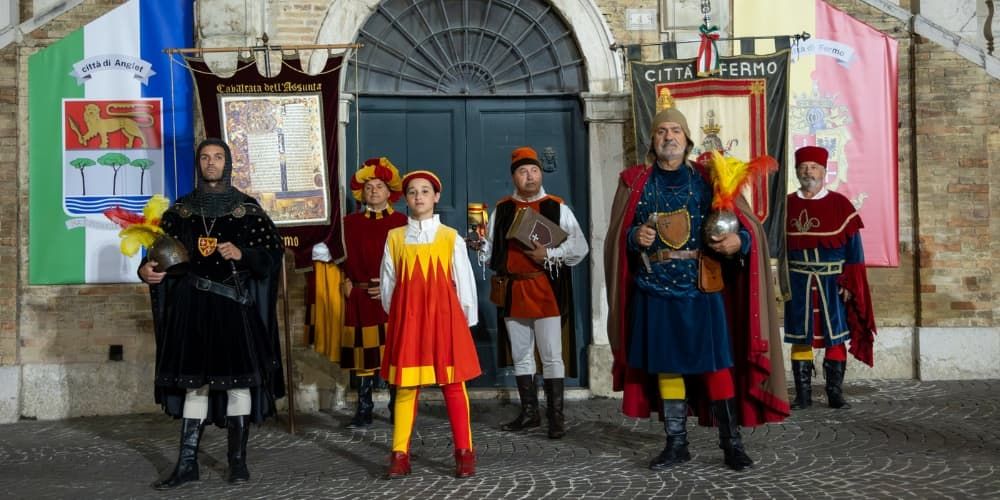
Then, almost without noticing, your gaze is drawn upward. Because alongside sound, in Fermo, there is movement in the sky: the flags.
During the Palio days, the flags of the various Contrade turn the sky into a stage. Visitors find themselves looking upward as colors rise and intertwine in carefully choreographed routines.
The banners display the colors and heraldic symbols of the ten districts (Contrade). The flagpoles are balanced with a counterweight at the base, allowing spins, throws, and exchanges between flag bearers.
The flag throw is one of the most intense moments, holding the audience in suspense: the flag rises and hangs in the air for an instant that feels eternal. Then it returns to the hands of the performer, who catches it with confident precision. Applause comes naturally—but briefly—because the flag bearers are already moving into the next sequence.
These performances are not merely acrobatic displays. Every movement expresses pride and belonging. The distances between performers, the height of the throws, and the timing of the returns follow a grammar rooted in the Middle Ages: nothing is left to chance.
During the most magical event for flag lovers, Bandiere al vento, the colors of the Contrade synchronize with the beat of the drums. In the Fermana night, sound and movement merge into an unforgettable spectacle.
Walking through a city that sounds and moves
During the days of the Cavalcata dell’Assunta, Fermo offers an immersive experience. You walk and you listen. Every street invites attention; something is always happening.
The historic center becomes fully immersive. The medieval walls amplify sound, the squares spread it, and the narrow alleys focus it. The use of flags creates visual dynamism, maintaining a constant dialogue between sound and sight.
In short, the visitor is never still. Travel becomes different: less rational, more sensory.
The night: when the Middle Ages take shape
This sensation intensifies as evening falls. Lights dim, and torches illuminate the paths. In these moments, the Middle Ages seem to materialize. It is not a historical reconstruction, it feels more like the Middle Ages themselves are asking to be truly experienced.
Many visitors say they eventually stop taking photos, choosing instead to immerse themselves fully in the atmosphere.
About the author
Written on 05/05/2026
Redazione Visit Italy
Visit Italy is a cultural platform dedicated to illuminating hidden places, untold stories, and overlooked beauty. Because every corner of Italy deserves discovery.

Redazione Visit Italy
The sound of the Cavalcata dell’Assunta: drums, chants, and medieval music transform Fermo into a living stage.