


Growth alone is not enough. A destination can increase arrivals, visibility, and desirability while losing something essential at the same time. It can fill up with people and yet be emptied of meaning. It can become more visited while becoming less livable. This is where the real challenge of contemporary tourism is being played out today, in Italy as much as anywhere else in the world.
In recent years, travel has changed profoundly. Travelers are looking for authenticity, quality, and a deeper connection with places and the communities that live in them. But precisely when a destination succeeds in attracting attention, the most important question begins to emerge. How can it keep growing without breaking the balance that makes that place special?
Out of this question comes the Tourism Sustainability Equation, a model introduced by Ruben Santopietro that proposes reading tourism not as a simple sum of visitor flows, but as a balance between what a place can welcome, what a community can sustain, and what a traveler can truly experience.
At its core are three dimensions that can no longer be treated separately. The well-being of residents, because no destination remains authentic if the people who live there lose their quality of life. The carrying capacity of the place, because spaces, services, infrastructure, and the housing market all have limits that cannot be ignored. The quality of the experience, because travel loses its value when it encounters places that are congested, standardized, and stripped of their truth.

The Equation of Tourism Sustainability: when those who arrive and those who remain coexist

This is exactly what makes the Equation relevant not only to those who work every day in destinations, but also to those who study tourism as an economic, social, and cultural phenomenon. Because it attempts to hold together what is too often kept apart. Visitor numbers, the lives of local communities, and the real quality of the experience being lived.
It is no coincidence that this theory has also already taken shape as an Italian academic volume, a sign that the debate it opens up goes beyond the operational level and touches a broader dimension of interpretation and research.
Seen through this lens, a destination is no longer just a place to promote or consume. It becomes a living, delicate, relational ecosystem in which the future of tourism depends on the ability to make those who arrive and those who remain coexist.
This is the core idea behind the Tourism Sustainability Equation. Not simply measuring how much tourism arrives, but understanding whether that tourism leaves the place stronger, more balanced, and more alive.
Three pillars for sustainable tourism
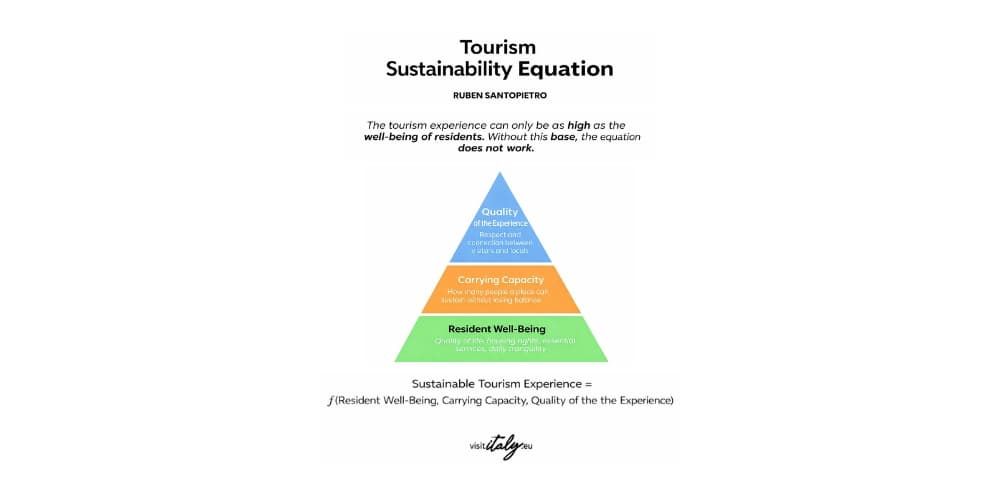
The Sustainability Equation can be summarized as:
Sustainable Tourism Experience (STE) is a function of Residents’ Well-being (RWB), Carrying Capacity (CC), and the Quality of Relationships (QR):
STE= f ( RWB , CC , QR )
In practice, the model is based on three fundamental pillars:
Resident well-being – a happy community is the foundation of every authentic experience. Residents’ daily lives must continue without feeling overwhelmed by tourism.
Territorial capacity – spaces, services, infrastructure, and housing must withstand visitor flows without losing balance. Each destination has its own unique, context-specific threshold.
Experience quality – visitors should encounter living, vibrant places—not overcrowded or standardized sets. Only then does travel become memorable and authentic.
The key principle is simple: if any one of these elements is neglected, the whole system loses balance. Even the highest numbers cannot guarantee value, beauty, or sustainability.
From concept to practice: the equation in action
The Sustainability Equation comes to life when we look at Italy with fresh eyes, as we do with 99% of Italy and Luminous Destinations. Here, the equation translates into everyday choices: where to shine the spotlight, how to let territories grow without suffocating them, and how to allow visitors to enjoy authentic experiences without compromising local life.
It means, for example, highlighting a forgotten village in southern Italy without turning it into a tourist set; supporting local markets, artisan workshops, and small businesses so tourism becomes a driver of vitality, not just numbers; distributing visitor flows so that every place has room to breathe.
In practice, the equation teaches us that a balanced territory is a happy place for its residents and unforgettable for its visitors. Technology, storytelling, and multimedia content are not just tools to showcase beauty—they are tools to tell it with respect, building real connections between travelers and communities.
In this way, tourism ceases to be just attraction: it becomes care, responsibility, and strategy. Sustainability is no longer theory; it can be seen and felt in every alley, every piazza, every encounter.
A compass for the future

Tomorrow’s tourism will no longer be measured by arrivals or selfies, but by balance, authenticity, and the ability to endure over time.
It means choosing a Ligurian coast where beaches are not overcrowded, wandering through the alleys of medieval villages without interrupting local life, or stopping at a countryside trattoria where the cuisine follows the rhythm of the territory, not the tourist checklist.
With the Tourism Sustainability Equation, Visit Italy provides a concrete compass: a guide for experiencing Italy with curiosity and respect, discovering authentic places, supporting local communities, and creating lasting memories. It is an invitation to travel not just to see, but to understand, feel, and contribute to the beauty and vitality of every destination.
About the author
Written on 09/04/2026
Redazione Visit Italy
Visit Italy is a cultural platform dedicated to illuminating hidden places, untold stories, and overlooked beauty. Because every corner of Italy deserves discovery.

Redazione Visit Italy
The theory that helps destinations grow without losing balance, identity, or quality of life.