
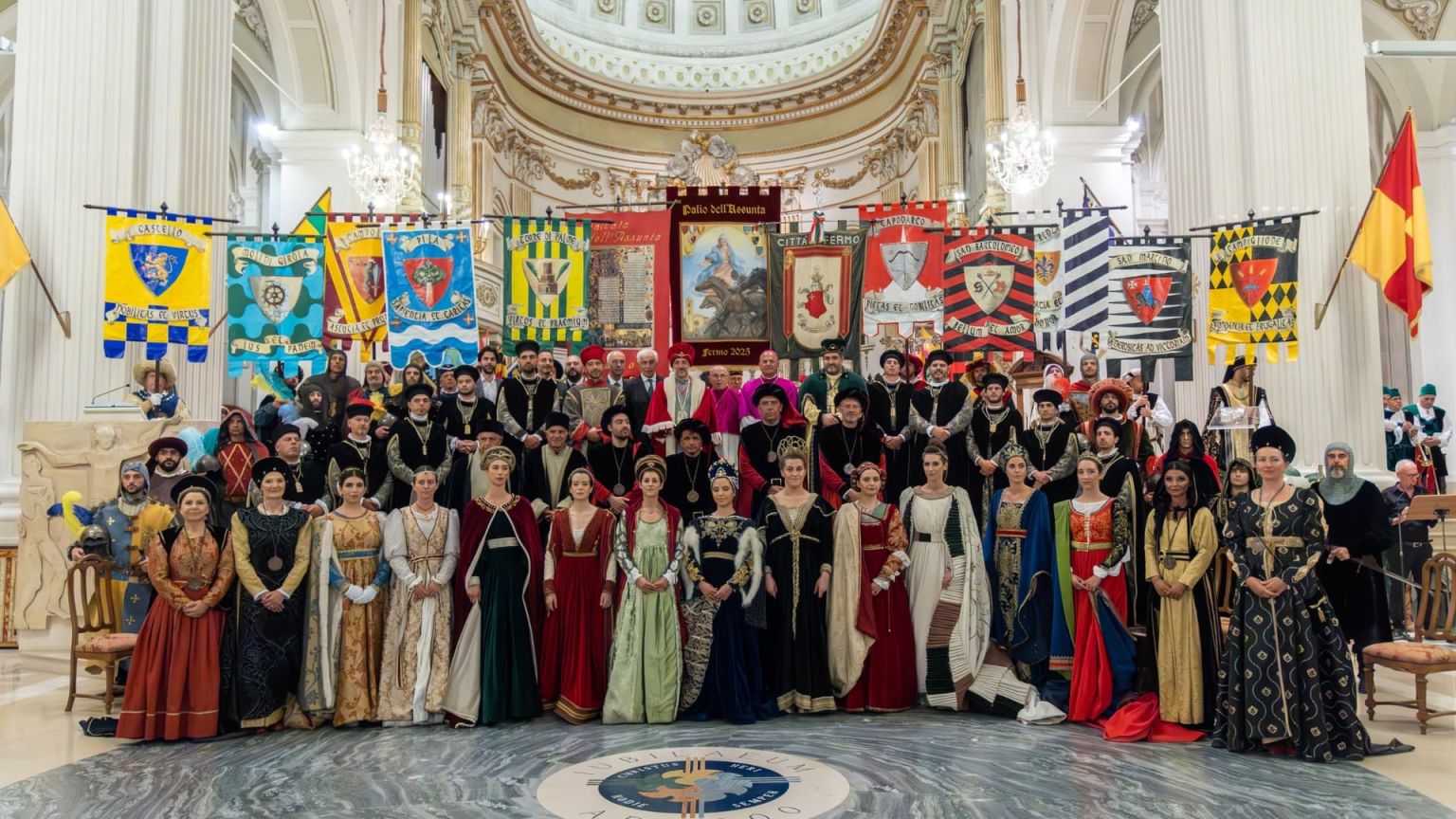

Every year, the city of Fermo chooses to tell its story through fabric as well. During the Cavalcata dell’Assunta, history takes visible form through clothing. Before the drums, before the clarions, before the procession winds through the streets, everything begins in the quiet of the contrada tailoring workshops — rooms scented with fabric and time itself. Here, the most authentic face of the Cavalcata comes to life: its medieval costumes, the true visual soul of the celebration.
The Middle Ages as a Living Image in the Costumes of the Cavalcata dell’Assunta
In Fermo, the Middle Ages are not a distant memory but a heritage layered across centuries, expressed through painting, architecture, and spirituality. It is a medieval legacy that has left deep traces throughout the region, particularly through the work of artists who lived and worked here, such as the Crivelli brothers.
Fifteenth-century painters, the Crivelli brothers — together with other artists of the period — shaped an extraordinarily refined visual world in which the sacred and the everyday coexist in delicate balance. Their figures appear still and solemn, yet vibrantly alive in the details: intricate brocades, rich velvets, jewels sculpted in paint, and structured sleeves that speak of rank and identity. In their works, clothing becomes a language of its own.
And it is precisely here that the contrada workshops of the Cavalcata dell’Assunta begin their work.
Find out more about La Cavalcata dell'AssuntaStudying in Order to Sew
Every costume featured in the Magnificent Historical Procession on August 14 is the result of meticulous research and preparation. The tailoring workshops study medieval paintings as though consulting precious manuscripts. Shapes are analyzed, proportions examined, and sacred and secular iconography compared.
The designs are never chosen at random: every participant represents a specific role within medieval society, and their clothing must communicate that identity clearly.
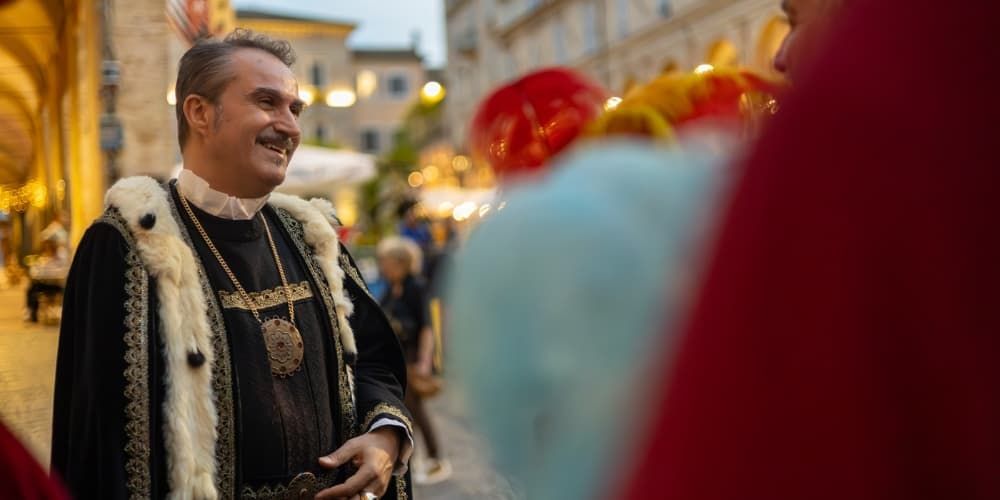
Ladies inspired by medieval Madonnas wear richly layered gowns with structured bodices and flowing sleeves. Nobles appear in elegant yet restrained garments, while commoners wear simpler fabrics — no less carefully crafted. Historical accuracy serves to create visual coherence: the Cavalcata seeks to present a world that feels believable.
In this sense, the medieval costumes of the Cavalcata do not merely imitate the past; they transform it into a living contemporary experience.
Choosing Materials: The Weight of History
After the design comes the material itself — and this is where the research becomes even more rigorous.
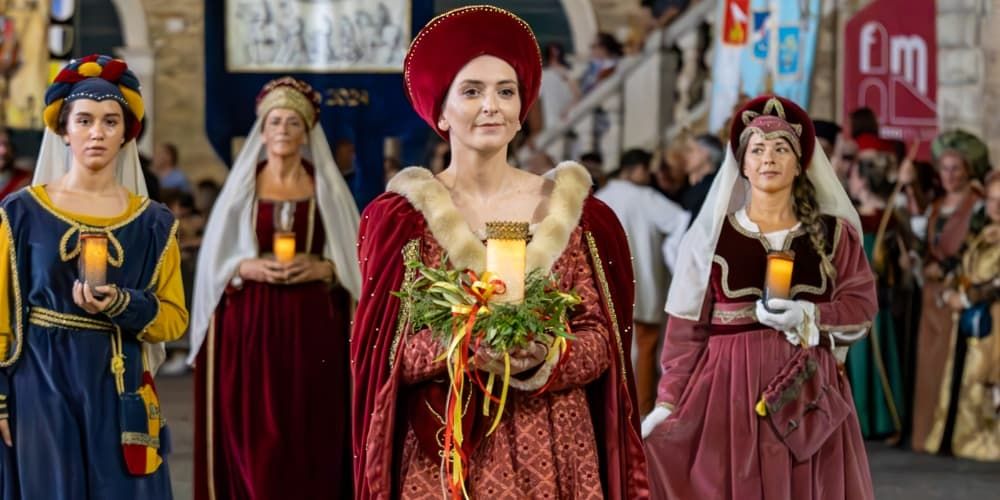
The contrada workshops carefully select fabrics, favouring natural fibres and richly saturated colours. Velvets must absorb the light, while brocades must reflect it without appearing artificial. Every textile is chosen with movement in mind: how it will flow through the procession, react to the wind, glow beneath torchlight, and withstand the close gaze of visitors.
Nothing is left to chance, because during the Cavalcata dell’Assunta, these costumes are not admired from afar. Spectators can observe them from only a few metres away. For this reason, the final effect is never theatrical in the superficial sense of the word — the garments must feel real.
The Contrada Workshops: Sewing Together
Yet the true value of these workshops cannot be measured solely in the beauty of the costumes. It is measured in shared time.
The contrada tailoring rooms are not merely workshops; they are spaces of encounter and knowledge-sharing. Different generations work side by side: those who have sewn for decades alongside those just learning to hold a needle.
Tailoring becomes a social gesture. Every costume is shaped by many hands, exchanged advice, and memories resurfacing through conversation. In these spaces, tradition becomes something that binds people together.
This is also why, when participants finally put on their garments, they know they are wearing not only fabric, but a collective story.
Fitting sessions: when the body changes its posture
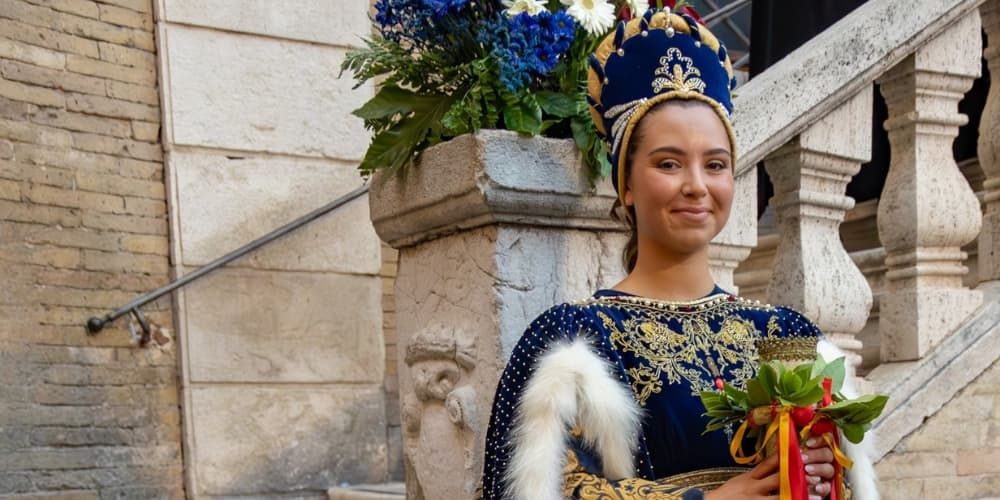
The fitting sessions are always charged with emotion. Costumes that until then had hung quietly or rested on worktables are finally worn. And that is when something extraordinary happens.
The body changes posture. The pace slows, becoming measured and deliberate. The gaze lifts. Movements grow solemn. People begin to inhabit the image they are embodying.
At that moment, the connection with medieval painting — particularly the work of Crivelli — becomes tangible. The figures moving through the streets of Fermo seem to step directly out of fifteenth-century panels and back into life. Painting becomes three-dimensional.
August 14: The Vision Takes Shape
All this quiet labour, stretching over months, reaches its fullest expression on the evening of August 14, when the magnificent historical procession of the Cavalcata dell’Assunta winds through Fermo.
The route begins at the Church of Santa Lucia, the farthest point of departure, and moves through ancient streets, narrow alleys, and the Piazza before slowly ascending toward the Cathedral, the spiritual heart of the city. It is a journey designed not only to be watched, but deeply experienced.
Thousands of visitors gather to witness something unique: a city shedding the present and immersing itself in the Middle Ages. Modern streets disappear beneath the weight of history. Electric lights give way to the warm glow of torches. Sounds soften and deepen.
And at the centre of it all are the costumes.
An Italian Folk Celebration That Speaks to the World
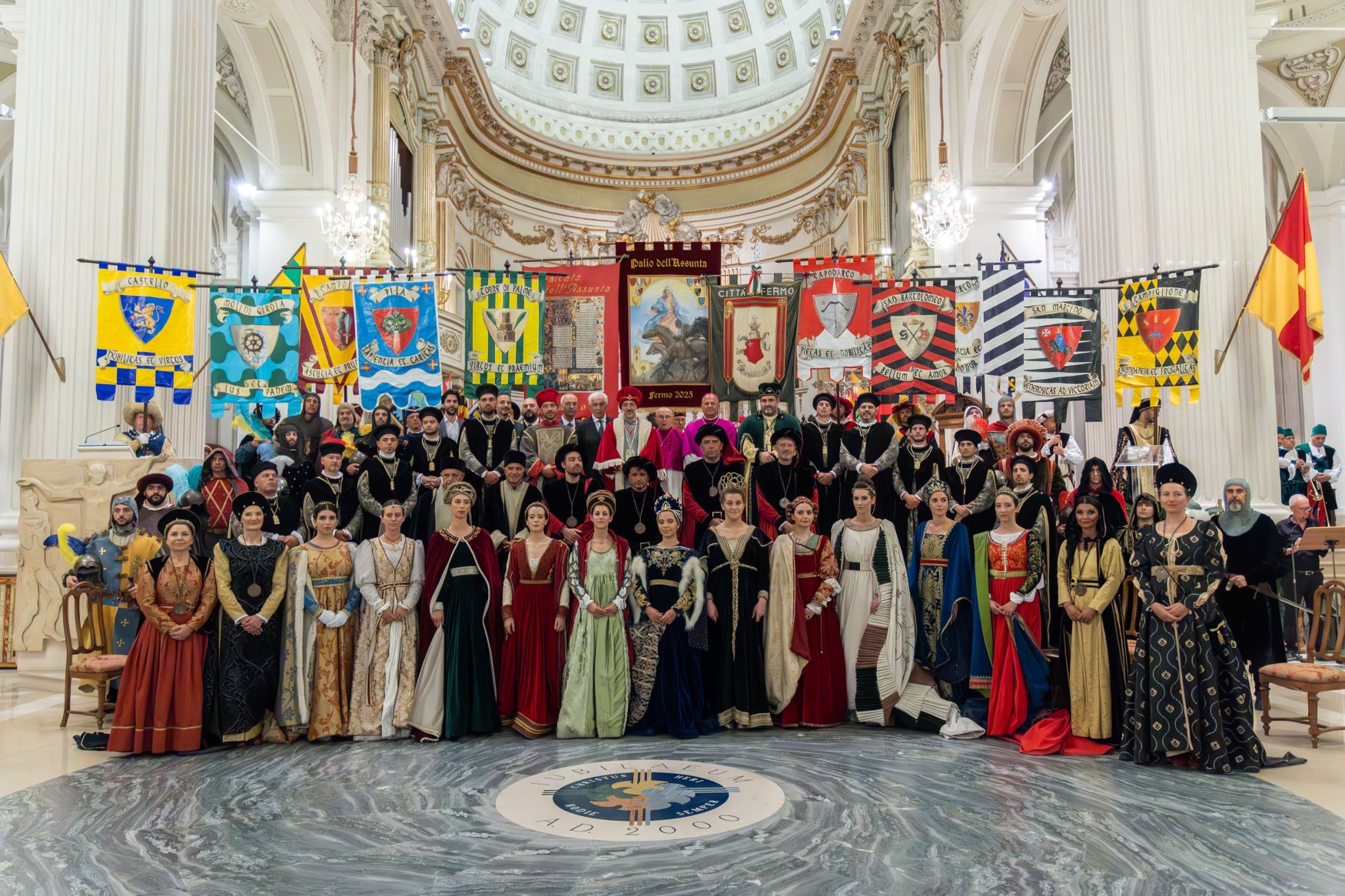
The Cavalcata dell’Assunta is an Italian folk celebration in the truest sense of the term: born from the community, sustained by the community, and expressed in the community’s own language. Yet it is precisely for this reason that it resonates so strongly with those arriving from afar.
Visitors come not simply to “watch” a historical reenactment, but to take part in a collective narrative shaped with care and passion. The medieval costumes are the key to this story, making visible what often remains abstract: the bond between a city and its history.
In Fermo, tradition is not frozen in time. It is worn.
Leaving with Eyes Full of Wonder
When the last participant enters the Cathedral and the procession dissolves, what remains is a feeling difficult to explain. You realise you have witnessed something rare: a city that has chosen to tell its story through meticulous attention to detail.
For this reason, visiting Fermo during the Cavalcata dell’Assunta is an experience that reaches far beyond the event itself. It is a journey into the material fabric of history, where the past is presented not through simplification, but with dignity and deep respect.
And as you leave the city, your eyes still filled with the colours of velvet and gold, one thing becomes clear: the true work of art is not any single costume, but the collective act that made them possible — a tradition stitched anew each year onto the living body of Fermo.
About the author
Written on 03/06/2026
Redazione Visit Italy
Visit Italy is a cultural platform dedicated to illuminating hidden places, untold stories, and overlooked beauty. Because every corner of Italy deserves discovery.

Redazione Visit Italy
Behind Fermo’s Cavalcata dell’Assunta lies a world of tailoring and memory: medieval costumes that bring the city’s history to life.