
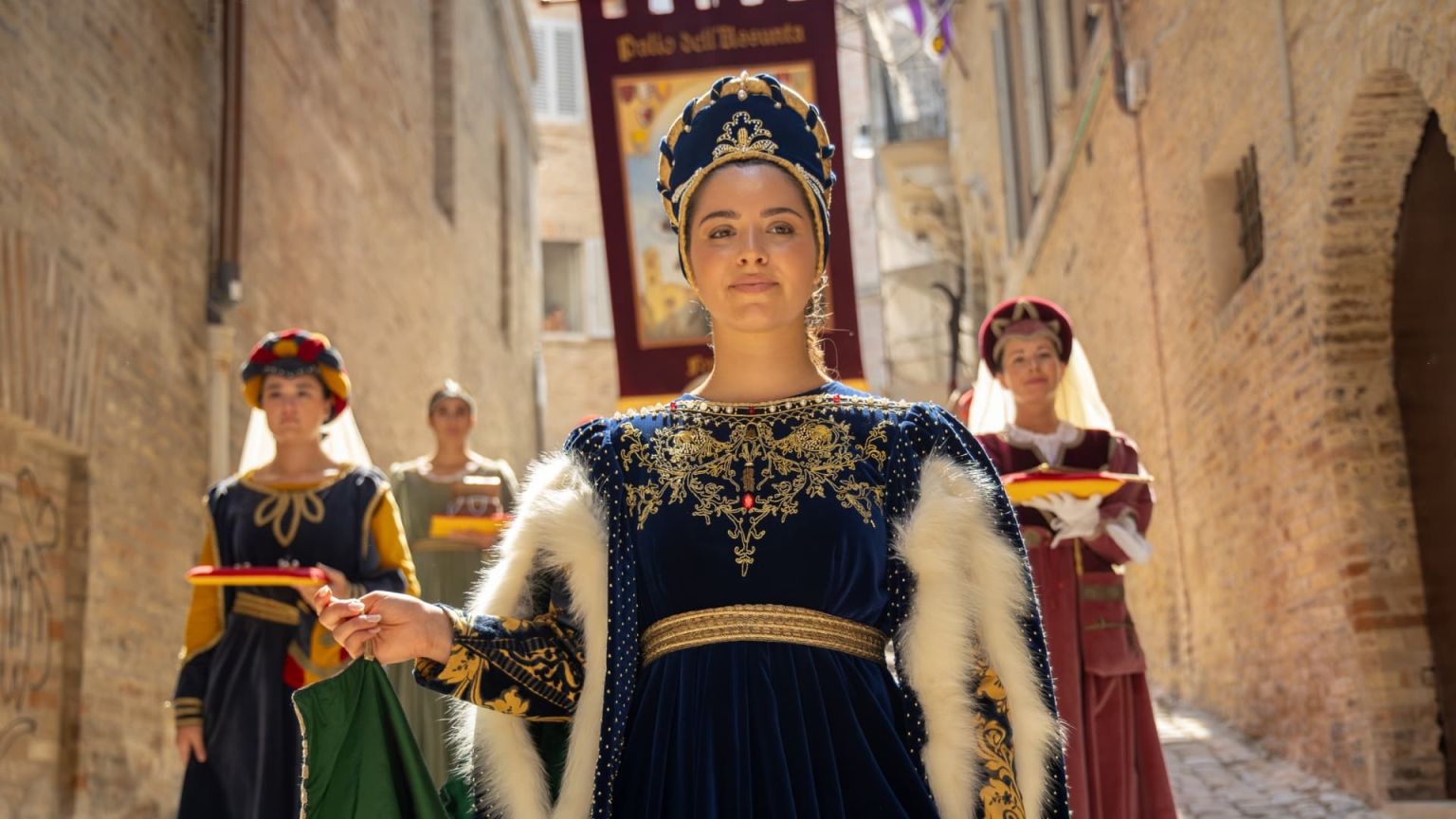

Nestled among the rolling hills of the Marche region and just a short distance from the sea, the city of Fermo celebrates its history, culture, and beauty every year.
Fermo and the historical reenactment known as the Cavalcata dell’Assunta are inseparable—you can’t mention one without thinking of the other.
Every Ferragosto, the medieval old town takes on a renewed magic, reviving a ritual that has spanned centuries, blending past and present, the sacred and the communal.
Cavalcata dell'Assunta's roots: when faith becomes foundation
The name says it all: Cavalcata dell'Assunta. Three words that carry within them the Virgin Mary, the sky, and a faith that in Fermo goes back to the 5th century, when the cathedral of Santa Maria in Castello was built at the city's highest point, the Girfalco, drawing pilgrims then as it draws visitors today.
The first written record dates to 998 AD, when Bishop Uberto granted land in exchange for an annual tribute to be paid "before the end of August, on the occasion of the Feast of the Assumption". In 1067, the same ritual appears again: land along the Menocchia river, 9 silver coins placed on the altar, every year, during the Assumption feast.
These weren't mere taxes, they were ritual acts. Repeated over a hundred times between the 10th and 13th centuries in the Codice 1030, they reveal a devotion that was religious, civic, and deeply tied to local identity. The Cavalcata dell'Assunta is the only historical reenactment in Italy built on a genuine, unbroken act of faith, one still performed today, exactly as it was a thousand years ago.
Ritual offerings: wax, the palio, and bread
From the 12th century onward, documents show that lords of castles under the authority of the Church of Fermo, along with monasteries and communities from the Macerata area and the Tronto valley, were required to offer gifts to the bishopric. These were not simple tributes, but servitia debitalia—ritual acts that marked the liturgical calendar and strengthened ties between the center and its territories.
Detailed records in the Liber Iurium reveal how important the Assumption feast was: not only the citizens of Fermo, but also people from surrounding territories would gather in the Cathedral to honor the Virgin and pay their dues.
Among all offerings, two stand out for their symbolic power: wax and the palio.
Wax: light illuminating faith
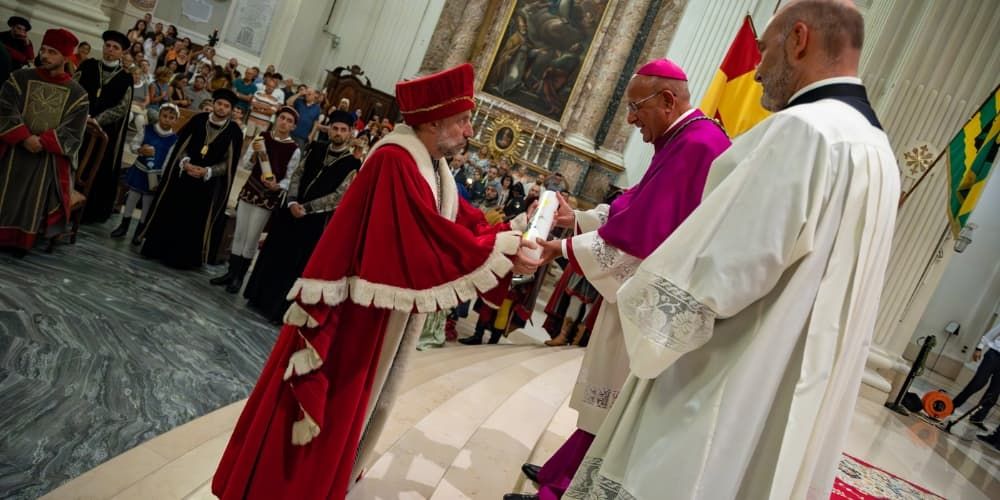
Wax, offered in large quantities, was used to light churches and symbolized the light of faith and purity of the soul. It was a precious gift, often carried in long, fragrant cylinders and placed on the altar as an act of devotion.
Each candle lit during the Assumption Mass represented a thought directed toward heaven—a symbol of hope and a promise of light in darkness. This ritual still takes place every year on the evening of August 14 at the Cathedral entrance, creating a deeply evocative atmosphere.
The palio: prize and promise
The palio, a richly decorated cloth, was awarded to the winner of the horse race that concluded the Cavalcata. But it was also a symbol of honor and prestige. Each district would send its best rider, hoping to bring the palio home as a mark of pride.
Every year its design changes, but its meaning remains the same: unity, celebration, and glory.
Today, the palio is still painted by renowned artists, and the winning contrada proudly displays it in its church or headquarters.
The Messale dei Firmonibus: a precious testimony
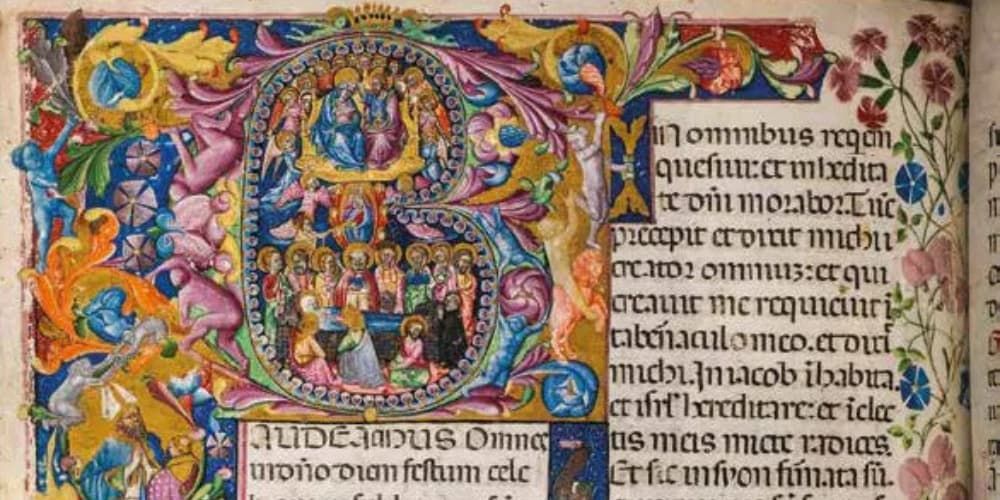
The Messale dei Firmonibus, dated 1436 and preserved in the Diocesan Museum of Fermo, is one of the most extraordinary illuminated manuscripts of the 15th century. Commissioned by Bishop Giovanni Firmonibus and created by Giovanni di Maestro Ugolino da Milano, it is a visual tribute to the Virgin.
Each page celebrates the Cavalcata, illustrating the procession, the offerings, the race, and the palio. Leafing through it feels like stepping back into the 15th century, accompanied by the sound of drums and medieval guilds.
The procession: where heaven meets earth
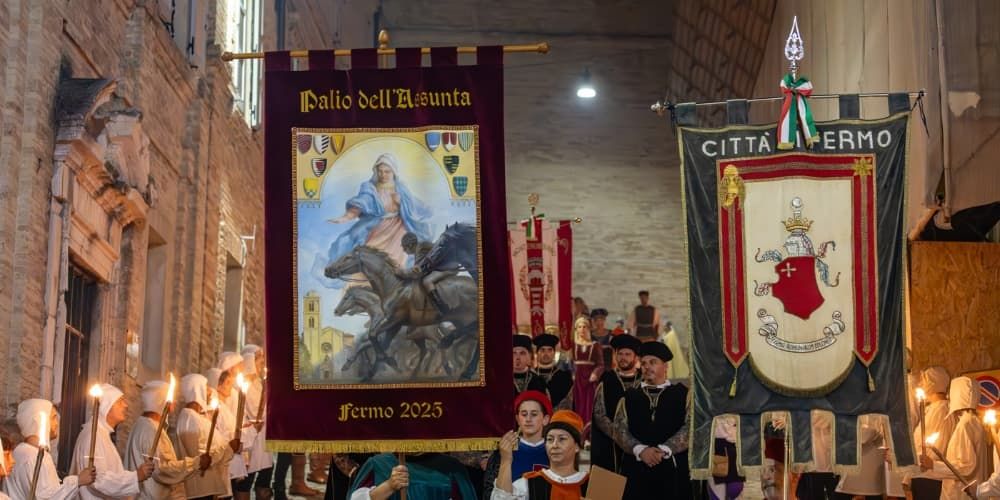
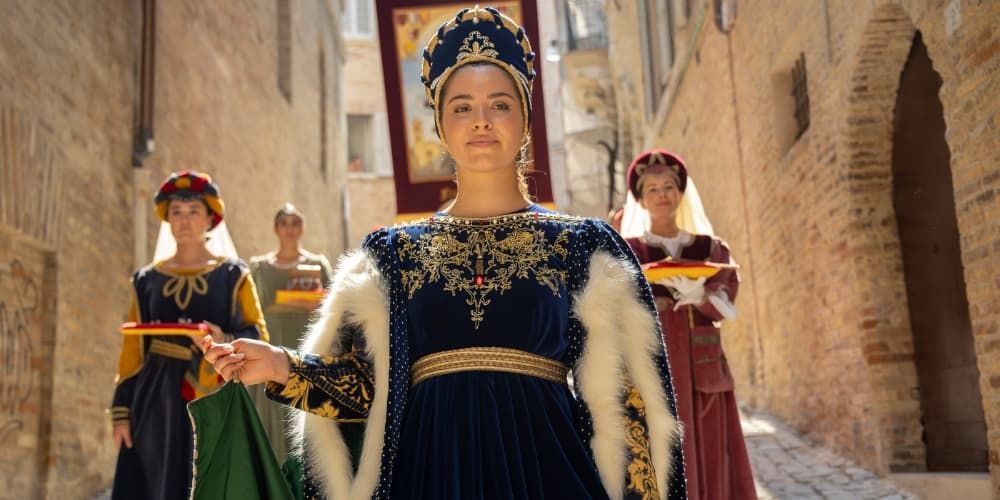
Now we come to the heart of the event: the Cavalcata itself. The name describes, at its core, a solemn procession — a parade of knights, nobles, clergy, and common people. The surrounding castles send their representatives, who travel to Fermo to present their offerings and take part in the celebration.
Nowadays, the procession brings together more than a thousand costumed figures, on some occasions as many as 1,400.
The costumes draw inspiration from the period of the Lordship of Francesco Sforza, 1434–1446, the first true Signoria in the Marche region. It was in Fermo, in fact, that Galeazzo Maria Sforza, fifth Duke of Milan, was born.
The cortege winds through the city streets to the sound of drums and beneath waving banners. At the end, the bishop receives the ritual gifts and celebrates a solemn mass. In that moment, the entire city pauses in prayer and in silence.
Games and the race: the festival comes alive
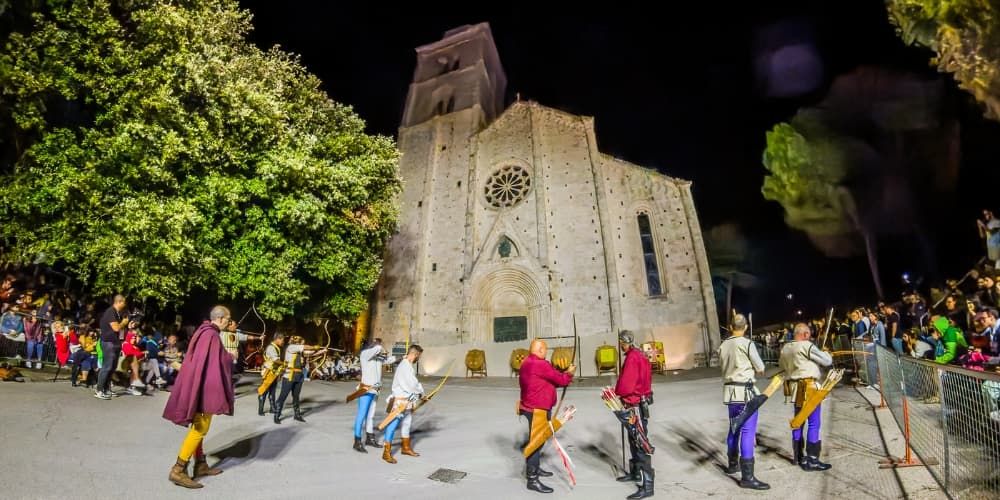
Still today the Palio is the grand finale — but the celebrations begin long before the race. In the days leading up to it, the city's Contrade compete in a series of skill contests that many consider the most exciting part of the entire festival.
There's the Tiro per l'Astore, a traditional archery competition, and the Tiro al Canapo, a tug-of-war that draws loud crowds. Then come the Bandiere al Vento, where flag-throwers turn the streets into a blur of color and precision, and the Gallo d'Oro, a drumming contest that fills the city with rhythm from morning to night.
Meanwhile, the piazza transforms into a living medieval village — the Osterie delle Contrade, faithful recreations of ancient taverns serving local dishes and local wine, including Fermo's own mistrà.
Then comes the race. The crowd falls quiet, the horses line up, and for a few suspended minutes the entire city holds its breath. Winning the Palio isn't just about the painted cloth — it means writing your Contrada's name into history.
What it means to the people of Fermo
For the people of Fermo, the Cavalcata is not just a spectacle—it’s a shared emotion. Those who take part in the procession feel as though they are carrying forward a legacy, walking alongside their ancestors.
During this time, the entire city transforms. Streets become more vibrant, Piazza del Popolo fills with life, and for days, everything revolves around the celebration. Visitors immediately sense the unique magic that only the Cavalcata can bring.
A journey through time
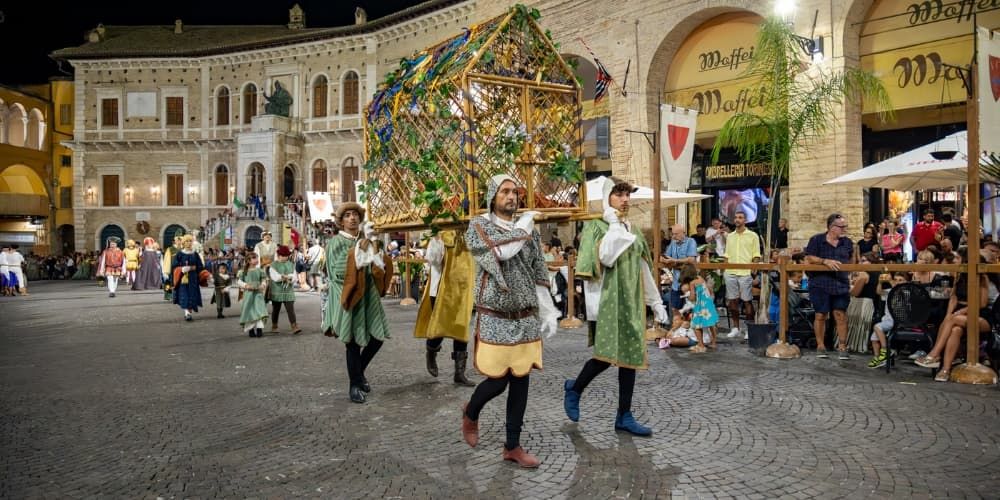
The Cavalcata dell’Assunta is a true journey through time. In the Middle Ages, it was a display of power and faith. During the Renaissance, it grew richer in art and spectacle, showcasing the city’s culture and wealth.
Despite challenges over the centuries—wars, political changes, social transformations—the tradition has endured. Thanks to institutions and the community, it continues not only to survive but to evolve and improve.
Today, it also serves as a bridge between generations, with educational projects involving young people in discovering the history of the contrade.
Tips for experiencing the medieval magic
Ready to experience Italy's oldest historical reenactment? Here's everything you need to know before you go.
The Cavalcata dell'Assunta takes over Fermo for nearly two weeks, from late July through the grand finale on August 15th.
The easiest way to get there is by car. If you're flying in, Ancona-Falconara International Airport has car rental desks right at arrivals. From there, take the A14 motorway south, exit at Fermo-Porto San Giorgio, and follow the signs into the city.
For parking, head to the Mario Dondero Terminal car park — a short ride on elevators and escalators takes you straight into the historic center.
Evenings are when the magic happens. The Osterie delle Contrade open at 7:30 PM, serving traditional Fermo dishes and the locally produced mistrà liqueur. At 9:00 PM, the historical games and costumed performances begin.
On August 14th and 15th, the city steps fully back in time — medieval processions fill the cobblestone streets, and the Palio dell'Assunta race brings everything to a breathtaking close.
About the author
Written on 16/04/2026
Redazione Visit Italy
Visit Italy is a cultural platform dedicated to illuminating hidden places, untold stories, and overlooked beauty. Because every corner of Italy deserves discovery.

Redazione Visit Italy
In 1436, a bishop commissioned a manuscript to immortalize Fermo's Cavalcata dell'Assunta. It's the oldest visual proof of Italy's most ancient Palio.