
Before Capri, before Sorrento, and long before the Amalfi Coast became one of Italy’s most recognisable images, the elite of ancient Rome looked elsewhere_ emperors, senators and aristocrats chose the Campi Flegrei, a coastline shaped by fire and overlooking a luminous sea, where villas, thermal baths and harbours turned leisure into an art form.
This was the Roman Riviera, an oasis devoted to otium: political encounters far from the Forum, banquets by the sea and residences built to impress.
Baia was its most fashionable heart, while Pozzuoli served as its great commercial port. All around them stretched a restless landscape of craters, fumaroles, volcanic lakes and ruins that still emerge along the coastline or lie beneath the surface of the water.
Just a few kilometres from Naples, this territory still preserves the rare thrill of discovery. While Campania’s most famous routes attract travellers from all over the world, the Campi Flegrei reveal themselves as a surprising and little-known destination, best explored slowly, following the curve of the coast and the traces left by more than two thousand years of history.
Over two days, we can rediscover this coastline as the ancient Romans once did: arriving from the water, watching the Bay of Naples shift before our eyes and allowing ourselves to be guided towards sunken cities, amphitheatres, castles and landscapes born from fire.
Campi Flegrei, the Roman Riviera: history and a two-day itinerary
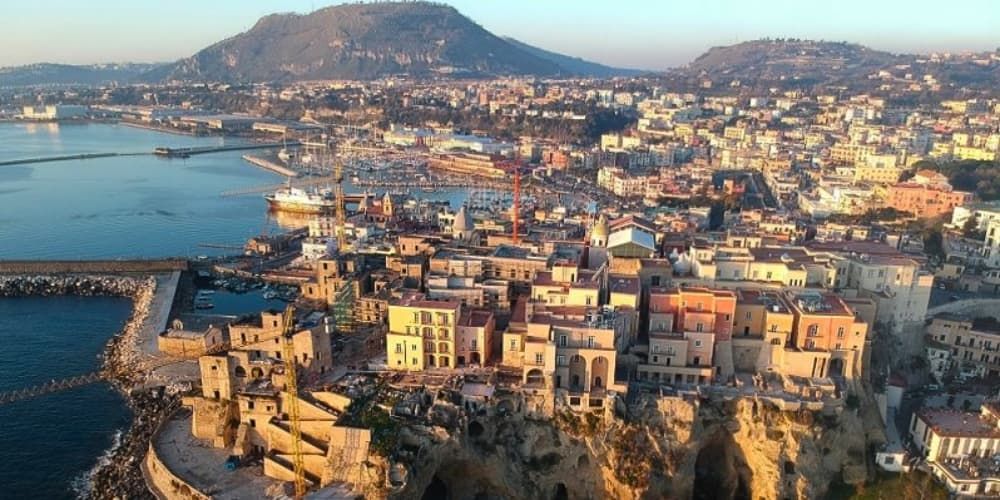
The name Campi Flegrei comes from ancient Greek and means “burning fields”: one glance at the landscape is enough to understand why. West of Naples stretches a vast volcanic area where craters, thermal springs, fumaroles and lakes alternate with coves overlooking the Tyrrhenian Sea. Here, the earth is a living presence, shaping the landscape, its history and even the way people inhabit it.
The ancient Romans found it irresistible. Pozzuoli became one of the Mediterranean’s most important commercial ports, while Baia developed into the aristocracy’s most coveted holiday retreat. Emperors, generals and politicians built panoramic villas, thermal complexes and seaside pavilions, taking advantage of the natural hot springs and proximity to Rome to escape public duties without giving up luxury or social life.
To follow in the footsteps of the Roman Riviera, we set out from central Naples and choose the sea as the first road of our journey. NLG – Navigazione Libera del Golfo is the ideal partner for this discovery, thanks to its connections across the Bay and towards the Phlegraean coast. From Molo Beverello, we watch Naples recede as Vesuvius, the islands and the volcanic outline of the Campi Flegrei begin to emerge on the horizon.
The first day takes us to Baia and Bacoli, in the heart of ancient Rome’s seaside retreat. We walk among thermal complexes, villas overlooking the blue and panoramic castles, before discovering the submerged ruins that bradyseism has transformed into one of the Mediterranean’s most remarkable archaeological landscapes. Staying overnight in the area allows us to experience the Campi Flegrei at an unhurried pace, when the sights close and the evening lights begin to shimmer across the harbour.
The following morning, we continue towards Pozzuoli to explore the remains of ancient Puteoli at Rione Terra, the Flavian Amphitheatre and the Macellum, where columns marked by marine molluscs still bear witness to the movements of a volcanic land that is never entirely still.
We conclude the journey by returning to Naples by sea. From the deck, the coastline we have just explored appears in a new light, and the crossing becomes our final opportunity to admire the Bay from an incomparable perspective.
Itinerary recap:
- Day 1: departure from Molo Beverello in Naples, navigation across the Bay, and a visit to Baia and Bacoli, including the Roman Baths, the Temple of Mercury, the Underwater Archaeological Park, Villa Ferretti and the Aragonese Castle, followed by an overnight stay in the Campi Flegrei;
- Day 2: transfer to Pozzuoli, visits to Rione Terra, the Flavian Amphitheatre and the Macellum, followed by the return journey to Naples by sea.
Day 1 - Sailing from Naples to the Roman Riviera in the morning
Our journey to the Campi Flegrei begins in the heart of Naples, at Molo Beverello, the city’s main maritime terminal. We are standing opposite Castel Nuovo, better known as the Maschio Angioino, between Piazzale Angioino and Via Ammiraglio Ferdinando Acton. Behind us lie the traffic of the city centre, its monumental squares and the dense outline of its buildings; ahead, the Bay opens before us.
We set sail, as Naples recedes wave after wave, Vesuvius seems to dominate the entire horizon from the sea. Castel dell’Ovo appears suspended above the water, while the coastline unfolds through a succession of headlands, harbours and districts reflected in the blue. The Bay reveals itself as a great waterway travelled for centuries by merchants, explorers, emperors and Roman aristocrats.
We continue west as Naples’ urban skyline gives way to a more secluded and irregular coastline, and the true nature of the Campi Flegrei begins to emerge: a land shaped by volcanic activity, where the sea enters ancient craters and the hills conceal ruins from the past.
The boat journey is not simply a way to reach Baia or Pozzuoli, but an integral part of the experience. Along the way, the audio guide available through the NLG app accompanies the voyage, helping travellers recognise the places that appear along the coast and connect the scenery with its history and archaeology.
Arriving by sea, we approach the Roman Riviera with the same sense of anticipation that travellers must have felt in ancient times. Even before setting foot in Baia or Pozzuoli, we have already begun to discover the Campi Flegrei: observing them from the water, following the curve of the coast and allowing the journey itself to slow the pace of the day.
Morning highlights:
- Departure from Molo Beverello, opposite the Maschio Angioino;
- Sailing across the Bay of Naples;
- Sea views of Mount Vesuvius, Castel dell’Ovo and the Neapolitan coastline;
- Approach to the volcanic coast of the Campi Flegrei.
Discover Baia and Bacoli, ancient Rome’s seaside retreat, in the afternoon and evening
When we reach Baia, we immediately understand why the ancient Romans chose this stretch of coast as their favourite holiday destination. Sheltered by a natural bay and embraced by volcanic hills, it became the preferred retreat of senators, generals and emperors, who built villas, gardens and thermal complexes overlooking the sea.
We begin at the Archaeological Park of the Baths of Baia, where arches, terraces and pools reveal a city designed to harness the natural heat rising from beneath the ground. Among its most evocative spaces is the Temple of Mercury, a vast thermal hall crowned by a dome and one of the earliest examples of Roman hemispherical architecture.
Nearby, one of the Campi Flegrei’s most curious sights awaits us: the upside-down fig tree, growing downwards from the vault of an ancient building. Its suspended branches seem to defy gravity and capture, better than any explanation, the constant encounter between nature and ruins that makes Baia so distinctive.
A precious part of the ancient Roman resort, however, no longer lies on dry land. Ground movements caused by bradyseism submerged villas, streets and mosaics that are now preserved within the Underwater Archaeological Park of Baia. We can explore it by diving, snorkelling or joining a boat tour, admiring mosaic floors, columns and ancient fishponds beneath the surface of the sea.
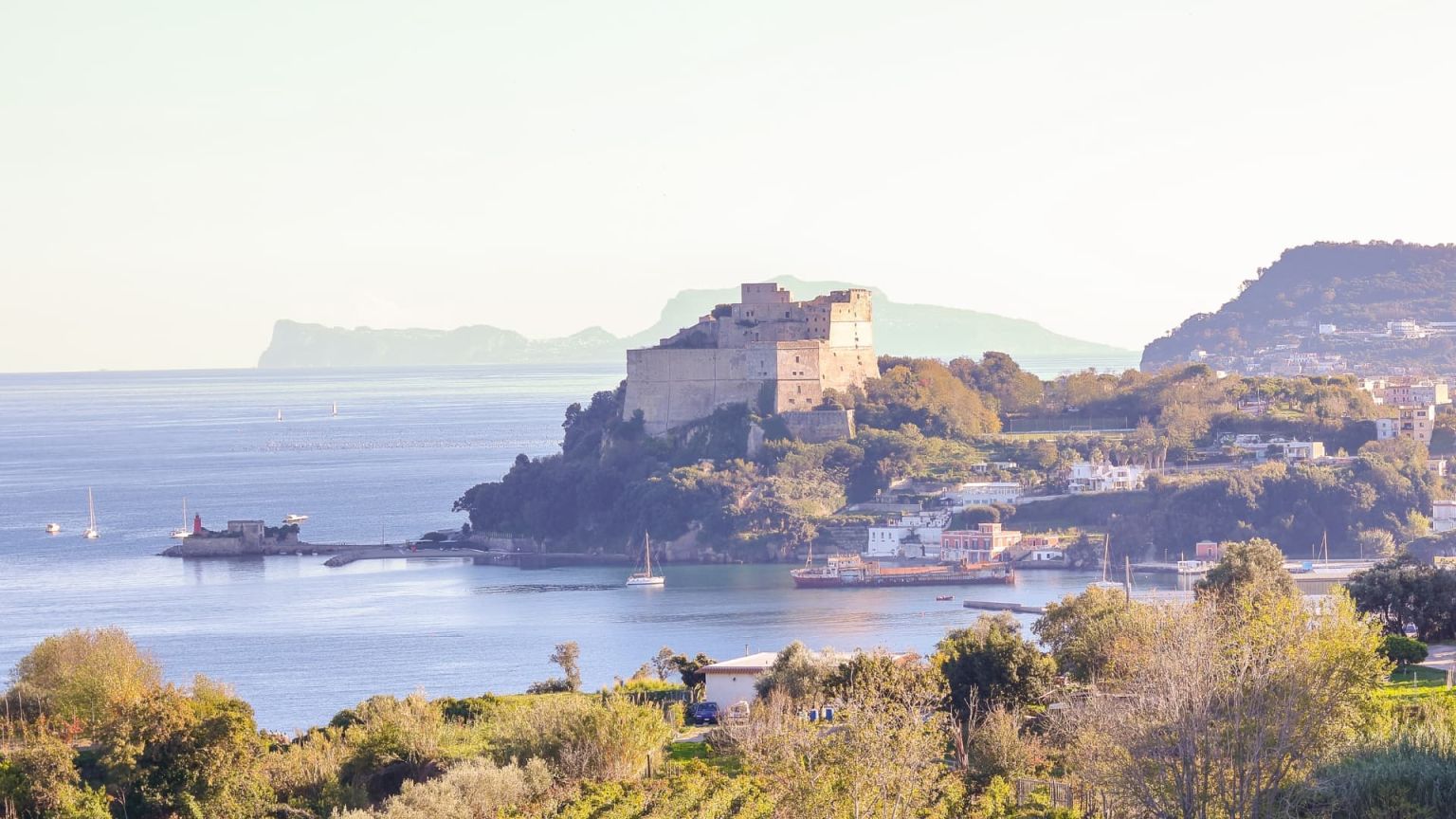
We return to the coast to reach Villa Ferretti, reflected in the water at the foot of the Aragonese Castle. Its grounds contain the remains of a Roman maritime villa and offer a beautiful panoramic walk through archaeology and landscape.
Dominating the bay is the Aragonese Castle of Baia, home to the Archaeological Museum of the Campi Flegrei. From its terraces, the view stretches across the gulf, the volcanic hills and the islands, reconstructing before our eyes the geography of the ancient Roman Riviera.
As evening falls, after a day spent among monumental baths and submerged cities, we stay overnight in Baia: spending the night in the Campi Flegrei allows us to slow down, dine by the sea and watch the evening lights shimmer across the harbour. The following morning, we will set out from here towards Pozzuoli.
Afternoon and evening highlights:
- Archaeological Park of the Baths of Baia;
- Temple of Mercury and the upside-down fig tree;
- Underwater Archaeological Park of Baia;
- Villa Ferretti and the Aragonese Castle;
- Dinner by the sea and an overnight stay in Baia.
Day 2 - Discover Pozzuoli, where Ancient Rome meets the sea: morning and afternoon
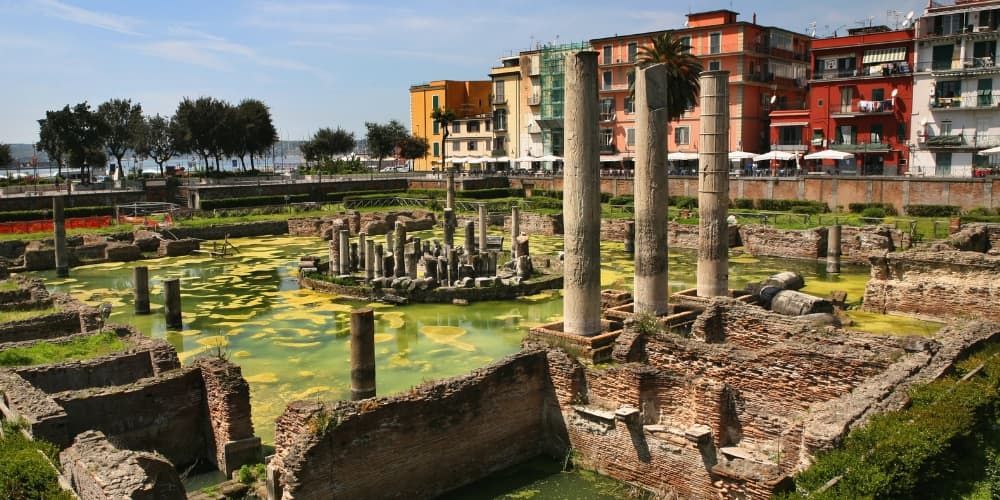
After spending the night in Baia, we set off again for Pozzuoli, known to the Romans as Puteoli, one of the Empire’s most important commercial ports. Grain, spices and goods from every corner of the Mediterranean once arrived at its docks. Even today, the city lives in constant dialogue with the sea, through its harbour, central alleyways and ruins woven into the urban landscape.
We begin at Rione Terra, Pozzuoli’s oldest district, built on a tuff promontory overlooking the gulf. Beneath its streets and buildings lies an archaeological route through shops, warehouses and rooms belonging to the ancient Roman city: a subterranean Pozzuoli that remained hidden for centuries.
We continue towards the Flavian Amphitheatre, one of the largest Roman amphitheatres in Italy. The tiers evoke the roar of the ancient spectacles, but it is the underground level that proves most surprising. Corridors, cells and passageways reveal the complex system once used to lead gladiators and animals into the arena.
Our final stop is the Macellum, commonly known as the Temple of Serapis, the public market of ancient Puteoli located just a short distance from the harbour. Its three monumental standing columns preserve one of the clearest traces of bradyseism: holes left by marine molluscs show how the ground sank below sea level over the centuries before rising once again.
In Pozzuoli, archaeology encounters a land that is still alive, shaped by movements within the caldera, fumaroles and the constant rise and fall of the ground. Here, the past is anything but still: it continues to move beneath our feet.
Morning and afternoon highlights:
- Transfer from Baia to Pozzuoli;
- Visit to Rione Terra and its underground archaeological route;
- Flavian Amphitheatre and its subterranean chambers;
- Macellum, also known as the Temple of Serapis;
- Discovery of the connection between bradyseism, archaeology and the volcanic landscape.
Evening: return to Naples by sea
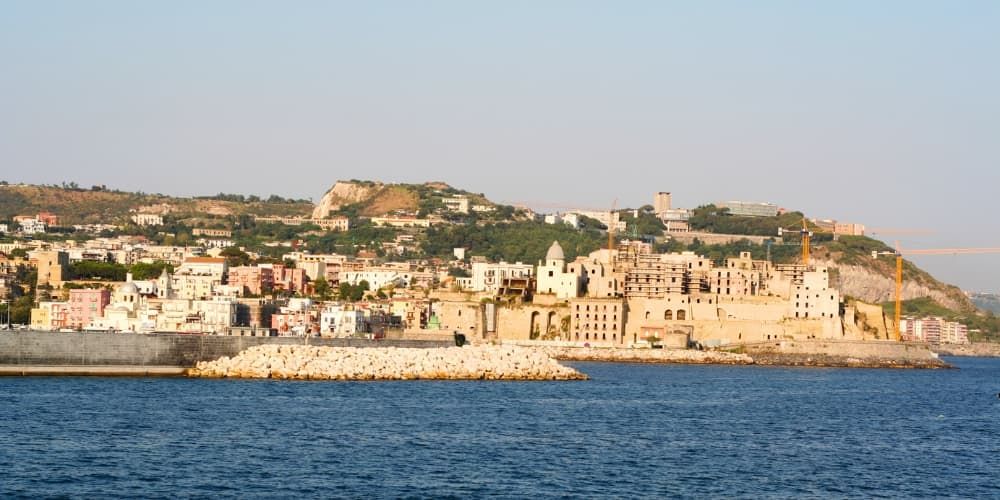
After walking among Roman ports, amphitheatres and ruins shaped by bradyseism, we return to Naples once again by sea. The crossing becomes the final chapter of our itinerary, giving us time to piece together the landscapes explored over the past two days.
From the deck, we watch the Phlegraean coast slowly recede, as the route takes us past Capo Miseno and opens out towards Procida: Volcanic headlands, coves and islands follow one another along the horizon, while the audio guide available through the NLG app allows the journey to continue telling the story of the area.
As we approach Naples, the city’s profile reappears from the water: Castel dell’Ovo, the seafront and Vesuvius unfold before us from a perspective unlike the one we usually know.
The return journey is also an opportunity to admire the Gulf from a privileged vantage point.
The journey ends where it began, at Molo Beverello, but we return with a new way of seeing the Bay. Beyond its most famous image, we have discovered a lesser-known coastline where the sea preserves submerged cities and ancient Rome still lives on through archaeology and landscape.
Return journey highlights:
- Departure from Pozzuoli by sea;
- Sailing along the Phlegraean coast;
- Views of the Bay, Castel dell’Ovo and Mount Vesuvius;
- Evening arrival at Molo Beverello in Naples.
How to plan your trip to the Campi Flegrei
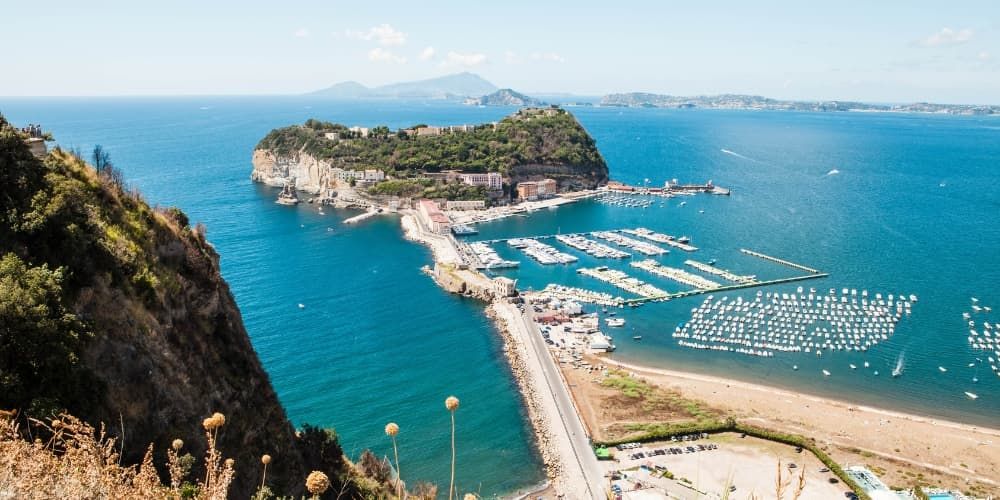
To embark on this journey, NLG – Navigazione Libera del Golfo is the ideal travel partner. From Molo Beverello in Naples, it offers two experiences as part of the Phlegraean Coast Archeotour: one dedicated to Pozzuoli and the other to Baia and the Phlegraean coast. Both provide an excellent way to begin discovering the area from the sea.
If you prefer to follow our itinerary with greater freedom, staying overnight in Baia and continuing to Pozzuoli the following day, you can purchase individual journeys and combine them with overland travel. This allows the sea crossing to remain an integral part of the experience without restricting the timing or stages of your trip.
Before setting off, remember to check the Phlegraean Coast Archeotour page to compare the experiences, choose between a one-way journey and a round trip, and verify the latest dates, timetables, fares and availability. Admission to archaeological sites and additional activities, such as a visit to Baia’s submerged city, must be arranged separately.
It is advisable to arrive at the port a little early. Once on board, all that remains is to leave Naples behind and let the sea guide us towards the Roman Riviera.
About the author
Written on 07/08/2026
Flavia Cantini
Freelance Content Writer with over a decade of specialized experience in tourism, culture, and creative/artistic activities. I assist magazines, web agencies, and end clients in managing blogs and crafting standout articles

Flavia Cantini
Discover the Roman Riviera on a two-day journey from Naples through Baia, Pozzuoli, sunken ruins and volcanic landscapes.