
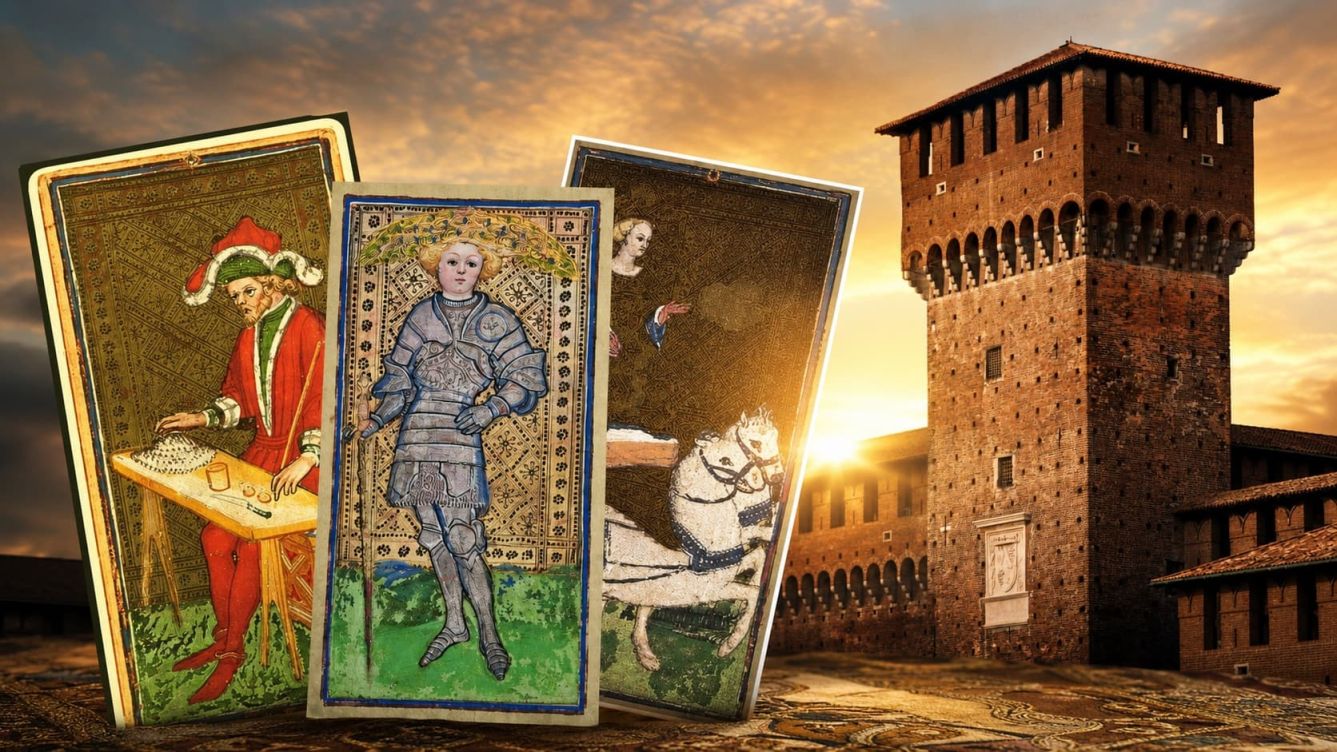

The first image that comes to mind when we think of tarot is almost always the same: enigmatic symbols and readings tied to destiny. And yet, what few people know is that (at least in the beginning) these fascinating cards had nothing to do with divination.
And not only that: we are used to associating tarot with the famous French decks, such as the Tarot of Marseille, but their origins are also (and above all) Italian.
Tarot cards were born in Italy, in the heart of the Renaissance, among the refined courts of Milan, Ferrara, and Bologna. They were not esoteric tools, but precious hand-painted objects created for noble families, designed for play and display, rather than interpretation.
Only later, as they spread across Europe, did their meaning begin to change, gradually transforming into what we recognize today.
Still, when we look at a tarot deck, we are seeing much more than just “symbols”: we are stepping into a story that spans centuries, shaped by art and journeys, a deeply Italian story, and, surprisingly, one that remains little known.
The origins of tarot in Italy: between Renaissance courts and art
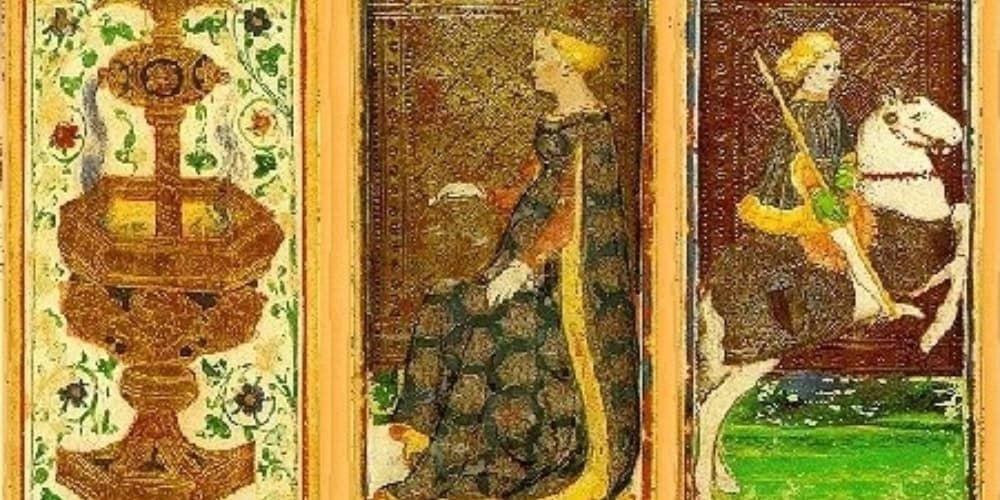
To truly understand the history of tarot, we need to set aside the modern imagination and step back in time, into an Italy shaped by refined courts, artists, and subtle power dynamics.
It is here, around 1430, between Milan and Ferrara, that the first cards we now recognize as tarot begin to take form. They emerge as an evolution of traditional Italian playing cards, enriched with a set of 22 additional figures (the so-called trionfi), now known as the Major Arcana, which introduce a new symbolic and visual dimension.
At this stage, there is no esoteric meaning. Tarot cards are created for play, with dynamics similar to games like briscola, and are commissioned by some of the most influential families of the time, such as the Visconti and the Sforza. Historical documents confirm this: in 1440, for instance, the notary Giusto Giusti of Anghiari wrote about a “trionfi” deck commissioned for a Florentine nobleman.
The cards are hand-painted, often enriched with gold and intricate details, and each figure reflects a precise vision of the world, social hierarchies, shared values, symbolic structures. To observe them is to step into the imagination of the Renaissance, where art and the representation of power are constantly intertwined.
From Milan and Ferrara, tarot cards begin to spread rapidly. They appear in Bologna as early as the mid-15th century (mentioned in a theft recorded in 1459) while in Florence they are regulated by an official decree in 1450. Each city develops its own iconographic variations: in Milan, for example, the Strength card depicts Hercules battling the Nemean lion, while in Ferrara the Moon takes on distinctly astrological features.
Around 1500, a document describes the rules of the Ludus Triumphorum, the Game of Triumphs, confirming tarot’s role as a structured and widespread pastime. Only much later, starting in the 18th century, would these cards become associated with divination.
How tarot spread across Europe
If tarot’s origins are unmistakably Italian, it is when these cards cross borders that their story begins to change direction.
From the second half of the 15th century, decks start to travel beyond the courts of Milan and Ferrara. These are the years of the Italian Wars, of cultural exchanges, of courts in constant dialogue with one another. And it is precisely through these movements that tarot reaches France carried, among others, by French soldiers returning from military campaigns in Northern Italy, bringing back with them this fascinating game.
Beyond the Alps, something begins to shift. Even the name changes: from trionfi it becomes tarot. The game spreads and evolves, giving rise to local variations (such as the famous Tarot de Marseille) that reinterpret symbols and imagery while preserving the original structure.
During the 17th century, tarot continues its journey into Central Europe. It reaches Germany, most likely through France, and from there spreads even further. The language itself transforms: many of the game’s terms derive from French, a clear sign of a cultural transition that has now taken root.
But this is not only a geographical expansion, it is also a social one. If tarot cards were once objects reserved for elites, the 18th century marks a turning point. The introduction of woodblock printing allows for wider production, making decks accessible to a much broader audience. Between 1730 and 1830, tarot becomes popular across much of Europe (from Switzerland to the Netherlands, from Denmark to Russia) gradually adopting more standardized rules, despite local variations.
And yet, the most radical transformation does not concern how tarot spreads, but what it comes to mean.
At the end of the 18th century, once again in France, tarot is reinterpreted through an esoteric lens. Scholars and occultists begin to read the cards as a symbolic language, linking them to astrology, the Kabbalah, and imagined ancient origins (such as Egypt) that captivate the imagination but lack historical evidence. Figures like Etteilla (Jean-Baptiste Alliette) transform tarot into a tool for divination, opening the way to an entirely new way of using it.
From that moment on, this interpretation spreads rapidly, eventually overshadowing almost entirely the original use of tarot as a game.
The symbolic meaning of the cards: a universal language
At first glance, tarot appears as a collection of enigmatic images: suspended figures, animals, symbols, gestures that do not explain, but suggest. And this is precisely where its enduring fascination lies.
A tarot deck consists of 78 cards (22 Major Arcana and 56 Minor Arcana) but reducing it to a structure would be limiting. More than a system, it is a language: a way of telling the human experience through images.
At the heart of it all is the so-called “journey of the Fool”, a figure without number, free from any scheme, moving through the cards as if they were stages of a path. It is not a linear journey, but a symbolic one: from the spontaneous and instinctive beginning represented by the Fool, to the completion of the World, where every element finds its balance.
In between unfolds a sequence of archetypes that still speak to the modern individual with surprising immediacy: the Magician embodies beginnings, the ability to act and transmute, the Empress evokes fertility and creation, while the Emperor brings order and structure. The Lovers confront us with meaningful choices, the Wheel of Fortune reminds us that everything changes, and Death (perhaps the most misunderstood card) does not mark an end, but a transformation.
Then there is the Hanged Man, suspended in an unnatural position, inviting us to pause and see things from a different perspective. And finally, the World, not a final destination, but a moment of harmony, integration, and understanding.
Alongside this broader journey, the Minor Arcana bring symbolism back into everyday life. The four suits (Cups, Swords, Wands, and Pentacles) speak of emotions, thoughts, actions, and material realities, shaping the challenges, desires, and tensions that define human experience.
Over time, especially outside Italy, additional layers of meaning have been added to these images: alchemical symbols, astrological references, connections to the Kabbalah and other ancient traditions. Decks such as the Rider-Waite-Smith have helped codify this imagery, making it recognizable across the world.
The most famous decks: masterpieces between art and power
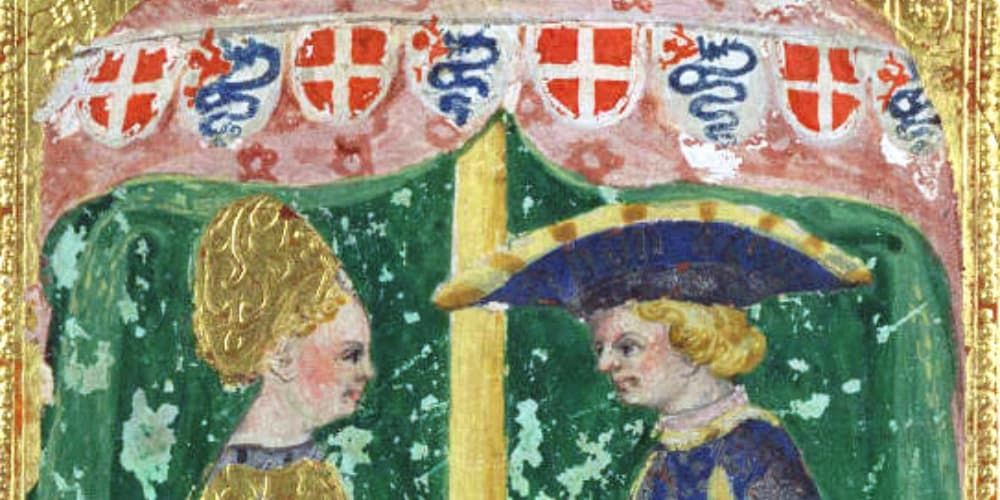
Detail of the Lovers card from the Visconti di Modrone deck, showing the Visconti coat of arms combined with that of the House of Savoy.
Among all Italian tarot decks, the most renowned are undoubtedly the Visconti-Sforza, created between around 1440 and 1460 for the Dukes of Milan. Rather than a single complete deck, they consist of a group of cards now dispersed across various collections, largely attributed to the artist Bonifacio Bembo.
To admire them is to step into a world of luxury and symbolism: gold and silver backgrounds, intricate details, figures that seem suspended beyond time. These were not simple playing cards, but true objects of prestige, designed to reflect the status and power of those who owned them.
Among the most fascinating examples is the Visconti di Modrone deck, of which 67 cards survive. Here, the triumphs and court figures emerge against golden backgrounds, while the numbered cards shine on silver surfaces. Equally striking is the Brera-Brambilla deck, preserved at the Pinacoteca di Brera: rarer and more fragmentary, it retains only two triumphs (the Emperor and the Wheel of Fortune) yet still preserves the refinement of its materials and craftsmanship.
Then there is the Pierpont-Morgan Bergamo deck, perhaps the most well-known. Originally composed of 78 cards, 74 survive today, divided between New York, Bergamo, and a private collection. It is one of the few examples that still allows us to grasp the full structure of early Renaissance tarot.
Alongside the Visconti-Sforza, another essential deck is the Sola Busca, dated 1491 and now housed at the Pinacoteca di Brera. It is the oldest complete tarot deck known to exist and stands out for its distinct style: full-figure illustrations, classical influences, and a visual language that anticipates many modern iconographic traditions.
Over time, tarot continued to evolve at a local level as well. A notable example is the Bolognese tradition, one of the longest-lasting in Italy, which, in the 18th century, found expression in the deck of Giacomo Zoni, a testament to how tarot had by then spread far beyond the courts.
Today, many of these decks are preserved in museums and collections, while others have been reproduced and made accessible to anyone with a passion for them.
Where to see ancient tarot decks in Italy
After traveling through centuries of history and symbolism, there is a way to make this mysterious and captivating journey tangible: seeing these ancient decks with your own eyes.
Tarot cards are real objects, fragile pieces of history that still carry the marks of the hands that created them, the places where they were born, and the stories they have silently witnessed.
One of the most fascinating places to step into this world is the Accademia Carrara in Bergamo, which, until June 2, 2026, hosts the exhibition “TAROCCHI. Le origini, le carte, la fortuna.”
After more than a century, the 74 cards of the legendary Colleoni deck (one of the oldest and most complete in existence) are brought together in a single space. Today, these cards are scattered between Bergamo, the Morgan Library in New York, and a private collection, and for the first time they return to tell their story as a whole.
The exhibition spans seven centuries, from the 15th to the 20th century, offering a deep immersion into the history of tarot, not only the cards themselves, but the hands that created them, the patrons who commissioned them, the techniques behind them, and the fascination they continue to inspire.
But Bergamo is not the only place where this story comes to life.
In the small village of Riola, in the Bolognese Apennines, the International Tarot Museum houses a remarkable collection, ranging from ancient decks to contemporary artistic interpretations. Here, the cards become the starting point for a broader narrative that weaves together culture, symbolism, and imagination.
In Milan, the Pinacoteca di Brera preserves some of the most celebrated Visconti-Sforza decks, among the oldest surviving examples. Observing them up close reveals the refinement of detail, the richness of materials, and the depth of a visual language that predates the idea of “reading” tarot as we understand it today.
Further south, in Catania, Castello Ursino holds important testimonies of the Sicilian tradition, with ancient decks that tell a lesser-known, yet equally significant chapter of tarot’s history.
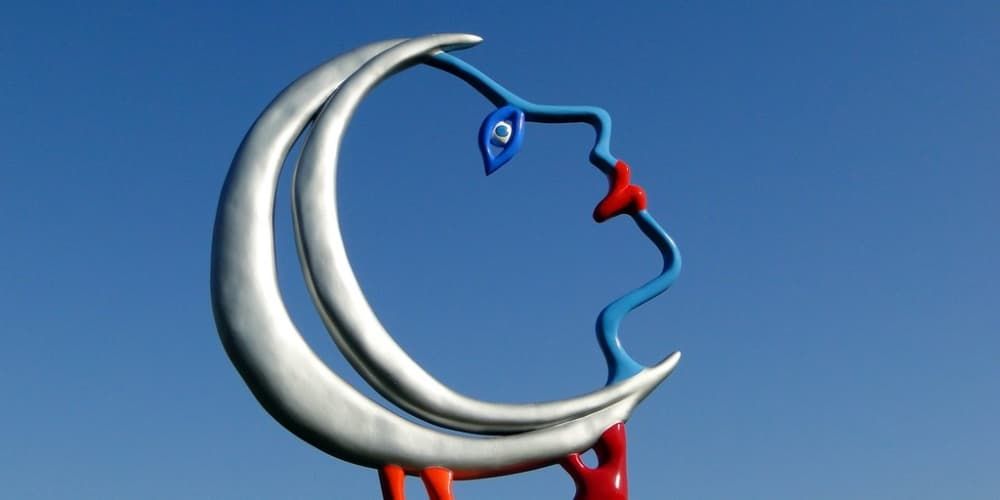
And then there is a place that, while it does not preserve cards, manages to embody their essence in a striking way: the Tarot Garden in Capalbio, Tuscany. A park of monumental sculptures inspired by the Major Arcana, where symbolism takes shape in space and becomes an experience to walk through, to inhabit, and to feel.
Fascinating facts about Italian tarot that (almost) no one knows
There are stories hidden within the cards, details that escape a quick glance, but once discovered, change the way we see them forever.
The first, perhaps the most surprising, is also the simplest: tarot was not created to predict the future. For centuries, it was a game (known by names such as Tarocchini) played in noble courts before spreading into cities. Only much later, in the 18th century, did it begin to be interpreted as a tool for divination.
And yet, even in its earliest forms, something deeper was already present. The 22 Major Arcana (then called Trionfi) were not merely decorative figures, but allegorical scenes that reflected human experience, as if each card belonged to a larger, unfolding story.
Over time, fascinating myths began to take shape around these images. One of the most widespread links tarot to ancient Egypt, imagining it as a fragment of the lost “Book of Thoth.” It is a theory born in the 18th century, one that captured the collective imagination but lacks any historical foundation.
Then there are the details, the ones that make each card feel almost alive.
The Fool, for instance, is often depicted as a wandering traveler, carrying a small bundle on his shoulder, with a dog at his heels as if pulling him back to reality while he moves toward the unknown. The Wheel of Fortune is populated by hybrid creatures and symbols that speak of cycles, change, and unstable balance. Death (so often misunderstood) was even left unnamed out of respect and fear, and never represents a definitive end, but rather a passage, a necessary transformation.
Some decks are true masterpieces. Those created for great Renaissance families, such as the Visconti-Sforza, were hand-painted with gold and precious pigments like lapis lazuli, luxury objects meant to endure over time.
Among the most fascinating is the Sola Busca deck, dated 1491 and now preserved at the Pinacoteca di Brera. It is the oldest complete deck known, engraved with remarkable technique and featuring full-figure illustrations that break away from traditional iconographic conventions.
Finally, there are the traces left in historical records, almost like clues. In Florence, in 1450, tarot cards were even banned for being considered an expression of “vanity.” And yet, only a few years later, a theft recorded in Bologna reveals just how widespread and popular they had already become as a game.
About the author
Written on 12/05/2026
Flavia Cantini
Freelance Content Writer with over a decade of specialized experience in tourism, culture, and creative/artistic activities. I assist magazines, web agencies, and end clients in managing blogs and crafting standout articles

Flavia Cantini
Between the Renaissance and hidden symbols: the true story of Italian tarot will surprise you.