

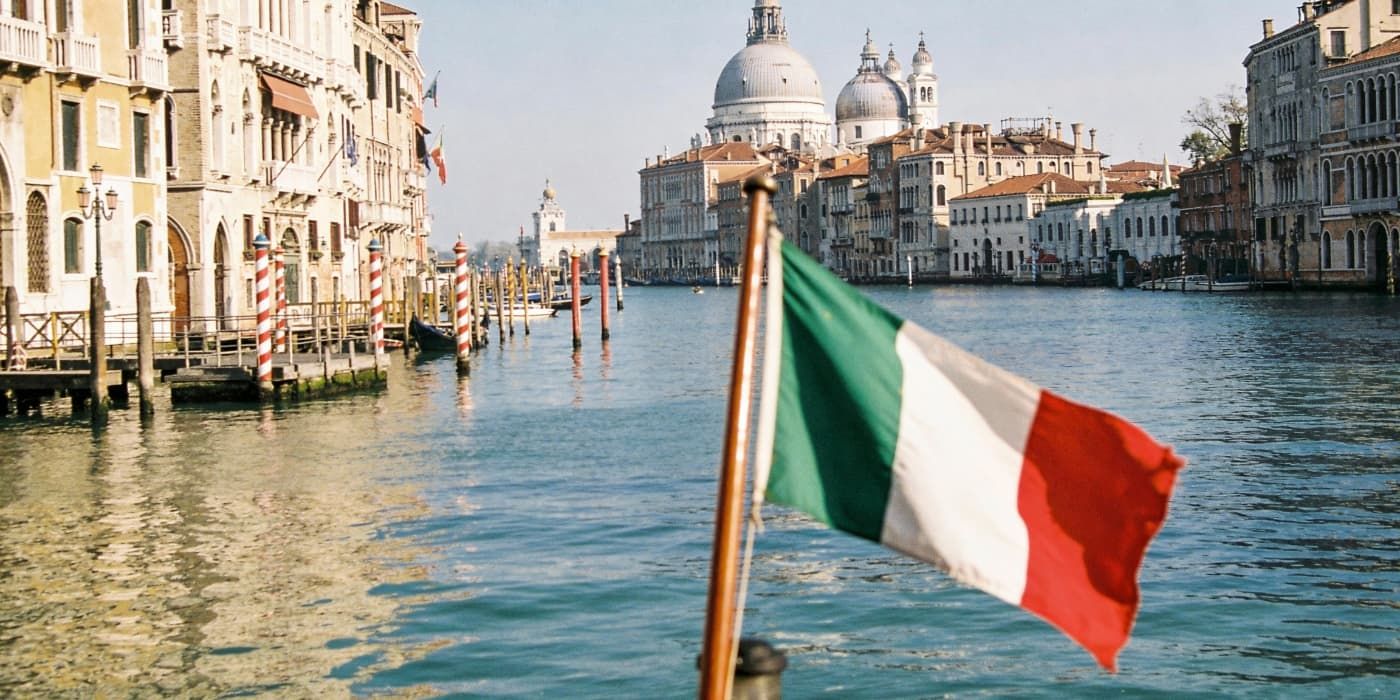

Behind the Italian flag lies a long, fascinating and complex history, born of the Risorgimento idea of independence and a united homeland. The "holy" tricolor—from left to right: green, white, and red vertical stripes—is a symbol of hope, faith, and love: a banner that calls for freedom, unity, and the struggle for a nation that overcomes divisions and represents an entire people.
"The tricolor flag is beautiful and blooms in the sun like a flower," wrote the great author Gianni Rodari in his poem Flags. "For centuries we have been trampled on, mocked, because we are not a people, because we are divided. Let us be united by a single flag, a single hope: the time has come for us to come together," was the wish of Goffredo Mameli in Canto degli Italiani, the national anthem of Italy composed in September 1847 and adopted de facto in 1946.

Everything you need to know about the Italian flag
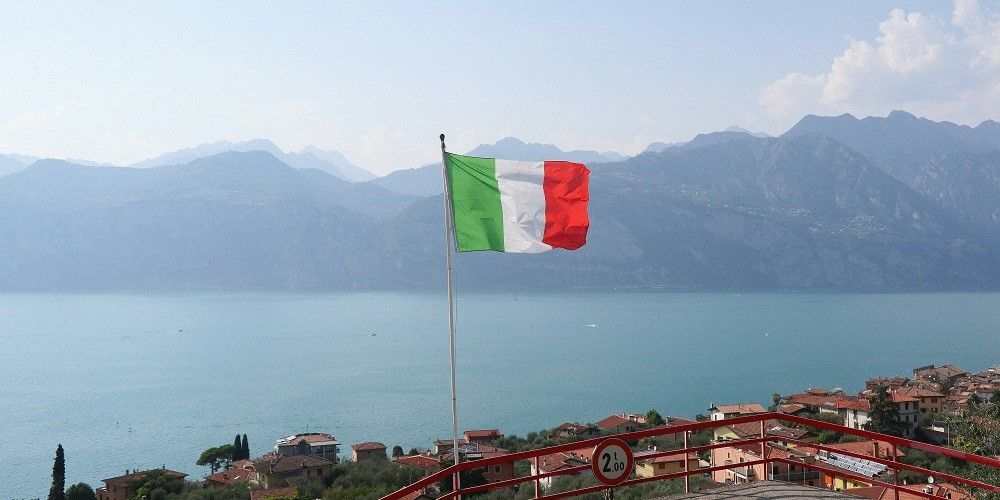
"The tricolor is not simply a state emblem, it is a banner of freedom won by a people who recognize themselves as united, who find their identity in the principles of brotherhood, equality, justice, and in the values of their history and civilization," declared Carlo Azeglio Ciampi. President of the Republic from 1999 to 2006, Ciampi made the spread of patriotism his mission.
But why does the Italian flag, the heritage of that national sentiment born of the Risorgimento and passed down through the Resistance, have the green, white, and red tricolor? How did this symbol come about, who is behind its design, how has it evolved over time, and why is it often not considered a shared value? Here is the true story of the flag and the people who helped build it, beyond all rhetoric.
Listen to the podcast version of the article with the voice of Monna Lisa & Leonardo
When and how the Italian flag was born
The Italian flag was officially created on January 7, 1797, in Reggio Emilia. At the time, Italy as we know it today did not yet exist. One of the first sister republics of northern Italy, born out of the French Revolution, was the Cispadane Republic, formed in October 1796 by the union of the territories of Bologna, Ferrara, Modena, Reggio Emilia, Garfagnana, Massa, and Carrara. Only formally an independent state, it nevertheless managed to establish a parliament, a constitution, and an army.
On January 7, 1797, the Congress of the Cispadane Republic, on the proposal of deputy Giuseppe Compagnoni, later renamed the "father of the tricolor," voted to adopt a green, white, and red national flag. "Compagnoni also moved that the coat of arms of the Republic be raised in all those places where it is customary to display the coat of arms of sovereignty," read the minutes of the meeting.
The decree of adoption specified that tricolor because it was inspired by the French model of 1790: at that time, Italy was crossed by the armies of Napoleon Bonaparte, and many Jacobin-inspired republics that replaced the old absolute states adopted flags with three equal bands in different colours.
In particular, the green, white, and red tricolor was a legacy of the regimental banners of the Lombard Legion, a Napoleonic military unit formed during the Italian campaign to protect the sister republics of revolutionary France from the monarchical powers of the Ancien Régime. In addition to their political significance, green, white, and red also had a symbolic meaning linked to the context: the green of nature, the white of snow, and the red of the blood of martyrs.
The Lombard Legion, serving in the Armée d'Italie, had a green, white, and red flag with the banner of the mounted hunters in the middle. These three colors were strongly linked to Lombardy: white and red already appeared in the ancient municipal coat of arms of Milan (the red cross on a white field), while the uniforms of the Milanese Civic Guard had been green since 1782.
The Cispadane Republic confirmed the tricolor in its flag because green, white, and red were also adopted in the banners of the Italian Legion, the military group that gathered soldiers from Emilia and Romagna. The decision of the Cispadane Parliament was welcomed with applause and approval: since then, the congress hall in Reggio Emilia has been known as the Hall of the Tricolor.
The meaning of the Italian tricolor and its evolution
Initially, the Italian flag had a distinctive element in the center of the white band: the coat of arms of the Cispadane Republic, namely a quiver with four arrows, surrounded by a laurel wreath and adorned with a trophy of arms. The four arrows represented Bologna, Ferrara, Modena and Reggio Emilia, while the flag symbolized the desire for freedom and autonomy from foreign invaders.
The tricolor survived the historical vicissitudes of the pre-unification period for years: the first Italian campaign, the birth of the Jacobin republics (the Ligurian Republic, the Roman Republic, the Neapolitan Republic, the Anconitan Republic), Suvorov's Russian-Austrian campaign that liberated the territories occupied by the French, the second Italian campaign, and the birth of the Kingdom of Italy, founded by Napoleon in 1805 and lasting until 1814.
Despite the collapse following the fall of Bonaparte, the flag remained alive with strength and passion and was an icon for the future unified Italian state that was established in 1861. For the first time, cities of ducal states that had been enemies for centuries identified themselves with a single symbol: the emblem of conquered freedoms, the banner of a united people and a nation.
During the Restoration following the Congress of Vienna, the tricolor persisted, resisting the post-Napoleonic reactionary idea. During the Risorgimento it flew in the revolutionary movements of 1831, in the Young Italy revolts, in the Bandiera brothers' expedition of 1844, in the uprisings of the Papal States and finally in the Capture of Rome, until 17 March 1861, the date of the proclamation of the Kingdom of Italy.
In the proclamation of March 23, 1848, to the peoples of Lombardy and Veneto, announcing the start of the first Italian war of independence against Austria, King Charles Albert of Sardinia, ruler of the Savoyard state, declared that "in order to better demonstrate the sentiment of Italian unity with outward signs, we want our troops entering the territory of Lombardy and Venice to carry the Shield of Savoy superimposed on the Italian tricolor flag."
With the proclamation of the Kingdom of Italy in 1861, the tricolor definitively represented the desire of all Italians for a common hope and a homeland. It was then that the flag was updated by adding a blue border to the dynastic coat of arms of the sovereigns, to prevent the cross and the field of the shield from being confused with the white and red of the bands of the banner.
From the unity of Italy to the birth of the Republic
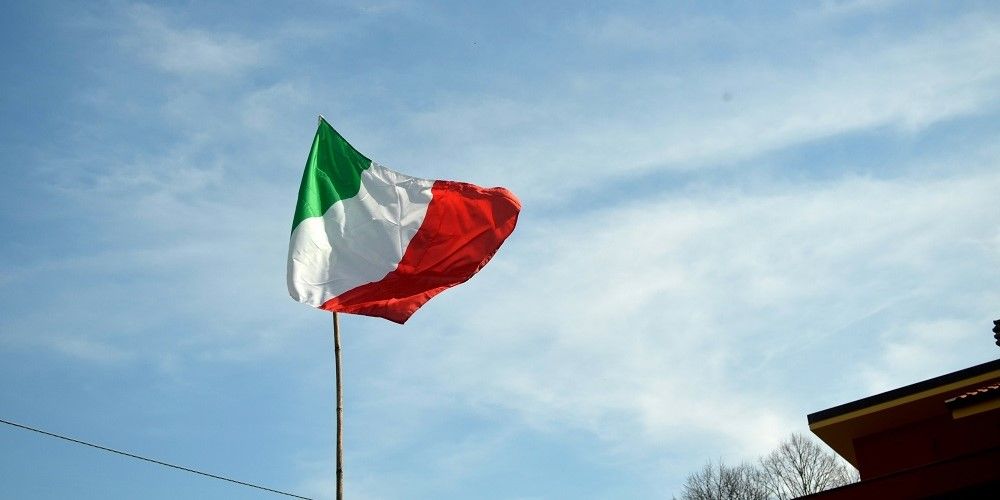
After unification, the Italian tricolor was only given its own specific regulation in 1925, with Law No. 2264 of December 24, which converted Royal Decree No. 2072 of September 24, 1923, defining the models of the flags: the national flag without a crown, and the state flag with the royal crown. The latter was used exclusively in the residences of sovereigns, in parliamentary seats, in public offices and in diplomatic representations.
With the end of fascism and the arrival of the Republic, born on June 2, 1946, on the ruins of World War II, the new democratic Italy institutionalized the tricolor with a presidential legislative decree of June 19, 1946, which defined the layout of the current flag without the royal crown or the Savoy shield. Enrico De Nicola, the first president of the Republic, went in person to Reggio Emilia on January 7, 1947, to celebrate the 150th anniversary of the tricolor.
The national flag was confirmed by the Constituent Assembly chaired by Meuccio Ruini in its session of March 24, 1947, and included in Article 12 of the Constitution, which reads: "The flag of the Republic is the Italian tricolor: green, white, and red, with three vertical bands of equal size." "The Assembly and the public in the galleries stand up. Lively, general, prolonged applause," reads the minutes of that historic session.
Specifically, the Pantone codes for the Italian flag are green 17-6153, white 11-0601, and red 18-1662. Today, the tricolor is celebrated every November 4th during the Day of National Unity and the Armed Forces, which commemorates the entry into force of the Armistice of Villa Giusti in 1918, an event that marked the end of the First World War on the Italian-Austro-Hungarian front.
The Italian flag also flies proudly every June 2, when the Festa della Repubblica (Republic Day) is celebrated in memory of the institutional referendum that took place between June 2 and 3, 1946: on those days, Italian men and women flocked to the polls, choosing the republic as the form of government for their country. It was also a historic date because, for the first time in a national consultation, women voted: a fundamental step towards the return to Italian democracy.
Explore Rome with the Visit Rome PassHow was the flag of Italy made?
The Italian flag, with its green, white, and red vertical stripes, has a complex historical origin: it was created under the influence of the French Revolution during the years of the Cispadane Republic, to belong to the world of republics rather than absolute monarchies and to represent the Italian people as a whole, its desire for freedom and independence.
What does the flag of Italy look like?
The Italian flag is a tricolor of green, white, and red, with three vertical stripes of equal size. The specific colors are bright grass green (Pantone 17-6153 TC), milk white (Pantone 11-0601 TC), and tomato red (Pantone 18-1662 TC). Symbolically, the patriots of Bologna considered green to be the color of hope, of meadows and plains, white to be that of faith and the snows of the Alps, and red to be that of the blood shed for the homeland.
When was the Italian flag made?
The Italian flag has a specific date of birth: January 7, 1797. On that day, in Reggio Emilia, the assembly of the Cispadane Republic, on the proposal of deputy Giuseppe Compagnoni, decreed the adoption of the green, white, and red tricolor as the national flag. After the unification of Italy, the end of fascism, and World War II, the second key date is June 19, 1946, when a decree by the Prime Minister, later confirmed by the Constituent Assembly, established the tricolor as the official flag of the Republic.
Who made the Italian flag?
The Italian flag does not have a single creator, but is the result of a collective historical evolution. Some significant figures directly associated with the tricolor are the Bolognese students Luigi Zamboni and Giovanni Battista De Rolandis, who wore green, white, and red cockades during their protests in the name of Italian unification, and the deputy Giuseppe Compagnoni, who on January 7, 1797, during the Congress of the Cispadane Republic in Reggio Emilia, presented a motion to officially adopt the tricolor as the flag. Since then, Compagnoni has been remembered as the "father of the tricolor." The flag was consecrated by Charles Albert of Sardinia, who on March 23, 1848, on the eve of the first war of independence, announced the tricolor with the Savoy shield in the center as the symbol of his troops.
About the author
Alessandro Zoppo
He has been listening to music and watching movies since he was 6. Proudly Samnite but Roman by adoption, he writes about culture, travel, economics, finance, politics and sports and curates film festivals.

Alessandro Zoppo
Everything you need to know about the Italian flag and its meaning: from its birth to the evolution over time.