
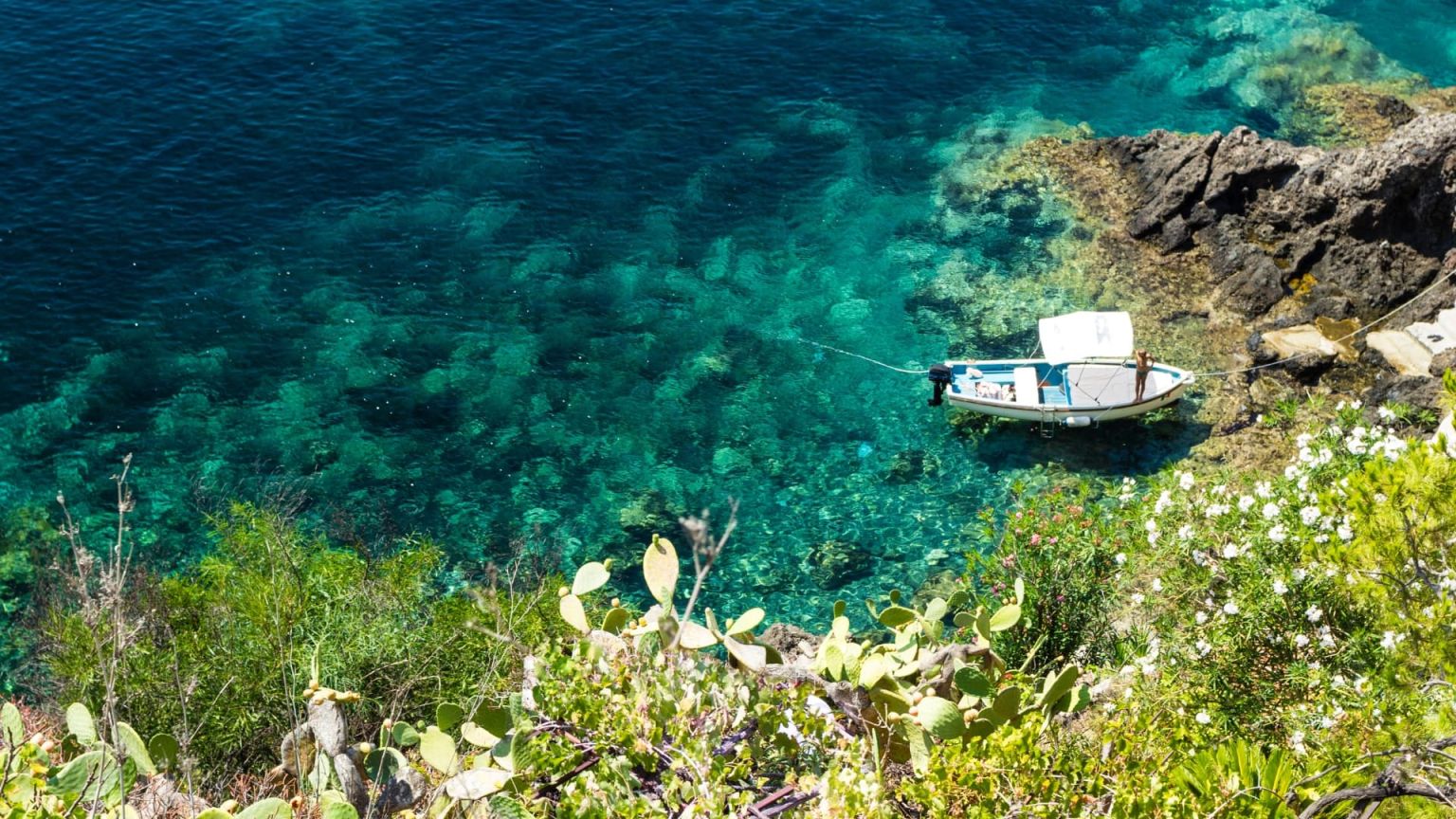

It’s just past midnight and Ustica’s Piazza Umberto I is filled to the brim with people of all ages, out for a post-dinner passeggiata. A DJ has just taken to the stage, and the town mayor is dancing to a set of 80s Italo disco hits. The crowd numbers a few hundred, from toddlers just finding their feet to pensioners, all soaking up the vibe. In the bar where I’m seated, every table is filled with people eating gelati, playing games, and simply watching life pass by. There is not a big brand logo in sight. This is life: simple and communal.
I’ve been writing about Italy for over a decade. As a journalist, I’ve visited all of the country’s regions and I’ve had the good fortune of reporting from most of the major tourist hotspots. This modest scene in Ustica, however, which took place a few summers ago during the run-up to the annual Festa di San Bartolomeo, holds a special place in my heart. It’s a mental sanctuary I return to whenever I need a reminder of how calm, social, and convivial this country can still be.
My time in Ustica was about more than a single vacation, though. The experience was a catalyst that sparked an obsession: since that experience, I’ve been adventuring to explore other of Italy’s ‘minor islands’ at every opportunity that arises. These places have become my greatest teachers, challenging my expectations and allowing me a purer understanding of how many Italians really approach summer, and even life.
In this piece, I’ve collected some of the most important things I’ve learned. I see them as a starting point for anyone who wants to get a deeper understanding of Italy.

The Geography of an Italian Secret
The term "minor islands" first emerged in the 19th century as a geographical distinction to separate Italy’s 450-odd smaller landmasses from the major islands of Sicily and Sardinia. Today, though, it has a more specific meaning. In the 1980s, a dedicated association was founded to protect the interests of 38 of these islands, all of which face shared structural and geographical difficulties.
Some of these islands are now globally famous, Capri being the most obvious example. Others, like Ustica, or Ventotene, remain local secrets. A few, like Palmaria off the Ligurian coast of Porto Venere, or Linosa, which sits equidistant between Malta and Tunisia, feel entirely off the beaten track.
Despite their diversity, these communities share common challenges. The combined year-round population of the minor islands is roughly 200,000, but in summer, that number swells into the millions. Without exception, these places have limited public services and depend on the mainland or larger islands for healthcare and logistics. Many suffer from a perennial lack of supplies and everyday goods.
These constraints create difficulties for residents. For visitors, though, they provide a striking contrast with everyday life, and a sense of wildness, adventure and unspoilt nature that can be hard to find sometimes on the peninsula. There’s a reason why Italians ‘in the know’ choose to return to them year after year.
The Art of the Slow Arrival
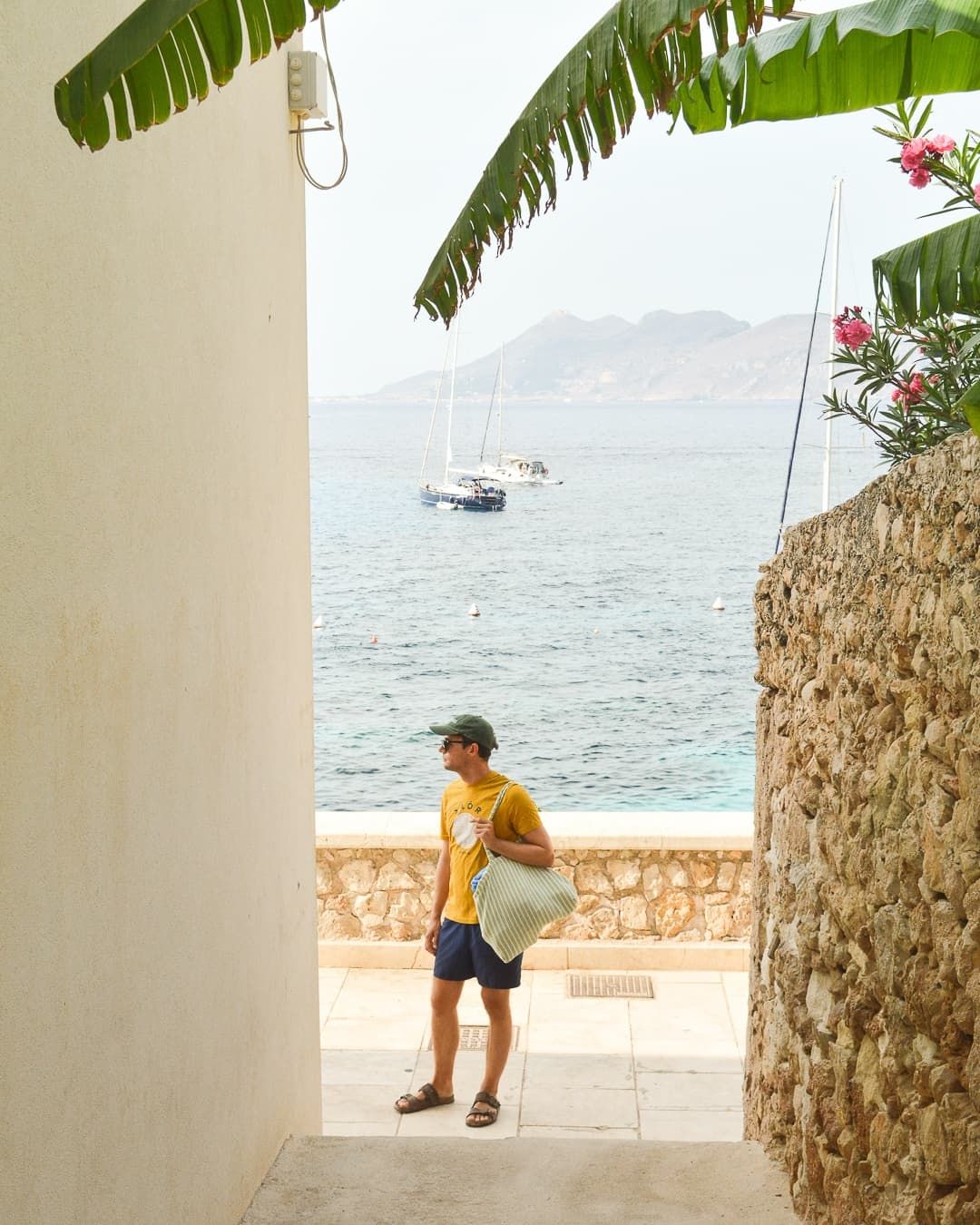
Traveling to the minor islands is all about confronting and navigating different kinds of limitation. The key for any traveller is to embrace this as part of the experience. If you value total ease and want a seamless holiday experience, these islands may not be for you. If, on the other hand, you are open to ambiguity, and the occasional delay, you’re sure to be rewarded.
The first trial is the ferry. While some islands are private or inaccessible, most are reachable via companies like Liberty Lines, Caremar, or Alilauro. Prices are competitive, but don’t expect luxury. Most of my journeys have started not on open sun-decks with cocktails in hand, but huddled in the stuffy cabins of cavernous, fume-filled traghetti (ferries) or bumpy, claustrophobic hydrofoils (aliscafi). In August especially, I guarantee every journey will end up in a scrum-like scramble over bags, and general sweaty discomfort.
The roads too are a baptism by fire. While it’s easy to lean on stereotypes about Italian driving, some exist for a reason. On Procida traffic reaches unimaginable levels, and the honking horns and road rage are alas part and parcel of travelling to the island. Yet even in more luxurious destinations, the vertiginous thoroughfares can be terrifying. The roads around Anacapri buzz with enough motorini to rival the Amalfi Coast, and the paths linking Salina, in the Aeolian islands, plummet worryingly down cliffs with sheer, borderless drops to the sea below. Travel here, as I say, is not for the faint-hearted.
Traveling to the minor islands is all about confronting and navigating different kinds of limitation. The key for any traveller is to embrace this as part of the experience.
Finding Beauty in the Bare Essentials
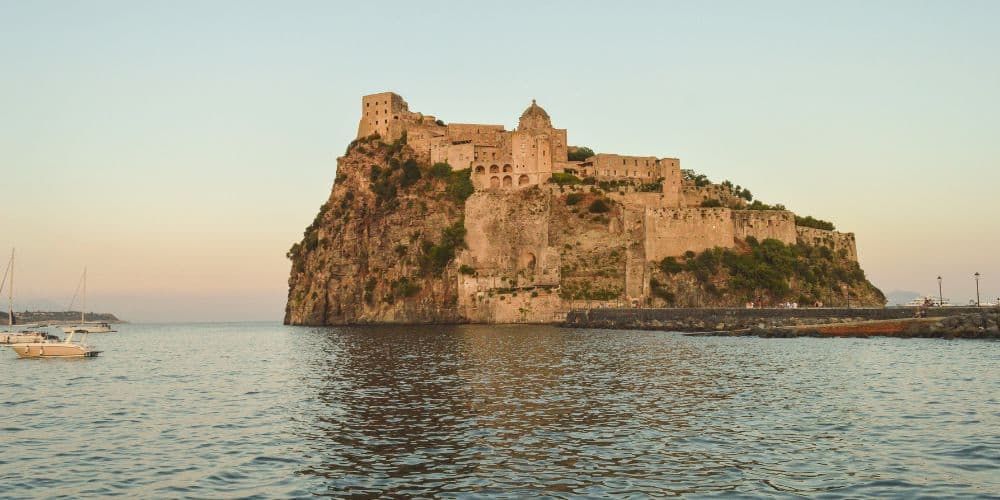
Still, on arrival, the struggle is quickly worth it. It’s impossible not to be blown away by the beauty of these wonderous little communities. Starting, of course, with the port towns. Every island has at least one, and they are, without exception, astonishing. Most have served as military bases throughout their histories, giving them a shared architectural language of fortresses, castles, and lighthouses. From the massive Aragonese Castle in Ischia to the medieval ramparts of Elba’s Portoferraio, there is theatricality here, a sense of an uncontaminated, dramatic past.
Practically speaking it can take a while to adjust to the rhythm of life. On many of these islands, finding mainland-style supermarkets, like Coop, Esselunga, or Conad, is out of the question. Instead, you are limited to alimentari and small mini-markets. At first, this might seem annoying, but after a few days it reveals a certain charm. Over years of various trips I’ve now learnt a routine from the locals: on my first day, shortly after arriving, I stock up on pasta, canned goods, sott'oli (vegetables in oil), capers, and olives. Then, a few times a week, I’ll head to the market to pick up fresh bread, tomatoes and other vegetables, very often grown on the island in question.
There is a joy to this simple ritual. While some of the islands boast perfectly good restaurants, it’s the home cooking, simple meals eaten outside on a terrace watching neighbours doing the same, that I’ve come to love. In an age where so much travel revolves around bucket lists and ticking boxes, there’s something unashamedly restorative about the Italian minor island ethos: simple food, vino sfuso and a long afternoon nap are what life is all about.
Beyond the Sunbed, Seeking the Wild
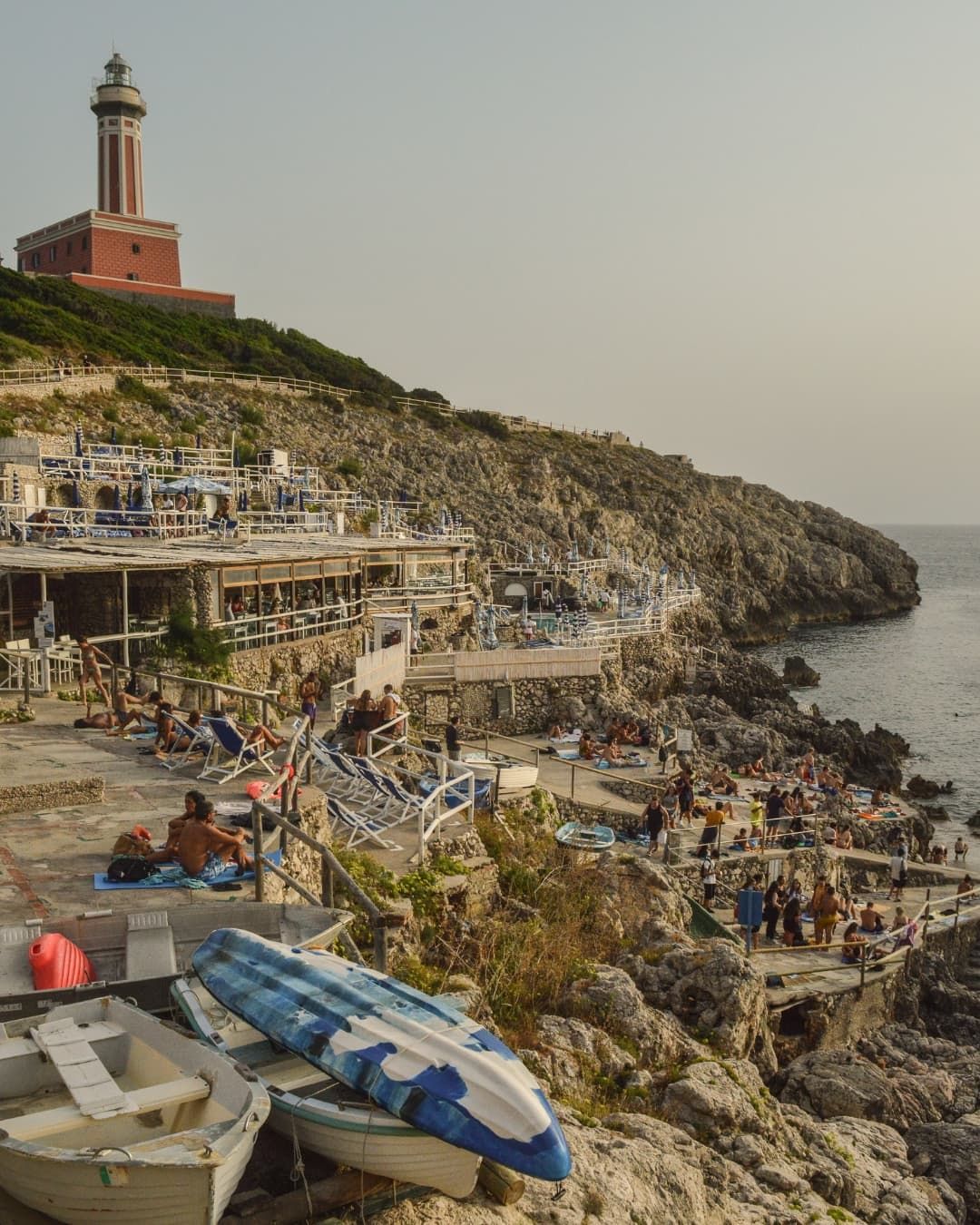
There are, notoriously, two kinds of beach-goers in Italy: those who cherish the comfort of the stabilimenti (beach clubs) and those who favour the wild and rocky coves the country has to offer.
Personally, I fall somewhere between the two camps, and luckily most minor islands cater to both preferences. Capri is deservedly renowned for its chic waterfront lounges, but it’s also full of secret crags away from the towns where nature reigns supreme. Pantelleria has its fair share of exclusive, high-end resorts too, but there are also swathes of wilderness to cater for wilder tastes.
Beach-going here is improvisational. In Tuscany, on Elba, it often means grabbing a slab of focaccia and some fruit before heading off on a hike to some secluded bay. In Puglia, on the Tremiti islands, holiday makers often head to the water with pasta al forno or parmigiana cooked the night before, shared from aluminium tins while a watermelon cools in the sea.
I used to think of the beach primarily as a place to swim and to sunbathe. Years of vacations on the minor islands, though, has broadened my perspective. Here, it’s as much about savouring the sound of cicadas, the shade and smells of a resinous pine forest, as it is taking the waters or working on a tan.
The Magic of a Midnight Passeggiata
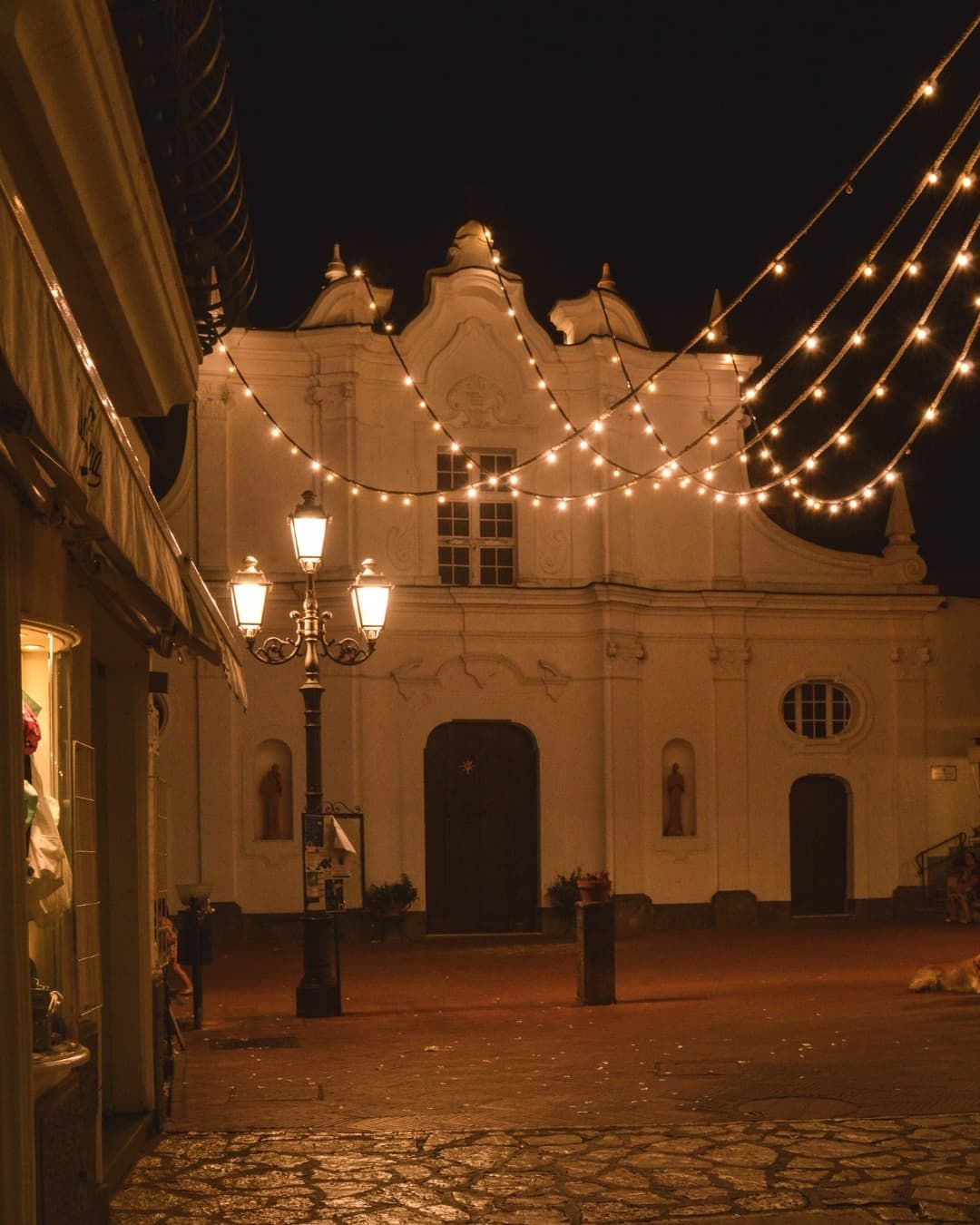
The pace of life on the minor islands is, by nature, erratic. On one hand, it’s chaotic and stressful. On the other, relaxed and soporific. There’s plenty of space for convivial, buzzy socializing, yet it’s easy to escape to more solitary, even spiritual experiences. Nowhere do these extremes become more apparent than after the sun goes down.
The aperitivo hour in Italy’s small ports is a thing to behold. This is the moment when every island’s DNA comes together: the local residents, the ‘itinerant’ regulars, the second-home owners, and the curious tourists all emerge in unison for a night on the town. With so little ‘scheduled’ to do, the evening stretches out luxuriously. On the mainland, an aperitivo is often just a prelude to a dinner reservation. On the minor islands, time is more fluid. People eat early, eat late, or simply stretch their drinks into a meal. Many comuni put on festivals in the warmer months including nightly programmes featuring local bands, actors and poets. Depending on the region I’ve enjoyed folk dances from elegant trescone to frenetic tarantelle.
Despite the joy of these gatherings, though, nighttime pleasure isn't confined to the clubs and music alone. To me, what makes the minor islands incomparable with their mainland counterparts is the raw encounter with nature. Unlike the Adriatic and Tyrrhenian coasts, which are all too often blighted by neglected suburbs and concrete sprawls, the beauty in these spaces is all around, from the immediate vicinity of the ports.
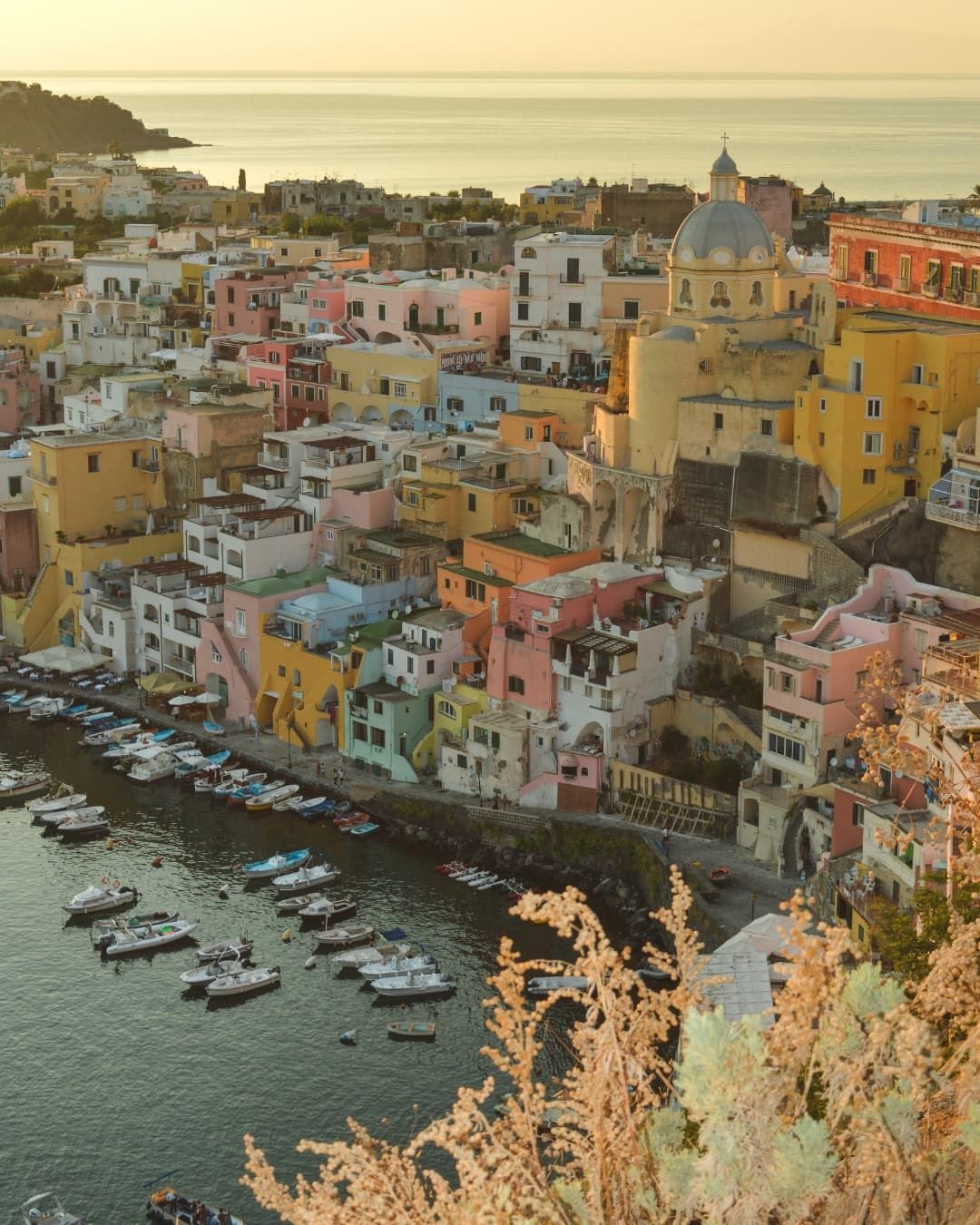
When I stayed on Procida a few years ago one of my favourite experiences was walking back from dinner along the Marina di Corricella towards my accommodation, admiring the little villas, the cats, the neon Madonna statues on small streets, as I promenaded through the night.
When I stayed in Malfa, on the island of Salina, my bed and breakfast was located a few kilometres out of town. While it was inconvenient at times, some of my most enduring memories from that trip are of strolling home from the port through fields of prickly pears and cacti towards my little apartment, the smell of grass, wild fennel and sweet zibibbo wine hanging in the warm air, the stars laid out above me like a map.
The aperitivo hour in Italy’s small ports is a thing to behold. This is the moment when every island’s DNA comes together: the local residents, the ‘itinerant’ regulars, the second-home owners, and the curious tourists all emerge in unison for a night on the town. With so little ‘scheduled’ to do, the evening stretches out luxuriously.
Unmapping Italy’s Stereotypes

As a journalist, I’ve often found myself collating stereotypical images of what Italy should look like. I’ve captured a Tuscany that resembles the Val d'Orcia with its cypress trees, or a Puglia that is all about trulli and olives. Yet while these labels exist for good reason, travelling too strictly with these criteria in mind can easily lead to a predictable itinerary.
The minor islands offer an escape from this. Because of their isolation, they don't just reflect their parent regions; they distil identities into something entirely their own. Levanzo and Favignana are both Sicilian, yet each has its own distinctive identity. From Sardinia’s Ligurian-looking Isola di San Pietro to the North African style flat-roofed houses of Linosa, these places offer a deeper, more fractured version of the country.
On that first trip to Ustica, back in that crowded square, I was jolted out of my overthinking ‘writer brain; and thrown into the present. Ever since that moment I have continued to enjoy loosening my labels about Italy. I have learned that the limitations and simplicity of the island lifestyle are not obstacles to be overcome, but are the very things that make the experience authentic. These places have taught me that constraints can be liberating, removing expectations in favour of a more locally-informed kind of travel.
By embracing the slow, often unpredictable rhythm of these shores, I have discovered a version of Italy that remains fiercely independent and vibrantly alive. Take it from me, then: whether you are a seasoned visitor or new to the country, a trip to the minor islands offers the security of everything you want from Italy and, at the same time, the thrill of a subtle, renewing adventure.
By embracing the slow, often unpredictable rhythm of these shores, I have discovered a version of Italy that remains fiercely independent and vibrantly alive.
About the author
Written on 20/02/2026
Jamie Mackay
Jamie Mackay is a British journalist, author, and cultural historian based in Florence. He has reported on Italian politics, society, and travel for over a decade for international titles including The Guardian, The Economist, and Frieze. He is the author of the acclaimed book The Invention of Sicily: A Mediterranean History and is a frequent commentator on the complex intersection of Italian heritage and contemporary life.

Jamie Mackay
A tale of summer on the minor Italian islands, and of how these suspended places capture the very essence of Italian life.