
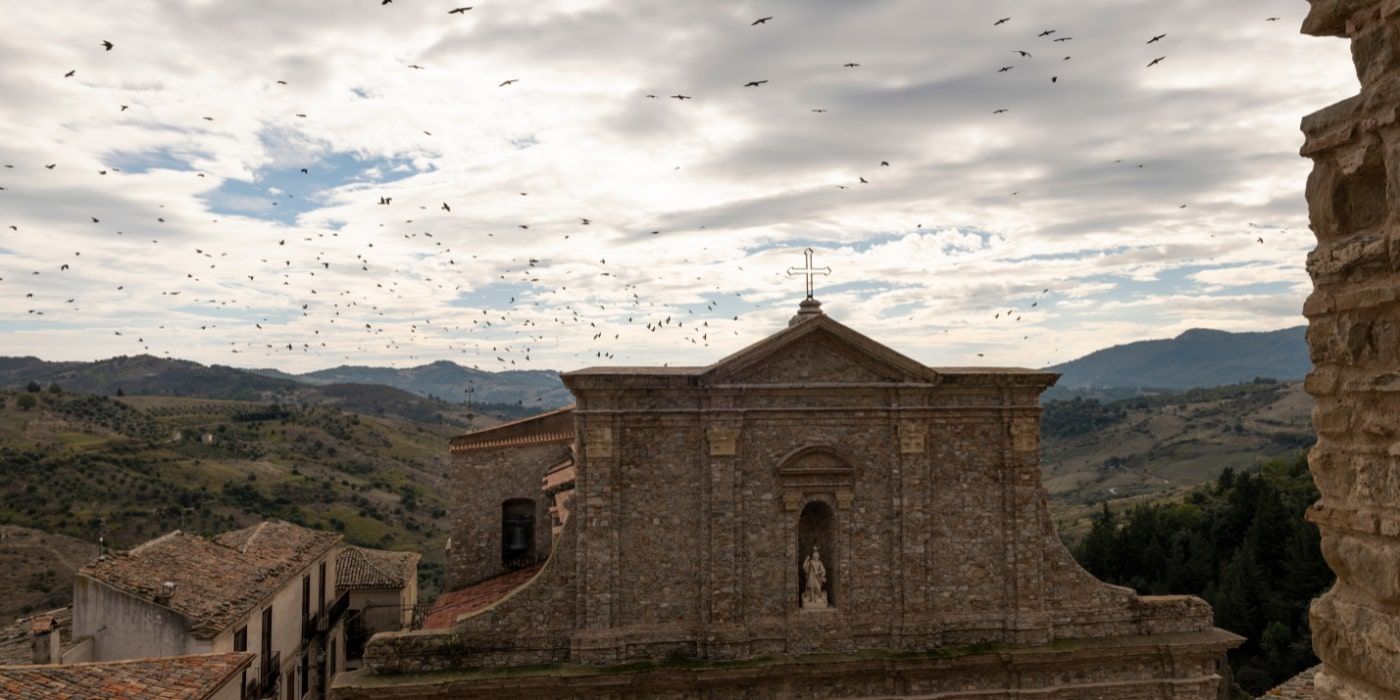

Travellers exploring southern Italy’s quieter corners will find here a single building that condenses almost a millennium of art, history, and everyday devotion. Oriolo is one of Italy’s officially recognised “most beautiful villages”. At its centre stands the Church of San Giorgio, the town’s main monument, together with the medieval castle above it. Both are listed by Italy’s Ministry of Culture as national heritage sites.
Is it worth a visit? What can you see inside? And what does a queen of France have to do with a small-town church in southern Italy? You’ll find the answers (and plenty of travel inspiration) in our guide to the Church of San Giorgio, Oriolo.

Faith and history: the Church of San Giorgio Oriolo
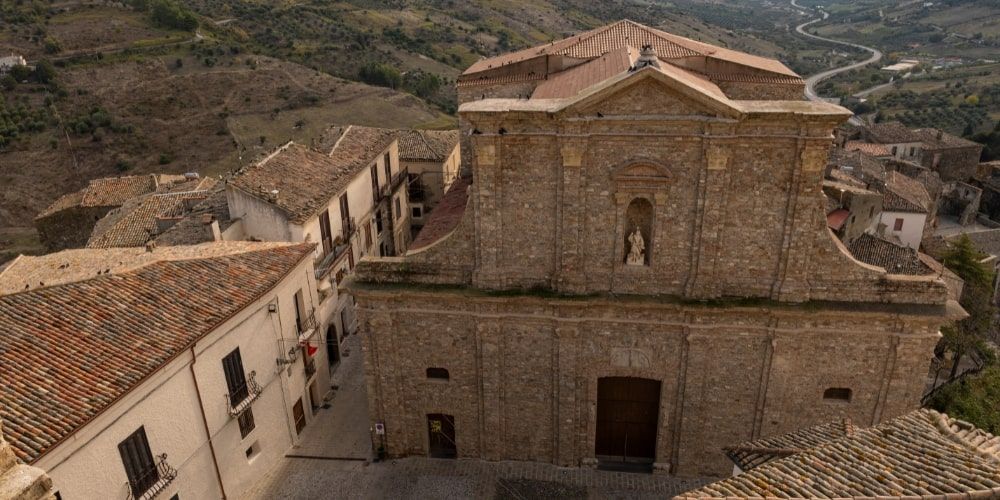
From the village gate, Corso Vittorio Emanuele threads uphill through houses with terracotta roofs and narrow side alleys. A few turns later, the street widens into a small square, and there it is, its stone façade standing out against the ancient buildings behind it. Two weathered marble lions, carved in 1264, guard the entrance as they have done for centuries.
Inside, everything is a reminder that even in a small hilltop village, treasure can be found.
Oriolo’s devotion to Saint George is represented in the Mother Church of this medieval town hidden in the heart of a southern Italian region off the tourists’ maps.
Saint George has been Oriolo’s patron since the Norman era, celebrated as the town’s protector in good harvests and hard years.
Each April, the local community continues to loudly celebrate its cherished sacred symbol. And even today, everything runs around the Church of San Giorgio, Oriolo.
From Norman roots to popular uprisings
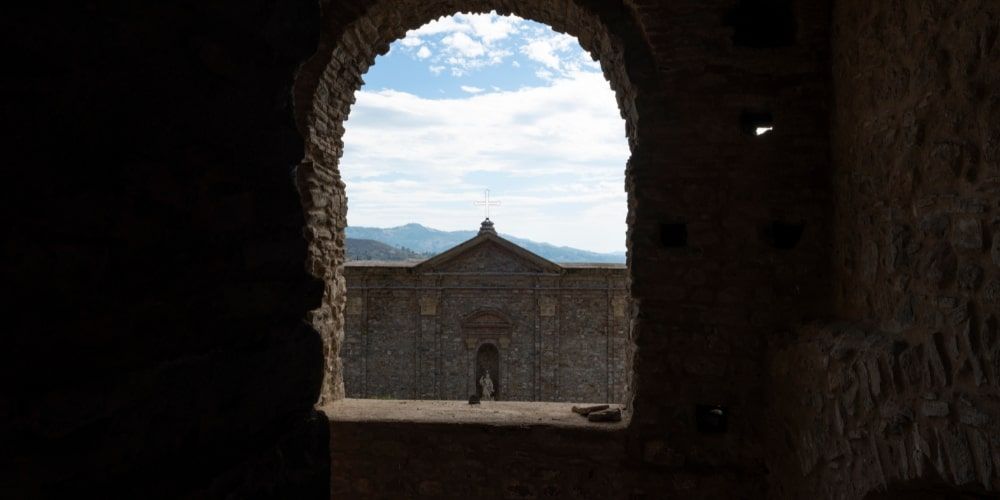
The Church of San Giorgio has watched over Oriolo since the Norman-Swabian era, when Latin Christianity began shaping Calabria’s hill towns. The twin marble lions flanking the portal, silent witnesses to nearly eight centuries of worship, are among the few survivors of that early church.
Over time, the building became much more than a place of prayer. In 1530, inside these same walls, royal officials gathered to confirm King Ferdinand’s charter granting the Sanseverino family control of Oriolo and its lands. This episode shows how the church held a civic role within Oriolo’s life, not only a spiritual one.
Its history is also an adventurous one. Would you ever imagine a church playing a role in a rebellion? That’s precisely what happened in Oriolo during the 1647 uprising. Inspired by Naples’ Masaniello uprising, Oriolo’s townspeople rose against feudal rule and barricaded themselves in the church’s bell tower, which once stood almost as high as the castle above.
Church of San Giorgio Oriolo: art and architecture
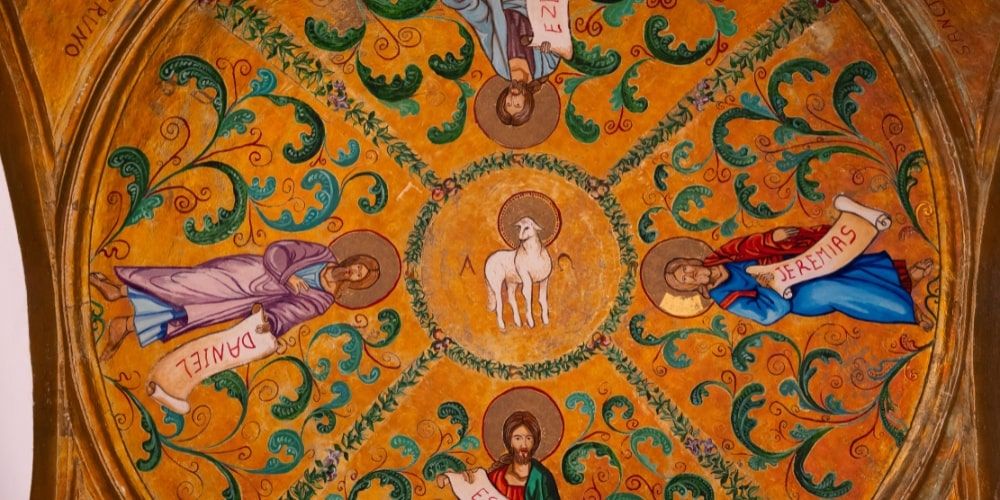
Even after later additions and changes, the Church of San Giorgio in Oriolo still shows its medieval background. The layout keeps the original Norman design. Since 1793, restorations have added Baroque and neoclassical touches, but the old stonework remains visible.
Travellers can still spot traces of the early building: basal pillars, brickwork from medieval chapels, and fragments of ancient tomb crypts revealed during later restoration.
Among the highlights are a 15th-century marble stiacciato relief, probably from the Donatello school, and the 1581 Madonna by 15th-century artist Antonello Gagini. A panel showing saint Francis of Assisi captures the saint receiving the stigmata exactly as described by Thomas of Celano, the saint’s first biographer.
A wealth of sacred artworks has been collected over the centuries. Among them are a finely restored Baroque wooden altar, an Ecce Homo in terracotta from the 18th century, and liturgical pieces brought here from the former Capuchin convent.
The mid-18th-century pipe organ is said to have been donated by the Queen of Spain, and two bronze bells, dated 1637 and 1926, still mark the rhythm of local life.
Unearthing Oriolo’s sacred heritage
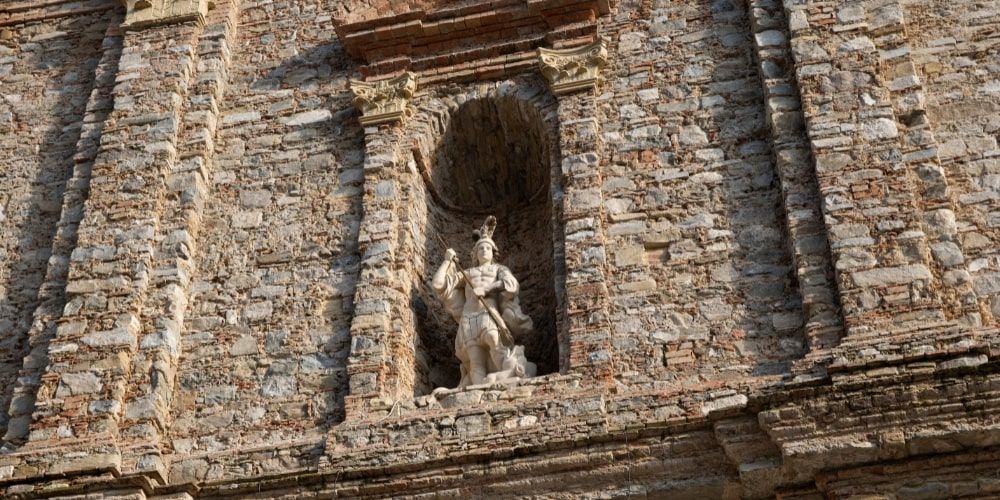
Restoration work has revealed layers of ancient chapels, votive spaces dedicated to Saint John the Baptist, the Blessed Sacrament, and Saint Mary of the Angels.
Around them revolved numerous congregations and brotherhoods: Saint Michael, Saint Joseph, Saint Carlo, and others. In the past, they had a crucial role in local life, since they organized processions, charity, and burials.
All of those traces help to explain why Oriolo’s Church of San Giorgio is a record of how small southern communities intertwined faith, social care, and art long before modern institutions existed.
The relics: Saint George and Saint Francis of Paola
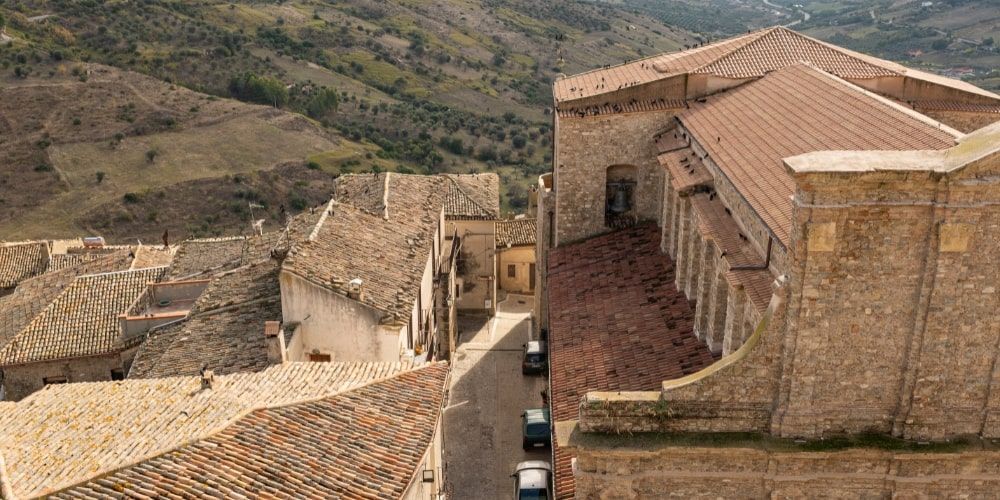
Among the treasures kept in the Church of San Giorgio are two reliquaries that link Oriolo to Calabria’s spiritual heritage.
One contains fragments of Saint George Martyr’s skull, the town’s patron and protector. The other holds the toe bone of Saint Francis of Paola, the Calabrian saint who died in France in 1507.
According to records, the latter relic travelled from Tours to Oriolo in the late 1500s, when a local friar, Father Dionisio Colomba, received it as a gift from Catherine de’ Medici. But what could the Queen of France possibly have to do with a hilltop village in southern Italy?
As it turns out, it was all in the family. Catherine de’ Medici was, in fact, the cousin of Donna Fulvia Gattinara, the wife of Oriolo’s first marquis, Marcello Pignone del Carretto, a family connection that was enough to bring here a relic destined to leave its mark on the town’s history.
Its presence was later confirmed by a 1680 notarial act discovered in the State Archive of Castrovillari by historian Vincenzo Toscani, and formally recognised by the Minims Order in 2008.
In April, three days of celebrations are dedicated to Saint George and Saint Francis.
The Feast of Saint George and Saint Francis – faith, music, and marching guards
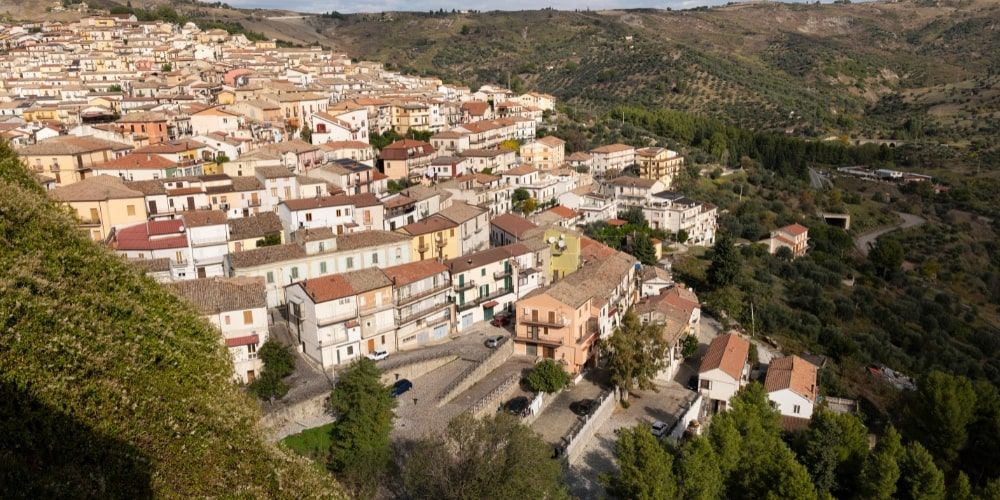
From 22 to 24 April, Oriolo celebrates its patron saints, Saint George and Saint Francis of Paola, with one of Calabria’s most distinctive festivals.
The streets glow with coloured lights, children crowd around the fairground rides, and kitchens fill with the sweet scent of pastries baked for “l'Incanto”. This is a special community auction where families and groups of friends bid against one another to win traditional sweets, local delicacies and handcrafted items. The proceeds are then used to help fund the festival.
Festivities kick off on the 22nd, when the town’s historic marching band winds through the narrow lanes to announce the Vigilia.
Inside the Mother Church, the statues of the two saints are brought out from their chapels to “meet” before the main altar: it’s the symbolic gesture that marks the true start of the celebrations.
Over the following days, civic leaders, clergy, and hundreds of residents join the long processions through the historic centre. Balconies along the route bloom with flags and flowers as families open their doors to friends and visitors.
Two ceremonial guards lead the way: the Traditional Guard and the Spanish Guard. Dressed in historic uniforms, they march for hours, some of them boys who have dreamed of this moment since childhood, accompanying the saints with rhythmic steps and solemn pride.
It all culminates in a blaze of music, banners, and fireworks beneath the shadow of the castle. Faith and spectacle in true southern style.
Oriolo is one of the destinations featured in our 2025 guide to must-visit places in Italy.
Beyond the Church of San Giorgio – convent ruins and rural chapels
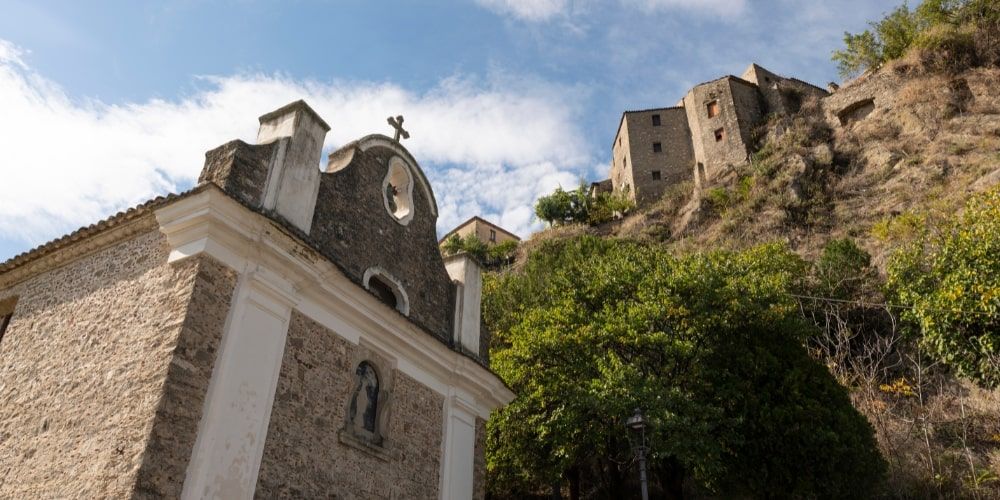
Oriolo’s faith extends beyond the Church of San Giorgio to a network of smaller sacred sites that reflect the story of the local devotion through the centuries.
Let’s begin with the seventeenth-century Chapel of Santa Maria delle Virtù. To find it, head towards Porta San Giacomo. The chapel’s façade stands out for its finely carved eighteenth-century stone portal and the coats of arms of the Pignone del Carretto family and the Franciscan Order. Each year, on the first Saturday of June, Oriolo honours the Virgin with an open-air celebration that brings residents back to this small and beloved chapel.
Another site well worth a visit lies just beyond the old town, along the state road 481: the ancient Franciscan convent. Dating back to 1439, it has resurfaced after centuries and brought to light by recent archaeological excavations.
Researchers have identified the church, the cloister, and the frescoed walls that once housed the friars of the Third Order Regular of Saint Francis of Assisi. Within the complex, you can still make out the old refectory, the scriptorium, and traces of a sixteenth-century Byzantine-style fresco cycle.
Plan your visit – practical information for travellers
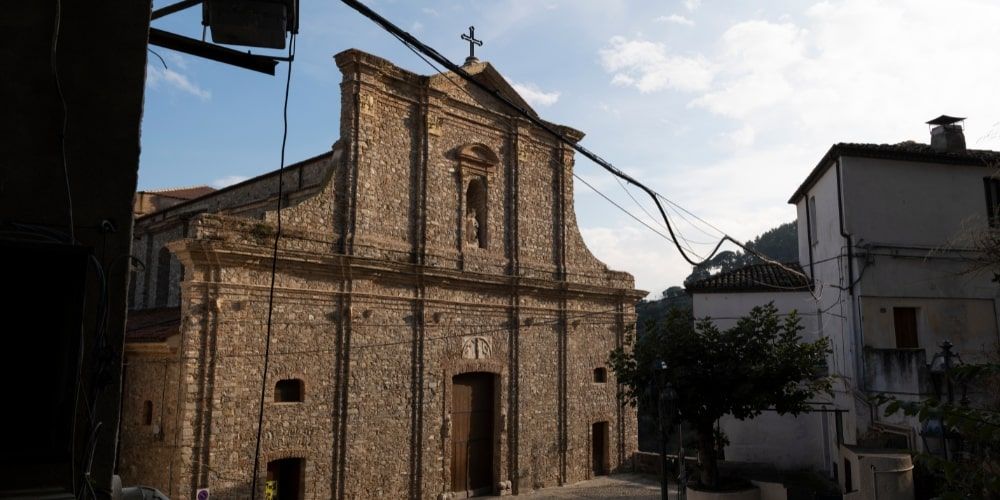
Location: Church of San Giorgio Martire, Corso Vittorio Emanuele, Oriolo (CS) – Calabria.
Access: The church stands in Oriolo’s historic centre, about a five-minute uphill walk from the castle. The lanes are cobbled and fairly steep, so wear comfortable shoes. Free parking is available near the lower gates of the old town; from there, follow the signs up to the church.
Combine with: the Castle of Oriolo, one of Calabria’s best-preserved medieval fortresses, where visitors can see restored halls, period costumes, and exhibits that tell the story of the village; Palazzo Giannettasio, for an insight into local rural life; artisan workshops in the old centre. Nature lovers can continue towards Pollino National Park, about 30 minutes away by car.
Etiquette: Modest clothing is appreciated, and it’s best to avoid taking photos during Mass or other religious services.
How to reach Oriolo: the nearest railway stop is Trebisacce (about 25 minutes by car). Oriolo is roughly 120 km from Matera and 126 km from Cosenza.
The Church of San Giorgio, Oriolo – FAQs
When was the Church of San Giorgio Oriolo built?
The first structure dates back to the Norman-Swabian period (12th century) and was later expanded, particularly in the 1790s and the 1800s.
What artworks can visitors see inside the Church of San Giorgio?
Highlights include the 13th-century marble lions guarding the entrance, a Madonna by Gaggini (1581), and a rare 15th-century relief depicting Saint Francis of Assisi receiving the stigmata. You’ll also find a Baroque wooden altar, 18th-century organ pipes, and sacred art collected from Oriolo’s former chapels and convents.
Which relics are preserved in the Church of San Giorgio?
Fragments of Saint George Martyr’s skull and the toe bone of Saint Francis of Paola, recognised in 2008.
When does the Saint George Feast take place?
Oriolo celebrates its patron saints, Saint George Martyr and Saint Francis of Paola, with three days of processions, marching bands, and fireworks. From 22 to 24 April, with the main procession on the 23rd.
About the author
Written on 31/10/2025
Lorena Calise
I'm a content writer for magazines and websites. I also explore Italy through my writing for Visit Italy and Visit Naples.

Lorena Calise
The town of Oriolo is home to a centuries-old church and a festival dedicated to its patron saint. What lies behind it’s a story worth knowing.