

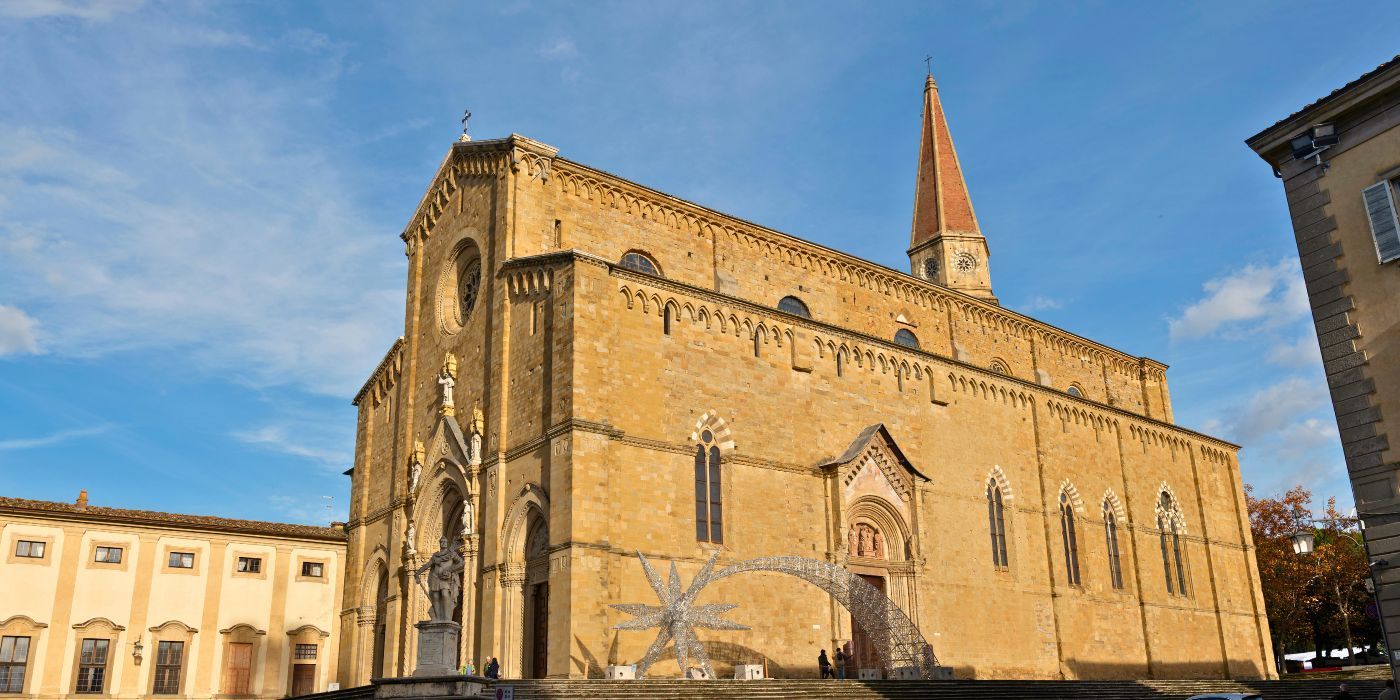
Majestic, solemn, elegant, just like the whole city indeed, the Cathedral of Arezzo is one of the most iconic and must-see attractions in the City of Arts. A place where everything tells the story of ancient Arretium, its transition from an ambitious free municipality to an inspired fiefdom under the rule of the Medici family from Florence, yet the stories of men brimming with creativity and sensitivity to beauty who honored it and elevated it as great among the greatest at the heart of the Italian Renaissance.
While the first brick of this imposing church at the top of the historic centre (Piazza Duomo), officially the Cathedral of Saints Peter and Donato, was laid in 1278 according to the canons of gothic arts dominant at the time, the aesthetic we all know and admire today reveals a long and complex construction process that spanned over the following centuries (even up to 1914), giving the building a layering of styles that feels striking to visitors.
But beyond its distinctive outer architecture, the true magic of Arezzo’s Cathedral must be discovered and marveled on the inside of its walls, amidst many works of art of immense value. Among these, certainly cannot be missing the unmistakable signature of one of the undisputed masters of renaissance art: Piero della Francesca, the great painter and mathematician, one of the personalities who most contributed to defining Arezzo as a land of beauty and a destination to discover.
Prepare for a journey through harmonies of light, color and geometry, where the spirituality of sacred art does not negate, but rather amplifies the pursuit of sculptural perfection in painting.

Cathedral of Arezzo and Piero della Francesca, when the gothic meets the renaissance
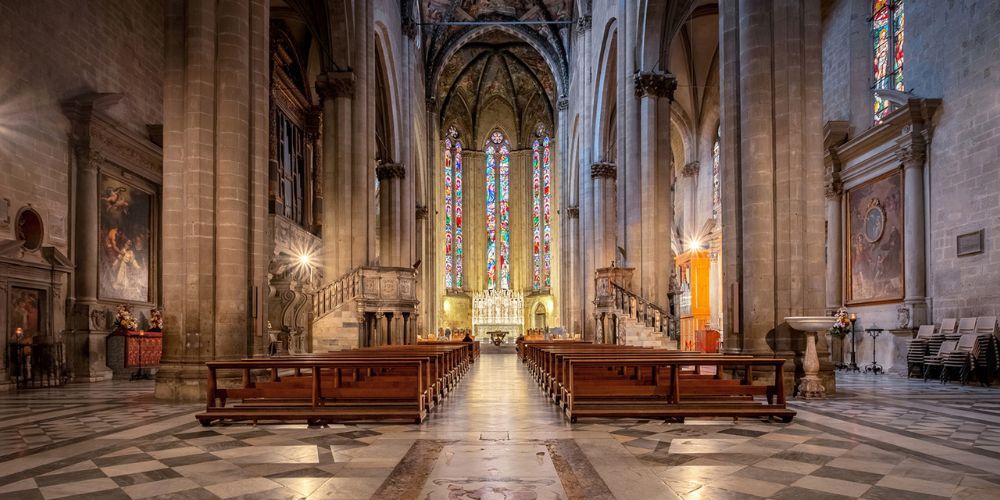
As you step through the sumptuous gate of the Cathedral of Arezzo and look upward at its lofty naves supported by massive and regular pillars, you're immediately captivated by an atmosphere of solemn verticality and momentum, typical of gothic art and architecture.
This imposing structure, though typically medieval and rooted in the years of its original construction, nonetheless houses precious testimonies to the renaissance artistic ferment that redefined the aesthetics and vibes of the entire town.
Arezzo’s Cathedral thus represents an ideal and peculiar meeting point between the angular lines of the gothic and the elegant rationality of the renaissance. A combination of styles expressed in masterpieces such as the magnificent multicolored stained-glass windows by Guillaume de Marcillat, crafted between 1516 and 1524, which bathe the inner environment of the church in a vibrant and mystical light, inevitably shifting their reflections and hues with the changing of seasons.
The art of Piero della Francesca fits into this crossroads of styles with unparalleled purity and formal precision. Originally from nearby Sansepolcro, Piero is one of the most representative artists of the Arezzo school, with a legacy of rare beauty, flair and mastery of perspective to admire throughout the City of Arts.
The presence of Della Francesca in the interior halls of the Cathedral, though seemingly hidden, is no mere detail anyway. His contribution enriches the artistic heritage of this enchanting site in the historic centre of Arezzo, combining the spiritual exploration in art with mathematical precision, pursuing the renaissance purpose of harmony and composure.
Magdalene by Piero della Francesca, a masterpiece inside the Cathedral of Arezzo
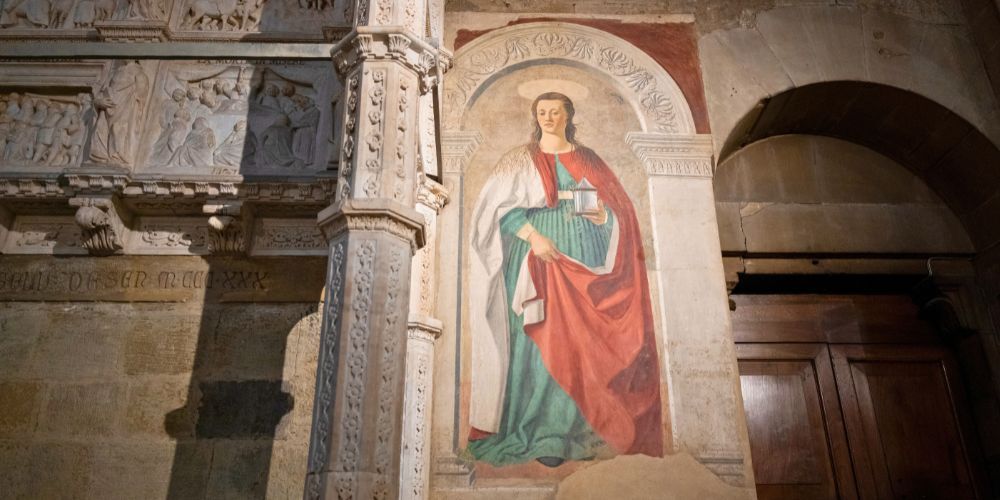
In a secluded and almost hidden corner on the wall of the left nave of the Cathedral of Arezzo, next to the majestic funerary monument dedicated to Guido Tarlati - bishop and lord of the city in the early 14th century - here appears one of Piero della Francesca's masterpieces, in full elegance, radiance and grace: the fresco of Magdalene.
Dating approximately 1460, this Magdalene is one of the most refined and prestigious examples of renaissance art, both Italian and European. This fresco distinguishes itself by an almost obsessive search for harmonies between stylistic geometry and chromatic balance, signature elements of Piero della Francesca's approach to painting. The work depicts the image of Mary Magdalene in a manner that seemed innovative for the sacred art of the time, with an extremely vivid elegance, simultaneously calm yet monumental.
The fresco, painted directly on the wall within a niche with a rounded arch, appears to visitors aesthetically more akin to sculpture rather than painting, partly due to its imposing size (190 cm x 105 cm), conveying a natural sense of three-dimension. This realism feels evident in other details: the saint's long hair loose and flowing over her shoulders, the plasticity of her pose and hand moves, her slightly inclined face pervaded by a sweet, thoughtful gaze.
This perceptible touch of humanity distinguishes Piero della Francesca's Magdalene from the usual hieratic nature of sacred figures, making it one of the most interesting and technically advanced female representations of renaissance art. The skillful use of light, which strikes the figure from the viewer's left, enhances forms, lines and nuances of color, as in the flesh tones as in the clothing and the details that complete the image.
These stylistic elements make this fresco a must-see for art enthusiasts, setting aside its strictly spiritual aspect to focus instead on della Francesca's exquisite aesthetic purity and precision. The Magdalene, however, is only the elegant and emotional prelude to an even more evocative and rich discovery of this artist's genius in the heart of Arezzo.
Beyond the Cathedral: more stunning frescoes by Piero della Francesca in Arezzo
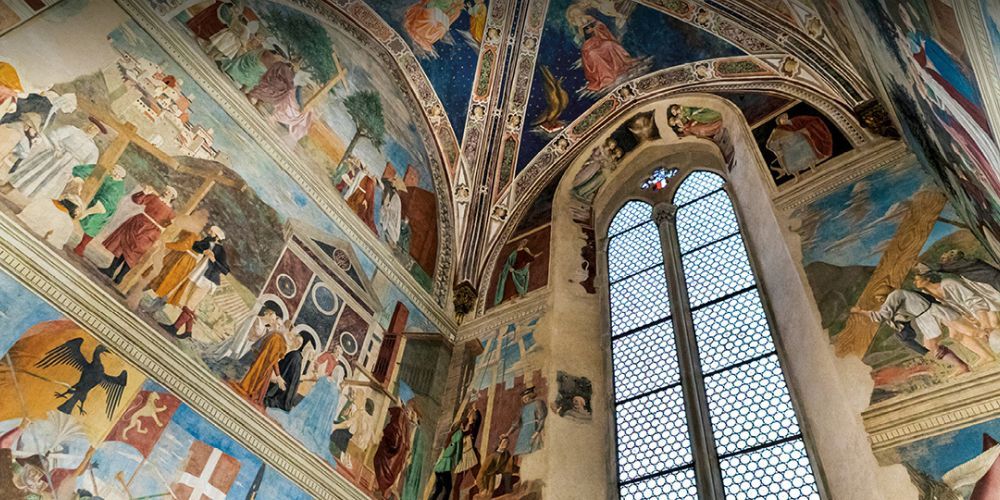
Leaving behind the magnificence of the Cathedral of Arezzo and its artistic gems, among which the fresco of Magdalene stands out, the artistic pilgrimage through Piero della Francesca's legacy in the city continues towards another key location: the Basilica of San Francesco, more precisely the Bacci Chapel, which houses the fresco cycle of the Legend of the True Cross.
Completed by Piero della Francesca between 1452 and 1466, this pictorial cycle universally acknowledged as one of the peaks of Italian Renaissance art, is not a simple narrative by images. These figures represent a deep historical-theological compendium, drawn from the tales of the Legenda Aurea by the Dominican friar Jacopo de Varagine and masterfully arranged across the chapel's three levels walls.
One by one, like pieces of a puzzle, these frescoed images by Piero della Francesca fit together perfectly to retrace like the pages of a book, or for those who prefer like scenes from a film, all the stages of the story of the Cross of Christ.
It is precisely here that the artist's mathematical genius fully emerges, giving an almost scientific meaning to the art of painting and fresco: the perspective construction of the sequences of scenes is precise and rigorous, and carefully considers the need for enough light to model the subjects with intense shades of color, thus giving each scene an almost metaphysical vividness.
From the Death of Adam to the celebrated Dream of Constantine, every element of the Legend of the True Cross is a lesson in stylistic balance, harmonious contrasts between light and color and sculptural monumentality crafted by brushstrokes. The artist once again makes skillful use of color and geometry, transforming each frescoed episode into clear and palpable visions, eternally intense yet remote, to admire with fascination here in Arezzo.
Find out the creative genius of Piero della Francesca around Arezzo
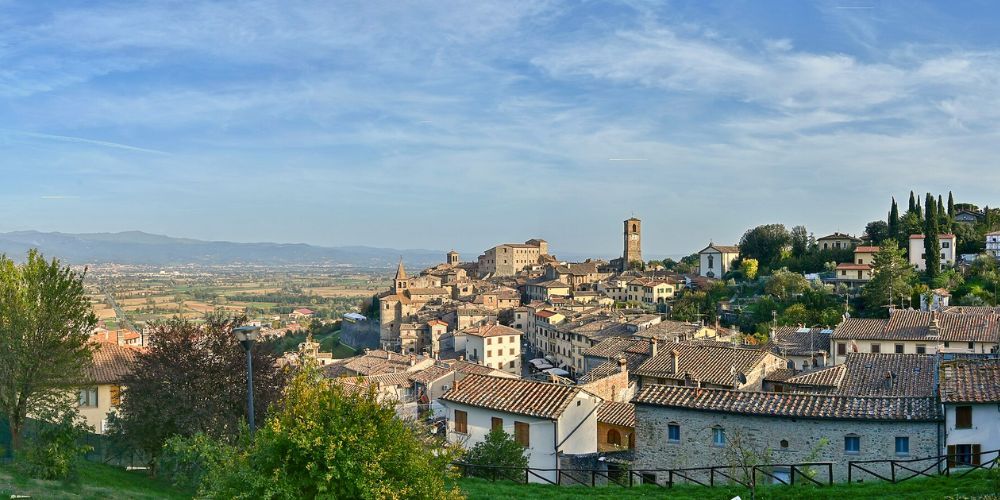
Piero della Francesca's artistic and cultural legacy extends far beyond the confines of the city of Arezzo, inviting art enthusiasts to join a fascinating tour of the surrounding villages in the province, the very places that shaped both the man and the artist throughout his life and stylistic development. This is an ideal Path di Piero, a journey to discover more master's gems after marveling at his Magdalene at Arezzo’s Cathedral and the extraordinary Legend of the True Cross at the Basilica of San Francesco.
An essential stop to begin is Sansepolcro, near to Anghiari, that is Piero della Francesca's birthplace. Here at the Civic Museum you can admire the celebrated Resurrection, a fresco described by author Aldous Huxley as the most beautiful painting in the world. In this artwork, the figure of the risen Christ stands solemnly and dominantly over the entire scene, once again highlighting the sculptural-like plasticity of the protagonist, perfectly balancing the calm typically conveyed by renaissance art with the awesomeness and pathos of the sacred event. Also located in the same place there’s the Polyptych of Mercy, an early work of art that anyway already reveals an innate mastery of light, color and perspective.
Another must-see stop is the small village of Monterchi, nestled in the hills of the Tiber Valley. Here is preserved the Childbirth Mary, a unique fresco of great aesthetic beauty and rich symbolism. The work depicts the Virgin in her state of maternity with regal majesty, sided by two mirrored angels on either side, creating a scene that conveys a sense of divine intimacy. A fresco celebrating the birth of life and the maternal figure, testifying to the artist's ability to depict delicate themes beyond the purely sacred aspect, with an expressive power that transcends his time.
This journey through Piero della Francesca's major works and places of his life is an inviting, evocative and captivating opportunity to discover the artist's creative genius, immersed in the genuine and natural beauty of a still little-known corner of Tuscany. And just like his relentless pursuit of harmonies and perspectives, Arezzo and its artistic heritage welcome lovers of beauty for unique and vivid travel experiences, like shades of a wonderful fresco in these dreamlike lands.
About the author
Written on 12/12/2025
Massimiliano Antonio Primi
I write by profession, but first of all by passion. I love to tell emotions and stories through the magic of writing. With my articles I want to accompany you on a journey to discover Italy, the most amazing country in the world.

Massimiliano Antonio Primi
Find out the exciting beauty of the frescoes made by Piero della Francesca at the Cathedral of Arezzo, a timeless wonder in the City of the Arts.