
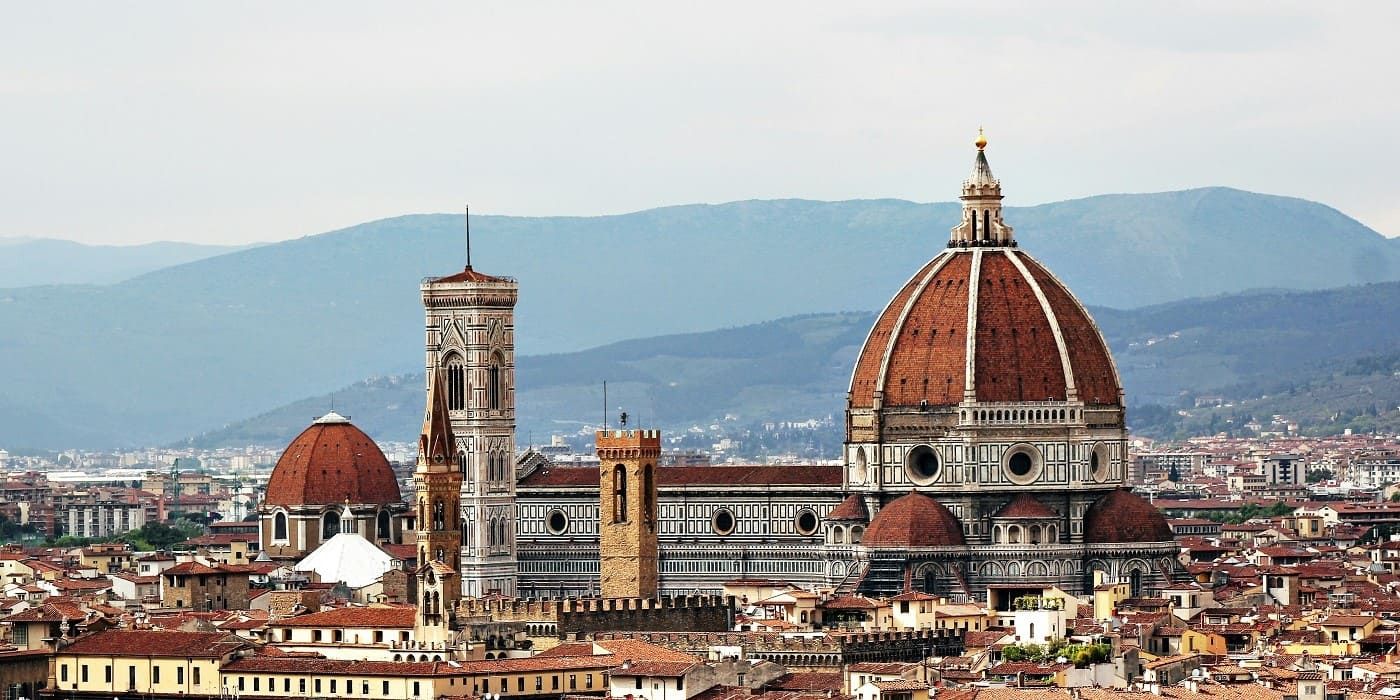

Asking what the best views of Florence are risks being a rhetorical question, as Piazzale Michelangelo is the most significant and famous panoramic viewpoint in the city. A must-see destination for tourists visiting the Tuscan capital, the famous square with one of the three copies of David guarantees a breathtaking view of the historic center in all its splendor.
The terrace, designed by architect Giuseppe Poggi in 1869 to celebrate Michelangelo and his works, is a must-see for those who want to capture Florence from above, especially at sunset and from a picturesque photographic angle. Today, however, the square is crowded with stalls and prey to overtourism, which has a negative impact on the area, the local community, and their balance.

The best views of Florence, beyond Piazzale Michelangelo
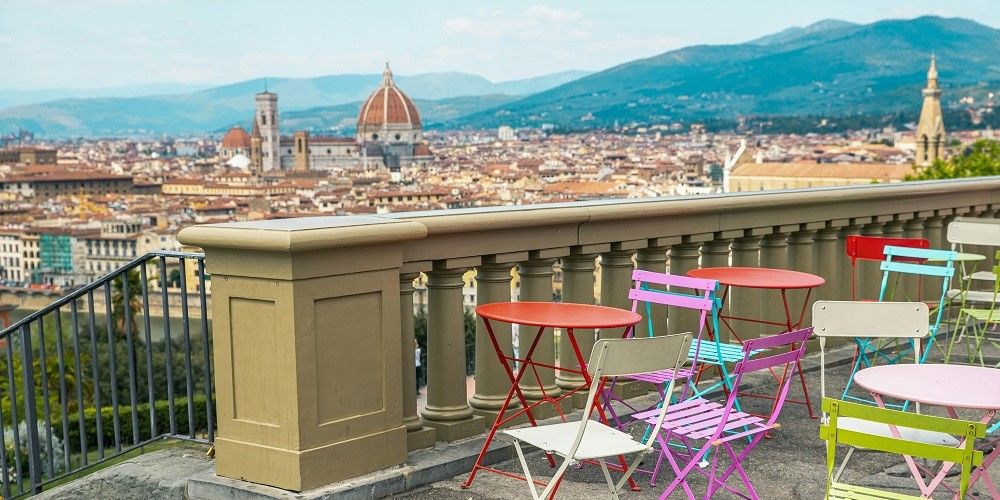
Those arriving in the center of Florence can discover many other panoramic terraces overlooking the city: some equally famous, others authentic hidden gems that are no less fascinating. Beyond Piazzale Michelangelo, there are several enchanting and exciting viewpoints, characterized by fewer visitors. In these places, you can appreciate the beauty and colors of the city from a new perspective, without encountering hit-and-run tourism.
Here is an alternative Top 10 list of the best views of Florence, including lesser-known and off-the-beaten-track spots, with a series of useful tips on the best times to visit these extraordinary vantage points. This guide is indispensable for an informed trip to the city and for avoiding the Instagram effect, i.e., the tendency to visit a particular place solely for the purpose of taking the right shot to post on social media.
Explore Florence with Florence Pass10. Giardino delle Rose (The Rose Garden)
Below Piazzale Michelangelo, there is a balcony overlooking Florence's historic center that is not just a viewpoint: Viale Poggi is home to a green oasis with 400 varieties of roses, lemons, tillandsias, and numerous botanical rarities. But that's not all: in this natural environment, created in 1865 by Giuseppe Poggi, there is a small Shorai Japanese garden (designed by architect Yasuo Kitayama) and several works by Jean-Michel Folon, the Belgian artist famous for his little man in blue and for his social and political commitment.
The Rose Garden offers one of the most beautiful views of Florence, especially at sunset, the best time to take a photo that will leave a lasting memory of your tour. It is easy to get there: you can enter directly from Viale Poggi, from San Niccolò on the steps leading to San Salvatore al Monte, from the Poggi ramps, and from the intersection between Via dei Bastioni and Via del Monte alle Croci. Admission is free: the garden is open all year round from 9 a.m. until sunset. The ideal season to visit is in spring, during flowering. In addition, there is a kiosk just outside where you can enjoy an aperitif and listen to excellent live music.
9. San Miniato al Monte
The abbey in Via delle Porte Sante, one of the city's most famous Romanesque churches, is the “Gateway to Heaven,” as Giacobbe called it. While the façade and interior are not to be missed, the view that opens up before your eyes is also unmissable: Florence in all its splendor, with a small part of the Porte Sante cemetery stealing the show. The only effort required to admire one of the most expansive views of Florence is the challenging monumental staircase leading to the monastic complex, but what would a Benedictine place of worship be without a good dose of effort?
The basilica is open every day from 9:30 a.m. to 1 p.m. and from 3:30 p.m. to 7 p.m. Entry is free and no reservations are required. The only time the church is not open to visitors is during liturgical celebrations. The best time to visit is in the spring, and the recommended time is just before closing time so that you can combine your visit with the twilight. The abbey is located in the Viali dei Colli area, not far from Piazzale Michelangelo. The best way to get there is by public transport: from Santa Maria Novella station, go to Prato Barbetti, take bus number 12 for 18 stops, and get off at Galileo San Miniato.
8. The dome of Santa Maria del Fiore
Brunelleschi's dome, built between 1420 and 1436, is an absolute masterpiece of world art, but it also offers a 360-degree view of Florence from a height of 91 meters. In addition to all the city's monuments, from the cathedral's terraces you can admire the details of the dome from a unique perspective. The view is incredible because it is from the heart of the city. There is usually not too much of a queue because the climb is strenuous, so much so that it is not recommended for people with cardiovascular or respiratory diseases, those suffering from vertigo or claustrophobia (the passage is between very narrow spaces), and pregnant women.
Tickets to access Florence Cathedral can be purchased on the Opera di Santa Maria del Fiore website: the best option, which must be booked in advance, is the Brunelleschi Pass, which allows you to visit the dome, Giotto's bell tower, the Baptistery of San Giovanni, the Opera Museum, and Santa Reparata at a cost of €30. Access to the dome of Santa Maria del Fiore is from the north side of the cathedral's Porta della Mandorla: the climb to the top consists of 463 steps and there is no elevator. The effort is rewarded by the view that opens up once you arrive.
7. The terrace of La Rinascente
A few steps from the Duomo, in Piazza della Repubblica, La Rinascente has been open for 150 years. On the top floor of the 19th-century building that houses it, the Trianon, there is the Food Hall with the ToscaNino rooftop, where you can taste typical Made in Tuscany products and sip a glass of wine with a view of the city. The view is unique: on one side is Piazza della Repubblica with its splendors, on the other the dome of the Duomo and Giotto's bell tower among the rooftops of the city center. Inside, the atmosphere is refined and elegant, and the restaurant's prices are affordable: a large platter costs €15, a first course between €10 and €15, and a tagliata €20.
The Rinascente Food Hall is open every day, Monday to Thursday and Sunday from 10 a.m. to 11 p.m. and Friday and Saturday until midnight. Direct access is from Piazza della Repubblica: those arriving by car can use the Santa Maria Novella, San Lorenzo - Mercato Centrale, and Sant'Ambrogio car parks. There are other places in Florence where you can eat or have an aperitif with a panoramic view: staying in the city center, behind the Duomo between Via dell'Oriuolo and Via Sant'Egidio, there is the Biblioteca delle Oblate with a café offering a terrace of extraordinary beauty. Alternatively, there is the Caffè del Verone, at the next point.
6. The terrace of Museo degli Innocenti
The Spedale degli Innocenti, now known as the Istituto degli Innocenti, is Italy's oldest public institution dedicated to the care and education of children. The institution's artistic and cultural heritage is preserved in the museum in Piazza Santissima Annunziata, in the monumental building designed and built by Brunelleschi between 1419 and 1427. Inside, visitors can admire unique works such as Luca della Robbia's Madonna and Child, Domenico Ghirlandaio's Adoration of the Magi, and Pietro di Cosimo's panel painting of the Madonna Enthroned with Child and Saints. The museum also hosts temporary exhibitions exploring the work of prominent figures in modern and contemporary art.
On the fifth floor of the historic loggia of the Museo degli Innocenti is the Caffè del Verone, one of the most evocative panoramic terraces in the city. Back in use since 2016 after extensive renovation, it offers a spectacular panoramic view of the city center. Book presentations, exhibitions, and meetings are also held in this space. The Museo degli Innocenti is open every day from 9:30 a.m. to 7 p.m.; the Caffè del Verone is open from 10 a.m. to 9:30 p.m. A full-price ticket to visit the museum's permanent collection costs €9; for temporary exhibitions, it costs €16. Admission to the café is free. Getting there is easy: the museum is just a short walk from the Duomo. The nearest public transport bus stops are Colonna Museo Archeologico and Santissima Annunziata.
5. The Uffizi Gallery
Visiting Florence means making a mandatory stop at the Uffizi Gallery, one of the most prestigious and famous museums in the world, with authentic masterpieces such as Giotto's Maestà di Ognissanti, Raphael's Madonna del Cardellino, Titian's Venus of Urbino, Botticelli's Birth of Venus, Caravaggio's Medusa, Leonardo da Vinci's Annunciation, Artemisia Gentileschi's Judith Beheading Holofernes, and many others. After viewing the works housed in the museum, the south wing offers a unique panoramic view of the historic center, overlooking the Arno, the Vasari Corridor, and the Ponte Vecchio. From the museum's terrace, above the Loggia dei Lanzi in Piazza della Signoria, you can take a break at the Bartolini Café, open every day until 6 pm.
To visit the Uffizi Gallery, you need to book well in advance and plan your visit so that you are inside the museum at sunset if you want to take stunning photos of the Florentine skyline. The Uffizi is open Tuesday through Sunday, from 8:15 a.m. to 6:30 p.m. For the view of the Arno at dusk, it is advisable to enter with the last admission at 5:30 p.m. The full price ticket costs €25 if purchased on the day of admission to the museum, otherwise €29. In the second half of the year, from July to December, the museum organizes a special opening of the Vasari Corridor every Friday from 7:00 p.m. to 11:00 p.m. In this case, the ticket costs €20 (if purchased on the day of the visit, otherwise €24) and includes passage through the Gallery, but does not allow you to visit its spaces.
4. The garden of Villa Bardini
One of Florence's green hearts is the garden of Villa Bardini, a historic residence in the Oltrarno district surrounded by art and nature. The villa extends over the Montecuccoli hill from the slopes of Piazzale Michelangelo to the Arno, between Piazza dei Mozzi, Via de' Bardi, Costa Scarpuccia, Costa San Giorgio, and Forte Belvedere. Thanks to its location between Costa San Giorgio and Borgo San Niccolò, the hill with its woods, vegetable garden, and orchard offers impressive views. A visit (preferably in spring, during flowering) is a great opportunity to appreciate the beauty of the Italian garden with its Baroque staircase, the English woodland, and the agricultural park with its wisteria.
The rooms of the residence also host exhibitions, providing yet another opportunity to soak up the cultural tradition that permeates the city. Villa Bardini is just a short walk from the historic center: the main entrance is on Costa San Giorgio, while the secondary entrance is on Via de' Bardi. To get there by public transport, take the C3 bus from Via Il Prato (500 meters from Santa Maria Novella) towards Piazza Beccaria or the C4 from Stazione Scalette towards Palagi and get off at Torrigiani Chiesa Luterana. There is an admission fee for the garden: the ticket (open or fixed date) costs €16, but is also valid for the Boboli Gardens, mentioned in the next point.
3. The Boboli Gardens
With the same ticket for Villa Bardini, you can visit Boboli, the Medici family's green space that extends behind Palazzo Pitti for over 30 hectares between the ramparts of Forte Belvedere and Porta Romana. A visit to Boboli is an absolute must when you arrive in Florence: this fantastic open-air museum is home to the Porcelain Museum, the Egyptian Obelisk, Buontalenti's Grotto and Giambologna's Venus, Giambologna's large Isola and Oceano fountains, the Limonaia, the Fontana del Carciofo and the Amphitheater, all of which are unmissable stops on a tour of the city. Two spots, however, offer a breathtaking view that is difficult to find elsewhere.
In front of the building where the Bastione del Cavaliere is located, built in 1529 on the south-eastern border of Boboli to a design by Michelangelo, is the Cavaliere garden, the highest point of the museum. From its embankment, you can enjoy a view that stretches towards the hills south of Florence, from San Miniato to the Gallo tower. To access it, you must pass through a double ramp designed by Giuseppe del Rosso in 1793. Zanobi del Rosso is responsible for the Kaffehaus, a Rococo-style building constructed in 1775: from its terrace on the top floor, you can enjoy a unique viewpoint with an enchanting view of Florence, designed by Grand Duke Leopold II of Tuscany to impress his guests. The best time to plan your visit is during Indian summer: those days in the first half of November when the autumn warmth returns after the first cold spells.
2. Forte di Belvedere
Remaining in the Boboli area, the highest point of the hill is the fort designed by Buontalenti at the end of the 16th century: a fortified villa built between 1590 and 1595, offering one of the best views of Florence. Also known as Forte di San Giorgio, the bastion was built at the behest of Grand Duke Ferdinando I to protect the Oltrarno and the residence of Palazzo Pitti. A splendid example of late 16th-century military architecture, the building, with its characteristic star shape, enjoys an elevated position that offers a wonderful view of the Arno on one side and the architectural beauties of Florence on the other.
The Forte di Belvedere is located in Via San Leonardo and can be reached by bus with the special FB line (the stop is right at the entrance) or on foot by taking a walk through the hills, from Costa San Giorgio along Villa Bardini. Admission is very inexpensive: for non-residents, the ticket costs €5. You just need to choose the right time of year: the fort is open from mid-June to mid-October, Tuesday to Sunday from 10 a.m. to 8 p.m., with last admission at 7 p.m. The panoramic terrace is enhanced by the presence of Belvedere Firenze, an open-air lounge (with free admission) with a café, concerts at sunset, talks, workshops, exhibitions, and installations.
1. The patrol walkway of Palazzo Vecchio
A beautiful panoramic viewpoint of Florence is located on the tallest tower in the city: the Arnolfo Tower, named after Arnolfo di Cambio, who designed the building constructed between 1299 and the early 14th century. Access is on the ground floor of Palazzo Vecchio in Piazza della Signoria: to reach the interior of the tower and the 95-meter-high walkway, you have to climb 233 steps.
The effort to reach the top level of the crenellated watchtower is rewarded by a truly spectacular view of the city. Along the way, you will also find the Alberghetto, a small cell where Cosimo il Vecchio was imprisoned in 1433 and Girolamo Savonarola in 1498. The tower is open every day from 9 a.m. to 5 p.m. (Thursdays until 2 p.m.) with tickets to the Palazzo Vecchio Museum starting at €10. While you're there, you can admire masterpieces in the collection such as Donatello's Judith and Michelangelo's Genius of Victory.
Before choosing one of these 10 alternatives to the famous Piazzale Michelangelo, here's one last tip: to see Florence from a different perspective, try a unique experience such as a boat tour on the Arno. There are many operators offering this service, often accompanied by an aperitif at sunset. Several boats depart from Lungarno Diaz, allowing you to admire the city's treasures from a romantic and timeless perspective.
About the author
Written on 30/12/2025
Alessandro Zoppo
He has been listening to music and watching movies since he was 6. Proudly Samnite but Roman by adoption, he writes about culture, travel, economics, finance, politics and sports and curates film festivals.

Alessandro Zoppo
With the exception of Piazzale Michelangelo, what are the best views of Florence? A guide to 10 “alternative” terraces.