
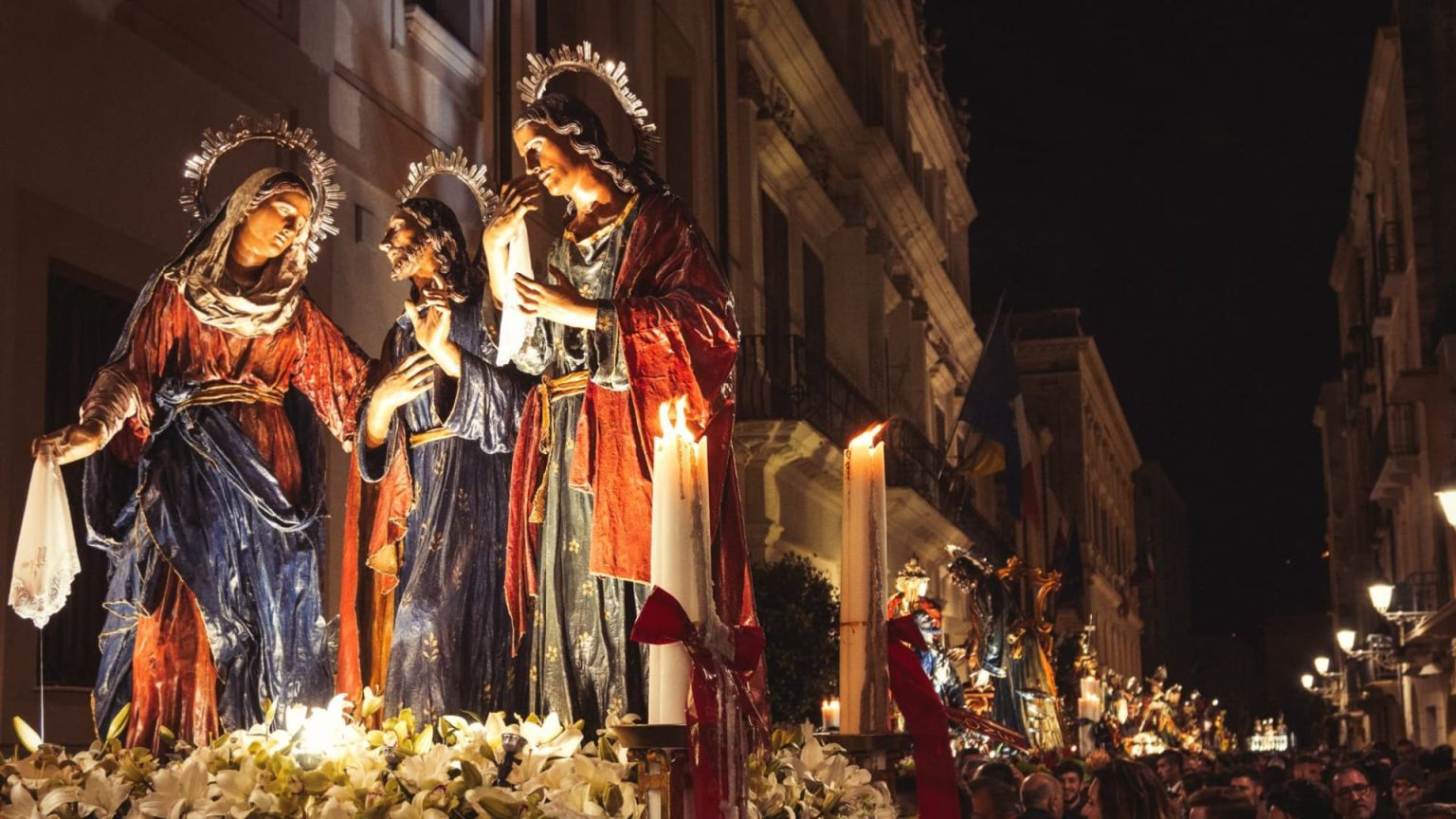

There is a moment in Sicily when time seems to slow down. It is Holy Week, when towns are transformed and traditions come to life through faith, art, and identity. And in Trapani, this moment reaches its most intense expression: the Procession of the Misteri, one of the longest and most evocative in Italy.
For 24 hours, from Good Friday to Holy Saturday, twenty sculptural groups from the 17th and 18th centuries move slowly through the historic center, accompanied by funeral marches, candles, and the ritual swaying motion known as annacata. A truly unique experience that draws you into the most authentic heart of Sicily.

The Procession of the Misteri of Trapani
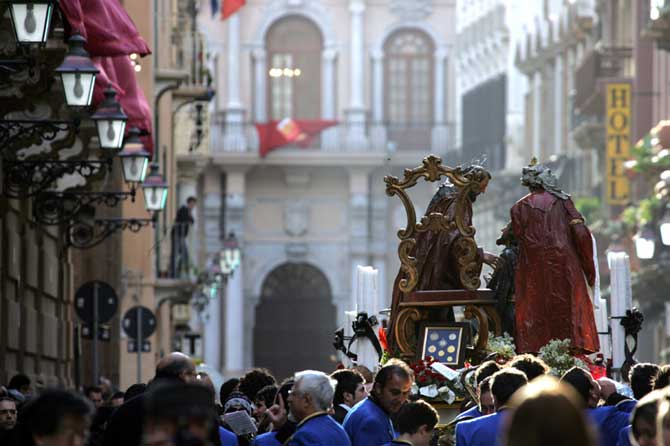
The Procession of the Misteri of Trapani is the ritual heart of Holy Week in the city: a grand penitential parade featuring twenty sacred groups, each entrusted to a guild, with statues, music, and gestures passed down through the centuries. Today it is organized by the Unione Maestranze, which coordinates the guilds, route, and logistics of one of the city’s most deeply rooted traditions.
Its uniqueness lies not only in its duration — 24 uninterrupted hours — but in its collective scale: each group is accompanied by its own marching band and followers, turning the historic center into a shared stage of faith and identity. For its size, continuity, and ritual intensity, it is considered one of the most significant Holy Week celebrations in Sicily and Southern Italy.
Origins and tradition of the Misteri
The origins of the Misteri of Trapani date back to the 17th century, in a city deeply influenced by Spanish rule.
During the Iberian domination, the tradition of representing the Passion of Christ through processional scenes and sculptural groups became established, following models already widespread in Andalusia. The first notarial document recording the assignment of a group dates back to April 6, 1612, a key milestone in the history of the procession.
The continuity of the tradition has been ensured by the guilds (maestranze), the city’s historic craft and professional associations. Each guild was entrusted with a sacred group, taking care of its maintenance, decoration, and public participation. This strong bond between profession, devotion, and social identity explains why the Misteri remain, even today, a deeply rooted cultural ritual rather than just a tourist event.
24 hours inside the procession: what really happens
On the afternoon of Good Friday, around 2:00 pm, the doors of the Church of the Souls in Purgatory open and the city slips into another dimension. One by one, the twenty sacred groups emerge: scenes of the Passion entrusted to the guilds, carried on shoulders through the historic center in an order that follows the Gospel narrative.
For hours, Trapani moves to the rhythm of funeral marches. Each group has its own followers, its own band, its own carriers. The movement is never neutral: it is the annacata, the slow, swaying motion of the platforms, almost a ritual cradle that advances with a hypnotic cadence found nowhere else.
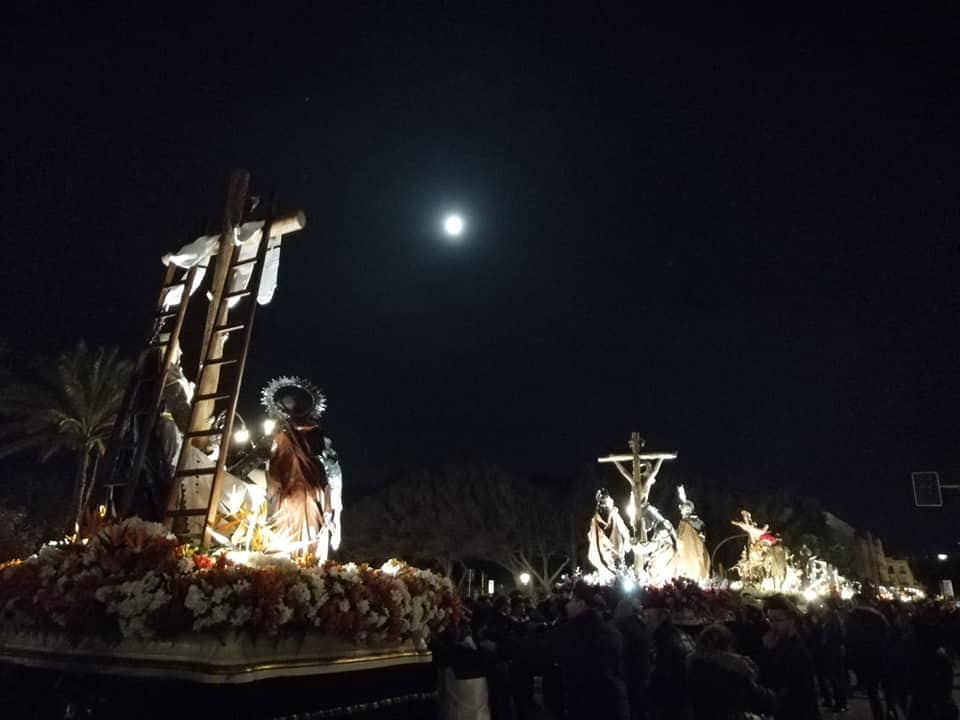
At night, the procession changes its face. The crowds thin, the sound becomes sharper, and details emerge: candles, flowers, metals, votive jewels. The statues pass through the oldest quarters in a more intimate atmosphere, reaching at dawn the area of the Barracche, where the ritual meets the sea.
Then comes the return. On Holy Saturday morning, the groups make their way back toward the Purgatory church, as the faithful gather once again along the route. The final entrance, usually in the early afternoon, marks the end not just of a 24-hour procession, but of a collective ritual that Trapani has renewed for over four centuries.
The sacred groups and their meaning
The Misteri of Trapani unfold, group after group, as a powerful visual narrative of the Passion. These are not simply statues, but sculpted scenes entrusted over centuries to the city’s guilds, designed to be read as a continuous story that follows Christ from his separation from Mary to the sorrow of the Virgin.
The procession opens with The Separation, also known as The License, followed by The Washing of the Feet, Jesus in the Garden, The Arrest, The Fall at Cedron, Jesus before Hanna, The Denial, Jesus before Herod, The Flagellation, and The Crowning with Thorns. In this first part, emotion builds steadily—from intimate farewell to betrayal and public humiliation.
The narrative then reaches its dramatic core with Ecce Homo, The Sentence, The Ascent to Calvary, The Disrobing, The Elevation of the Cross, and The Wound to the Chest. Here, the suffering intensifies: Christ’s body is exposed, condemned, raised, and pierced, forming a sequence that resembles a sacred theatrical act.
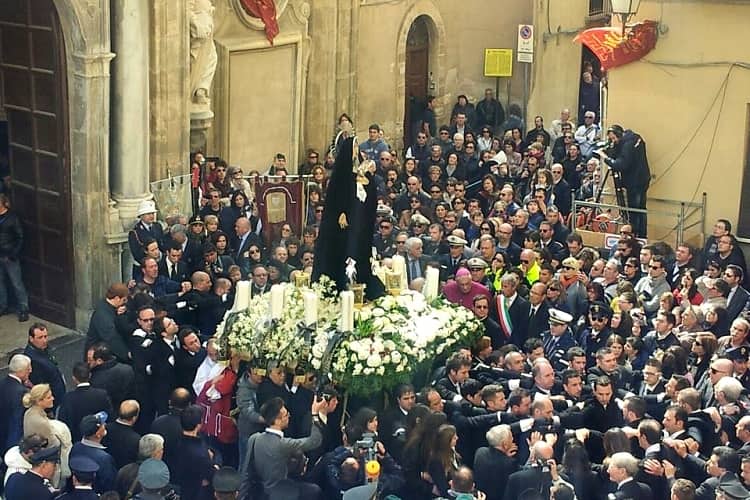
The final groups mark the time of mourning: The Deposition, The Transport to the Sepulchre, The Sepulchre, and Our Lady of Sorrows. It is a closing of deep symbolic power, where the narrative falls into silence and maternal grief. This complete iconographic cycle is what makes the Misteri of Trapani one of the most distinctive Holy Week traditions in Sicily.
Tips for watching the procession
To experience it at its best, it’s advisable to arrive in Trapani well in advance: the procession starts at 2:00 pm from the Church of the Jesuit College and winds through the city center, with an evening stop in Piazza Vittorio Emanuele. To secure a good spot, plan to be there at least 60–90 minutes early.
For the most striking first impression, position yourself along the historic center streets just after the departure. If you prefer a wider and less crowded view, Piazza Vittorio Emanuele offers one of the most comfortable vantage points thanks to the scheduled stop.
The most powerful moments are three: the afternoon departure, when the city gathers around the procession; the night, for a more intimate atmosphere; and dawn near the Barracche, the most evocative passage, where the ritual meets the sea.
Let the sea guide you, discover Pantelleria from TrapaniAbout the author
Eleonora Monaco
Eleonora Monaco, web editor. I come from Sicily, I love art, culture and walk around cities like a tourist. One of the most beautiful things in life is to be always curious. I speak English, French and Spanish ( and of course Sicilian)

Eleonora Monaco
Every Good Friday in Trapani a centuries-old tradition representing the Passion and death of Christ is repeated: the twenty-four hours Procession of the Mysteries (Misteri).